Possibility of Electrically Charging Pigments DIY?

  • Context: Chemical/Paint 
  • Thread starter Thread starter I8Paint
  • Start date Start date
  • Tags Tags
    Charging Diy
Click For Summary

Discussion Overview

The discussion revolves around the possibility of electrically charging pigments for artistic applications, particularly in the context of DIY projects involving alcohol inks and other mediums. Participants explore the behavior of pigments when mixed and the potential for creating patterns through electrical or magnetic manipulation.

Discussion Character

  • Exploratory
  • Technical explanation
  • Debate/contested
  • Experimental/applied

Main Points Raised

  • Some participants describe the behavior of pigments in alcohol inks and the patterns they create on non-absorbent substrates.
  • One participant mentions electrostatically charged pigment powder coating as a related method used in metal finishing.
  • Another participant suggests that electric charge may not be effective due to rapid dissipation when pigments come into contact.
  • There is a proposal to mix pigments with iron powder and expose them to magnetic fields to create patterns, with discussions on varying magnet strengths and configurations.
  • Some participants express curiosity about using a TENS unit to run current through a painting medium to see if it affects pigment movement.
  • There are suggestions that certain specialized liquids might flow when a current is applied, though specifics are unclear.
  • One participant raises the idea of electrodeposition or electro-solution to manipulate pigments in relation to metal interactions.
  • There is interest in preserving patterns created with iron filings in epoxy resin, with suggestions for preliminary experiments in simpler mediums.

Areas of Agreement / Disagreement

Participants express a mix of ideas and uncertainty regarding the effectiveness of electrically charging pigments. While some suggest alternative methods like magnetic manipulation, others remain skeptical about the practicality of using electric charge. The discussion does not reach a consensus on the best approach.

Contextual Notes

Participants note limitations regarding the effectiveness of electric charge in pigment manipulation and the need for further exploration of mediums that could be made conductive.

Who May Find This Useful

Artists, DIY enthusiasts, and individuals interested in experimental techniques involving pigments, electrical manipulation, and pattern creation may find this discussion relevant.

I8Paint
Messages
4
Reaction score
0
Sorry if this is an absurd question. I'm recently been playing with alcohol inks and noticed certain pigments seem to repel and apparently attract each other and create interesting patterns under the right conditions. e.g. non absorbent substrate with no 'tooth.'

So far this has worked best in an alcohol medium poured over a non absorbent plastic substrate. . Some have exploited the relative weights of various pigments to create patterns in acrylic paint.. I was wondering if its possible to electrically charge certain pigments positively and others negatively to see how they react when mixed. These could be pigments suspended in water (watercolor) or alcohol (alcohol inks) or even fluid acrylic inks.

Here's an example of pigments forming patterns on their own. This was done entirely by dripping alcohol inks and clear 91% isopropyl alcohol.I'm not sure of the exact pigments since they were not disclosed on the paint containers. Thank you in advance!
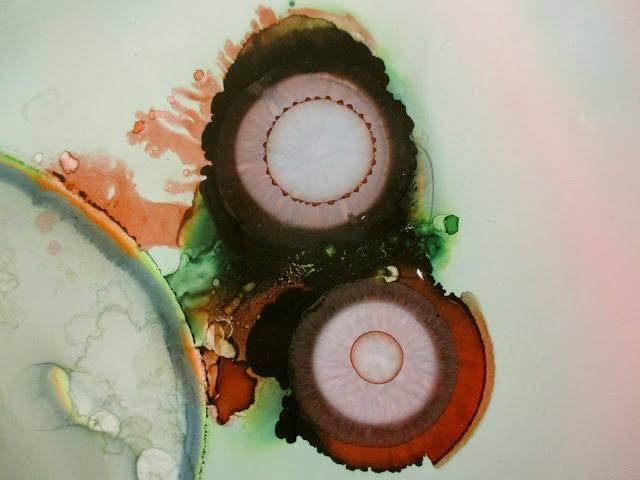
003.JPG


Thanks in advance!
 
Physics news on Phys.org
Perfectly good question. :biggrin:

A partial answer - you are describing one method:

Electrostatically charged pigment powder coating which is used in finishing metal - like wrought iron fencing which is orange-ish after finishing.

https://www.powdercoating.org/page/WhatIsPC

I think, but do not know for sure, there are low end powder application systems that may meet your needs. You need to decide on your own.
 
There's a whole field call "pour painting" that experiments with different paints, different media, different handling methods that produce those kinds of patterns. Alcohol is one mixing medium. Silicone oil is even more popular. Elmer's Glue a third. Experts in the field bring science in by finding out the differential densities of different pigments.

I doubt if electric charge is one of the methods because the charges would dissipate almost immediately when the colors are brought in contact with each other.

Try this search https://www.youtube.com/results?search_query=pour+paint&page=&utm_source=opensearch

There are also numerous books and tutorials on the techniques.
 
Seeing that makes me wonder what could be created by by mixing one or more pigment(s) with iron powder in alcohol (or silicone oil as mentioned above) on a plate and exposing them to magnets in different shaped arrays (and maybe even of different strengths) located below the plate; or, if this has already been done at some point.
Taking it bit further, using simple wire wound rods in a grid array as the magnets connected to a programmed controller that would vary the strengths (or even reversing the polarity) of the magnets according to different input patterns.
Obviously this could be done in monochrome with dry iron powder alone but the ability to vary the colors in different locations might be more interesting.
 
Thanks everyone for your help.
Jim I 've heard of the powder or e coating used to paint car components. I was wondering if if its possible to do this diy with household items. I even have a tens unit. I remember learning the e coats are all negatively charged.
Anorlunda I am familiar with paint pouring. I ve been able to get the sought after cell and lace patterns with acrylics and silicone and pouring mediums. As far as I know no one is fooling around with electricity or magnetism as part of the process.
Jba thanks Great idea with the magnets. This is sort of what I'm striving towards. I never though of iron powder. I supposed iron powder could be dyed and still react to the magnets. What I liked about the alcohol ink experiments is once the alcohol evaporates the patterns remain fixed.

I have a tens unit, I don't if running electricity through a shallow wet bed of medium like alcohol would cause the pigments to react. Or can anyone think of a better medium than alcohol?

Would it be possible using everyday materials (i have a tens unit) to positively or negatively charge paint or wet pigments? Sorry for my ignorance.
 
Re: @JBA's idea: You may not need to dye the iron filings. They might remain as black flecks i over a paint background, very nice.

But electrostatically charging the pigments does not sound promising. When they come in contact, the charges would dissipate rapidly without much movement the paint itself.
 
anorlunda said:
But electrostatically charging the pigments does not sound promising. When they come in contact, the charges would dissipate rapidly without much movement the paint itself.
Thanks for your help. Do you think it would it be possible to run current thru a painting medium , modifying it to be conductive if necessary, then introducing pigments into the charged medium to see how they react, like in electrophoresis? I am guessing a TENs unit could be used to run current through a conductive painting medium already spread across the canvas? Thanks again.
 
Yes you could run a current, but it may not cause much movement of the paint pigment particles. There may be some specialized liquids that flow when a current is applied, but I don't know what they are. Even a google search doesn't turn up much. It is common to allow currents to flow through water. I can't remember seeing any hint of movement in that water.

I think @JBA's idea is the best. Magnetic fields, not currents. Magnetized particles in the paint. Iron filings would be the best particles because of their elongated non-spherical shape.

The most readily available field you have is gravity.
 
  • Like
Likes   Reactions: I8Paint
There might be something you could try with a pigment that formed a colored/colorless complex with a metal. Electrodeposition or electro-solution (anode vs cathode) would either bleach or form the pigment at the electrode.
 
  • Like
Likes   Reactions: I8Paint
  • #10
Thanks @anorlunda and @chemisttree for your suggestions. I just google image searched 'iron filings art' and learned its already been done and some of the results are interesting. There is even a science toy on the market with sealed filings in glass that can be manipulated. I never would have anticipated such a beautiful pattern : Sealed Filings
I have a two part epoxy resin I've used to paint 3 d gold fish layer by layer. . I wonder if the filings could be manipulated like as shown in the 'sealed filings' link i posted while suspended in the wet epoxy resin, so that they would be preserved in that configuration once the resin hardens? I've seen people preserve delicate things like dandelion seed balls in resin.

Thanks chemistree for the idea with the electrode. Ill give that a try and will post if anything interesting happens. :)
 
Last edited:
  • #11
I8Paint said:
I wonder if the filings could be manipulated like as shown in the 'sealed filings' link i posted while suspended in the wet epoxy resin, so that they would be preserved in that configuration once the resin hardens?
Yes, that should be possible. Practice first with filings in water or alcohol or syrup, before the epoxy.
 

Similar threads

  • · Replies 2 ·
Replies
2
Views
2K
  • · Replies 21 ·
Replies
21
Views
4K
  • · Replies 5 ·
Replies
5
Views
3K