Pressure in a gas container measured with a barometer and a U pipe

Click For Summary
SUMMARY

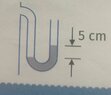
The discussion revolves around calculating the pressure in a gas container using a barometer and a U-shaped pipe. The user initially calculated the pressure as 105398.64 Pa by adding the pressure of mercury at 740 mm and a 5 cm difference in the U pipe. However, the textbook states the pressure should be 100062 Pa. The discrepancy arises from the misunderstanding of how external atmospheric pressure influences the pressure inside the gas container, particularly in relation to the U tube's function as a pressure equalizer.

PREREQUISITES
  • Understanding of gas pressure concepts
  • Knowledge of barometric pressure measurement
  • Familiarity with U-tube manometers
  • Basic principles of fluid mechanics
NEXT STEPS
  • Study the principles of U-tube manometers in fluid mechanics
  • Learn about the relationship between atmospheric pressure and gas pressure
  • Explore the conversion of mm Hg to Pascals in pressure calculations
  • Investigate common errors in pressure measurement and calculation
USEFUL FOR

Students in physics or engineering, educators teaching fluid mechanics, and professionals involved in pressure measurement and analysis will benefit from this discussion.

Callmelucky
Messages
144
Reaction score
30
Homework Statement
to a container filled with gas, U shaped pipe is attached, as shown in the picture(picture below). What is a gas pressure in the container if the height of the pillar of mercury in barometer is 740 mm?
Relevant Equations
pressure = density * g * height
Can someone please tell me where I am wrong, here goes the question:

to a container filled with gas, U shaped pipe is attached, as shown in the picture(picture below). What is a gas pressure in the container if the height of the pillar of mercury in barometer is 740 mm?

The way I solved it is: pressure of mercury(740mm) + 5 cm difference in U pipe --> 0.740 m * 13600 * 9.81 + 0.05 * 13600 * 9.81 = 105398.64 Pa. But the answer at the and of the textbook is 100 062 Pa.

Thank you.
 

Attachments

  • IMG_20230205_010729_edit_967933005698658.jpg
    IMG_20230205_010729_edit_967933005698658.jpg
    28.7 KB · Views: 117
Physics news on Phys.org
Any chance the textbook is wrong ?

I find somewhat different conversion factors, but with three digit accuracy the 105 kPa stands firmly.
mm Hg to Pa
density of Hg

(you can't find a seven digit result from a three digit factor)
 
  • Like
Likes   Reactions: Callmelucky
it seems that this textbook is full of flaws.
Can you check my previous post(from an hour ago or so), I think my answer is correct and their wrong on that one too.

Thank you for answering
 
Where is the 740 mm height of mercury? Oh, never mind. It's in a barometer that is not shown.
 
  • Like
Likes   Reactions: Callmelucky
erobz said:
Where is the 740 mm height of mercury? Oh, never mind. It's in a barometer that is not shown.
That is another thing, if it's gas, I guess that container couldn't be filled on normal pressure(atm), so I don't understand what does pressure outside container(thoose 740 mm Hg) has to do with pressure inside of gas?
 
The U tube links the outside world with the inside of the container. Ask yourself what happens to the 5 cm if the ambient pressure changes.
 
  • Like
Likes   Reactions: Callmelucky and erobz
BvU said:
The U tube links the outside world with the inside of the container. Ask yourself what happens to the 5 cm if the ambient pressure changes.
thanks, that makes sense.
 

Similar threads

  • · Replies 1 ·
Replies
1
Views
2K
  • · Replies 1 ·
Replies
1
Views
6K
  • · Replies 1 ·
Replies
1
Views
9K
Replies
10
Views
2K
  • · Replies 6 ·
Replies
6
Views
2K
  • · Replies 9 ·
Replies
9
Views
3K
Replies
6
Views
7K
Replies
7
Views
8K
  • · Replies 2 ·
Replies
2
Views
10K
  • · Replies 1 ·
Replies
1
Views
2K