Probability/Random variables question

Click For Summary
SUMMARY

The discussion centers on calculating the joint probability density function (PDF) for a point chosen from the unit square, specifically addressing the area of a quarter circle with radius 1. Participants confirm that the approach of using area calculations is correct for a uniform distribution. The calculations provided utilize both Cartesian and polar coordinates to arrive at the same conclusion regarding the ratio of areas.

PREREQUISITES
  • Understanding of joint probability density functions (PDF)
  • Familiarity with area calculations in geometry
  • Knowledge of Cartesian and polar coordinate systems
  • Basic principles of uniform distribution
NEXT STEPS
  • Study the properties of joint probability density functions in detail
  • Learn how to convert between Cartesian and polar coordinates
  • Explore area calculations for different geometric shapes
  • Investigate uniform distributions and their applications in probability
USEFUL FOR

Students and professionals in statistics, mathematicians, and anyone interested in probability theory and its applications in real-world scenarios.

ashah99
Messages
55
Reaction score
2
Homework Statement
Finding the probability of randomly choosing a point within the unit square constrained within the quarter circle
Relevant Equations
P(( X, Y ) ∈ A) = ∫∫ fXY ( x, y )dxdy
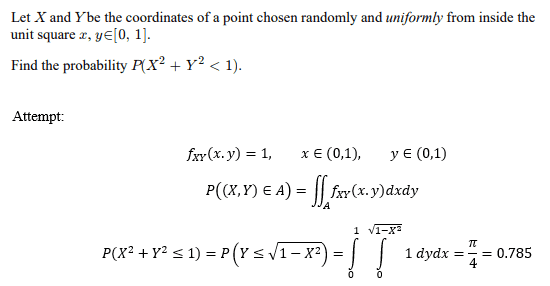
Hello all, I am wondering if my approach is coreect for the following probability question? I believe the joint PDF would be 1 given that the point is chosen from the unit square. To me, this question can be reduced down to finding the area of 1/4 of a circle with radius 1. Any help is appreciated!
1662300114874.png
 
Physics news on Phys.org
It's clear from your calculations that you are indeed simply calculating the area. Which is what you would expect for a uniform distribution.
 
PeroK said:
It's clear from your calculations that you are indeed simply calculating the area. Which is what you would expect for a uniform distribution.
Ok, makes sense. Would you agree that my answer is correct? Just want to make sure I understand.
 
ashah99 said:
Ok, makes sense. Would you agree that my answer is correct? Just want to make sure I understand.
Yes, it's just a ratio of areas, as you've calculated.
 
  • Like
Likes   Reactions: ashah99
Or use polar coordinates: <br /> \int_0^1 \int_0^{\sqrt{1-x^2}} 1\,dy\,dx = \int_0^{\pi/2}\int_0^1 r\,dr\,d\theta.
 
  • Like
Likes   Reactions: ashah99

Similar threads

  • · Replies 2 ·
Replies
2
Views
1K
  • · Replies 1 ·
Replies
1
Views
1K
Replies
2
Views
2K
  • · Replies 1 ·
Replies
1
Views
2K
  • · Replies 2 ·
Replies
2
Views
2K
  • · Replies 3 ·
Replies
3
Views
2K
  • · Replies 2 ·
Replies
2
Views
1K
  • · Replies 4 ·
Replies
4
Views
2K
  • · Replies 1 ·
Replies
1
Views
1K
  • · Replies 5 ·
Replies
5
Views
2K