Probability -- traffic lights (1. R=0.4, 2. R=0.5, 2x G=0.2)

  • Thread starter Thread starter CynicusRex
  • Start date Start date
  • Tags Tags
    Lights Probability
Click For Summary
SUMMARY

The discussion centers on calculating the probabilities associated with two traffic lights, where the probability of stopping at the first light is 40% (P(R1) = 0.4) and at the second light is 50% (P(R2) = 0.5). The probability of stopping at both lights is determined to be 10% (P(R1 ∩ R2) = 0.1) using the inclusion-exclusion principle. Additionally, the probability of stopping at at least one light is calculated to be 80% (P(R1 ∪ R2) = 0.8), derived from the complement of both lights being green. The discussion emphasizes the dependency of the events rather than treating them as independent.

PREREQUISITES
  • Understanding of basic probability concepts
  • Familiarity with the inclusion-exclusion principle
  • Knowledge of conditional probability
  • Ability to interpret probability notation (e.g., P(A ∩ B))
NEXT STEPS
  • Study the inclusion-exclusion principle in depth
  • Learn about conditional probability and its applications
  • Explore real-world applications of probability in traffic systems
  • Practice solving probability problems involving dependent events
USEFUL FOR

Students studying probability theory, mathematicians, and professionals in fields involving statistical analysis, particularly those interested in traffic systems and decision-making processes.

CynicusRex
Gold Member
Messages
98
Reaction score
68
There are 2 traffic lights. Bart knows the probability of stopping at the first light is 40%, stopping at the second light is 50% and the probability of stopping at no lights is 20%.
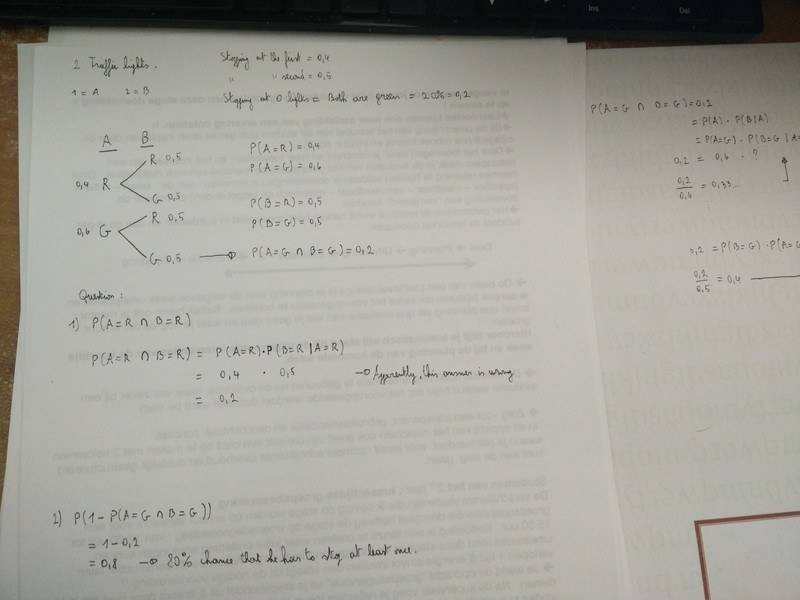
  1. What is the probability of stopping at both lights?
  2. What is the probability of stopping for at least one light?
My attempt:
yu868Zl.jpg


Apparently the chance is 10% and not 20% of stopping at boh lights. I thought they were independent but the opposite is true. So I used the formula for dependent probability. Now I'm trying to figure out how I can find P(B=R | A=R)
 
Last edited:
Physics news on Phys.org
But already earlier on you have a problem: case G G would be 0.6 * 0.5 and given is that it's only 0.2.

That tells you something about case G R !

The other given , 2nd light 0.5 / 0.5 on average, can then only be explained if case R G is a lot more likely than 0.4 * 0.5
 
  • Like
Likes   Reactions: CynicusRex
They are dependent, yes.
You don't need formulas for this. Just consider all four options:
(A) stop at both
(B) stop at first but not at second
(C) stop at second but not at first
(D) both green

Those four options sum to a probability of 1, and you can set up three equations with the given numbers. That is sufficient to find all probabilities.
 
  • Like
Likes   Reactions: CynicusRex
These are some serious cardinal mistakes I'm making. Thank you.
 
I understand my mistakes. But I really don't see how I can use the formula. To calculate the conditional probability P(B=R | A=R) I need the probability of P(B=R ∩ A=R) but that is what I'm looking for in the first place.

Our lecturer did this: P(X={red}) = 40%, P(Y={red}) = 50% (probability of red at the second light)
P(X=Red ∩ Y=Red) = P(X=R | Y=R)
P(X=Red ∩ Y=Red) = P(X=R) + P(Y=R) - P(X=R ∪ Y=R) = 40% + 50% - 80%
P(X=Red ∩ Y=Red) = 10%

I don't see how he got to P(X=R ∪ Y=R) = 80%

m2ntrGn.jpg
 
OK, you picked up GG = 0.2 and hence GR = 0.4.
To end up with *G = 0.5 you need RG = 0.3 - that's one way.
To end up with *R = 0.5 you need RR = 0.1 - that's an even more direct way.
*G is the chance you need to stop at light #2.

Teacher finds chance that one or both are red = 100% - chance that both are green (which is given). That explains the 80%.
But I can't follow the logic in
TheBlackAdder said:
P(X=Red ∩ Y=Red) = P(X=R) + P(Y=R) - P(X=R ∪ Y=R) = 40% + 50% - 80%
can you ?
 
Oh I think I somewhat start to see what he did.
P(X=R) + P(Y=R) = 90% = The probability the first one is red (R) + the probability the second one is red (GR + RR)
-P(X=R ∪ Y=R) = The first light is red (R) or the second light is red (GR) or both are red (RR) ~ which equals the second question: the probability of at least one light being red = 80%

After writing this I don't see anymore. I really want to grasp this, but can't seem to find the logic. So my answer is no @BvU :(
 
You don't need conditional probabilities at all.
If they confuse you, why do you try to keep using them?
 
Because we need to learn to write it in a formula. I'll figure it out tomorrow. Will update this thread.
 
  • #10
Then I suggest to start with the approach I posted and to calculate conditional probabilities afterwards (unnecessary, but...).
 
  • #11
TheBlackAdder said:
Oh I think I somewhat start to see what he did.
P(X=R) + P(Y=R) = 90% = The probability the first one is red (R) + the probability the second one is red (GR + RR)
-P(X=R ∪ Y=R) = The first light is red (R) or the second light is red (GR) or both are red (RR) ~ which equals the second question: the probability of at least one light being red = 80%

After writing this I don't see anymore. I really want to grasp this, but can't seem to find the logic. So my answer is no @BvU :(

Let R1 = {first is red (stop)}, R2 = {second is red (stop)}. You are given ##P(R_1) = 0.4, P(R_2) = 0.5## and ##P(\text{not}(R_1 \cup R_2)) = 0.2##. Thus, ##P(R_1 \cup R_2) = 1-0.2 = 0.8##. The inclusion-exclusion principle says that
P(R_1 \cup R_2) = P(R_1) + P(R_2) - P(R_1 \cap R_2),
so ##P(R_1 \cap R_2) = 0.4 + 0.5 - 0.8 = 0.1##.
 
  • Like
Likes   Reactions: CynicusRex, mfb and BvU

Similar threads

  • · Replies 0 ·
Replies
0
Views
4K
  • · Replies 0 ·
Replies
0
Views
2K
  • · Replies 7 ·
Replies
7
Views
2K
  • · Replies 96 ·
4
Replies
96
Views
12K
  • · Replies 1 ·
Replies
1
Views
2K
  • · Replies 2 ·
Replies
2
Views
2K
  • · Replies 18 ·
Replies
18
Views
4K
  • · Replies 8 ·
Replies
8
Views
2K
  • · Replies 7 ·
Replies
7
Views
2K
  • · Replies 184 ·
7
Replies
184
Views
23K