MHB Problem with idempotent matrices

  • Thread starter Thread starter Samme013
  • Start date Start date
  • Tags Tags
    Matrices
Click For Summary
The discussion revolves around proving that the matrix I+A is non-singular without relying on a given inverse. Participants suggest using the identity (I+A)(I-½A)=I to demonstrate invertibility, but there is uncertainty about whether this approach is permissible. The properties of idempotent matrices are explored, noting that they have determinants of either 0 or 1, leading to the conclusion that I+A could be invertible if A is not the identity matrix. The original poster expresses confusion due to the exercise being from a chapter prior to the introduction of determinants, indicating a need for a simpler proof method. Ultimately, the conversation highlights the challenge of proving non-singularity in a context where certain mathematical tools are not yet covered.
Samme013
Messages
15
Reaction score
0
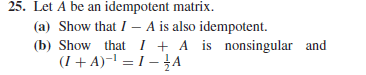
OK so i can prove that the given inverse is actually the inverse but i can not prove that I+A is non singular without using the given inverse so how do i go about doing that?(I have done part a)
Thanks in advance.View attachment 3586
 

Attachments

  • E8PTbbG.png
    E8PTbbG.png
    3.9 KB · Views: 96
Physics news on Phys.org
I'm confused. Is there a reason you can't use the fact that $(I+A)(I-\tfrac12 A)=I$ in order to show that $I+A$ is invertible?
 
Ackbach said:
I'm confused. Is there a reason you can't use the fact that $(I+A)(I-\tfrac12 A)=I$ in order to show that $I+A$ is invertible?

I am not sure if i can use that fact and i can't really ask but it is kind of trivial if i can use it.Is it even possible to show it without using that?
 
Samme013 said:
I am not sure if i can use that fact and i can't really ask but it is kind of trivial if i can use it.Is it even possible to show it without using that?

It might be. You might be able to do something clever with determinants. Let me marshall the facts such as we know them:
\begin{align*}
&\text{Idempotent matrices have determinant equal to } 0 \text{ or } 1. \text{ Why?} \\
A^2&=A \\
(\det(A))^2&=\det(A) \\
(\det(A))^2-\det(A)&=0 \\
\det(A)(\det(A)-1)&=0 \\
\det(A)&\in\{0,1\} \\
\therefore \; \det(I-A)&\in\{0,1\}. \\
&\text{Idempotent matrices are either the identity matrix, or are singular.} \\
&\text{Why? Assume } A \text{ is non-singular. Then } \\
A^2&=A \\
A^{-1}AA&=A^{-1}A \\
IA&=I \\
A&=I.
\end{align*}
Now we could take two cases: 1. $A=I$. 2. $\det(A)=0$.

For the first case, $I+A=I+I=2I$, and the determinant is $2^n\not=0$, where $A$ is $n\times n$.

For the second case, we have $\det(A)=0$. What if you formed the product
$$(I+A)(I+A)=I^2+IA+AI+A^2=I+2A+A=I+3A.$$
Not sure where that leads you. You could also form
$$(I-A)(I+A)=I^2+IA-AI-A^2=I+A-A-A=I-A.$$
Just seeing here:
$$(I-A)(I-A)=I^2-IA-AI+A^2=I-A-A+A=I-A.$$
Evidently, $(I-A)(I-A)=(I-A)(I+A)$, but I don't see where you can go further. There's no guarantee that $I-A$ is invertible (indeed, unless $I-A=I$, it won't be!), so you can't cancel anything, and the determinants won't give you anything here, either.

I think that using the formula for the inverse the problem asks you to show is just fine. If you simply compute $(I+A)(I-\tfrac12 A)=I$, you have just shown that $I+A$ is invertible. The problem asks you to show those two things. It does not tell you in what order to do them.
 
Ackbach said:
It might be. You might be able to do something clever with determinants. Let me marshall the facts such as we know them:
\begin{align*}
&\text{Idempotent matrices have determinant equal to } 0 \text{ or } 1. \text{ Why?} \\
A^2&=A \\
(\det(A))^2&=\det(A) \\
(\det(A))^2-\det(A)&=0 \\
\det(A)(\det(A)-1)&=0 \\
\det(A)&\in\{0,1\} \\
\therefore \; \det(I-A)&\in\{0,1\}. \\
&\text{Idempotent matrices are either the identity matrix, or are singular.} \\
&\text{Why? Assume } A \text{ is non-singular. Then } \\
A^2&=A \\
A^{-1}AA&=A^{-1}A \\
IA&=I \\
A&=I.
\end{align*}
Now we could take two cases: 1. $A=I$. 2. $\det(A)=0$.

For the first case, $I+A=I+I=2I$, and the determinant is $2^n\not=0$, where $A$ is $n\times n$.

For the second case, we have $\det(A)=0$. What if you formed the product
$$(I+A)(I+A)=I^2+IA+AI+A^2=I+2A+A=I+3A.$$
Not sure where that leads you. You could also form
$$(I-A)(I+A)=I^2+IA-AI-A^2=I+A-A-A=I-A.$$
Just seeing here:
$$(I-A)(I-A)=I^2-IA-AI+A^2=I-A-A+A=I-A.$$
Evidently, $(I-A)(I-A)=(I-A)(I+A)$, but I don't see where you can go further. There's no guarantee that $I-A$ is invertible (indeed, unless $I-A=I$, it won't be!), so you can't cancel anything, and the determinants won't give you anything here, either.

I think that using the formula for the inverse the problem asks you to show is just fine. If you simply compute $(I+A)(I-\tfrac12 A)=I$, you have just shown that $I+A$ is invertible. The problem asks you to show those two things. It does not tell you in what order to do them.

The exercise is listed under a chapter which is before determinants are introduced( i have no clue what they are yet) so most likely it is not expected to come up wit that solution.I will definitely come back and take a look at this when i get to the next chapter though, thanks for helping !
 
Samme013 said:
The exercise is listed under a chapter which is before determinants are introduced( i have no clue what they are yet) so most likely it is not expected to come up wit that solution.I will definitely come back and take a look at this when i get to the next chapter though, thanks for helping !

You're very welcome!
 
Thread 'How to define a vector field?'
Hello! In one book I saw that function ##V## of 3 variables ##V_x, V_y, V_z## (vector field in 3D) can be decomposed in a Taylor series without higher-order terms (partial derivative of second power and higher) at point ##(0,0,0)## such way: I think so: higher-order terms can be neglected because partial derivative of second power and higher are equal to 0. Is this true? And how to define vector field correctly for this case? (In the book I found nothing and my attempt was wrong...

Similar threads

  • · Replies 8 ·
Replies
8
Views
3K
  • · Replies 1 ·
Replies
1
Views
2K
  • · Replies 2 ·
Replies
2
Views
2K
  • · Replies 34 ·
2
Replies
34
Views
3K
  • · Replies 39 ·
2
Replies
39
Views
5K
  • · Replies 8 ·
Replies
8
Views
3K
  • · Replies 1 ·
Replies
1
Views
2K
  • · Replies 6 ·
Replies
6
Views
1K
  • · Replies 14 ·
Replies
14
Views
3K
  • · Replies 2 ·
Replies
2
Views
2K