Undergrad Problems with understanding the role of the partition of unity

  • Thread starter Thread starter Santiago24
  • Start date Start date
  • Tags Tags
    Partition Unity
Click For Summary
The discussion centers on the role of partitions of unity in manifold theory, particularly as explained in Spivak's "Calculus on Manifolds." Partitions of unity allow for the construction of smooth global objects from local functions defined on patches of a manifold. An example provided illustrates creating smooth functions on the unit circle that sum to one. The general partition of unity theorem is highlighted for its application in proving the existence of smooth vector fields on manifolds. Overall, partitions of unity are crucial for integrating local data into a coherent global structure.
Santiago24
Messages
32
Reaction score
6
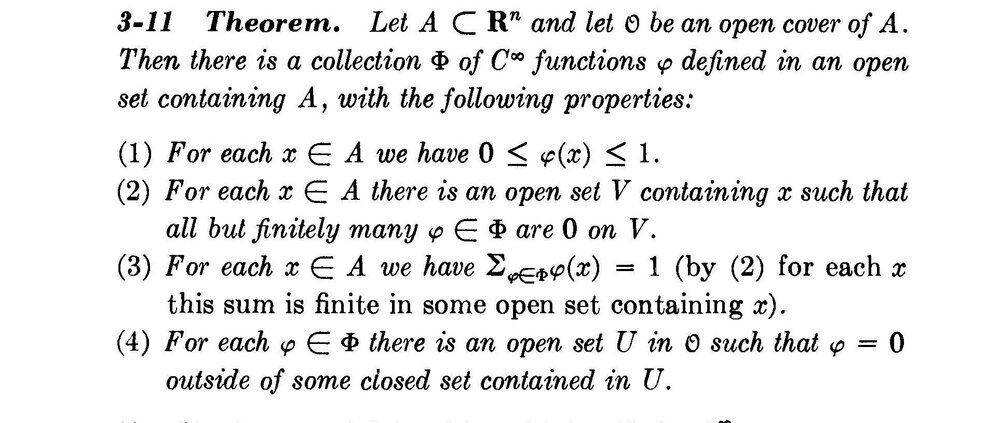
I'm reading "Calculus on manifolds" by Spivak and i can't understand the role that the partition of unity play and why this properties are important , Spivak say:
ml2cb.jpg

What is the purpose of the partition of unity? if someone can give me examples, bibliography or clear my doubt i'll appreciate it.
 
Physics news on Phys.org
We can use them to put together smooth objects, such as functions, that are only defined on parts of a manifold (patches) to make a smooth global object.

Here is an example of creating a partition of unity that gives us two nonzero, smooth functions defined on the unit circle ##S^1##, that add to 1 everywhere.

The second para of this wolfram page gives an example of how we can use the general partition of unity theorem (of which the theorem you quote above is a special case, using the manifold ##\mathbb R^n##) to prove that any manifold can have smooth vector fields on it that are not everywhere zero.

This lists other applications. I find the signal processing filter particularly interesting.
 
  • Like
Likes Santiago24 and fresh_42
andrewkirk said:
We can use them to put together smooth objects, such as functions, that are only defined on parts of a manifold (patches) to make a smooth global object.

Here is an example of creating a partition of unity that gives us two nonzero, smooth functions defined on the unit circle ##S^1##, that add to 1 everywhere.

The second para of this wolfram page gives an example of how we can use the general partition of unity theorem (of which the theorem you quote above is a special case, using the manifold ##\mathbb R^n##) to prove that any manifold can have smooth vector fields on it that are not everywhere zero.

This lists other applications. I find the signal processing filter particularly interesting.
Thanks for the answer and the links.
 
We all know the definition of n-dimensional topological manifold uses open sets and homeomorphisms onto the image as open set in ##\mathbb R^n##. It should be possible to reformulate the definition of n-dimensional topological manifold using closed sets on the manifold's topology and on ##\mathbb R^n## ? I'm positive for this. Perhaps the definition of smooth manifold would be problematic, though.

Similar threads

  • · Replies 8 ·
Replies
8
Views
3K
Replies
2
Views
2K
  • · Replies 9 ·
Replies
9
Views
2K
  • · Replies 7 ·
Replies
7
Views
3K
  • · Replies 2 ·
Replies
2
Views
4K
  • · Replies 4 ·
Replies
4
Views
2K
  • · Replies 3 ·
Replies
3
Views
2K
  • · Replies 1 ·
Replies
1
Views
2K
  • · Replies 1 ·
Replies
1
Views
2K
Replies
12
Views
3K