Why Does the Magnitude of r'(s) Equal 1 When s is the Arc Length Parameter?

Click For Summary
The discussion centers on proving that the magnitude of the derivative of a smooth curve, r'(s), equals 1 when s is the arc length parameter. The arc length is defined by the integral of the square root of the sum of the squares of the derivatives of the curve's components. By differentiating the arc length expression using the Fundamental Theorem of Calculus, it is shown that the magnitude of r'(s) must equal 1. However, it is clarified that this property holds specifically when s is the arc length parameter, as other parametrizations can yield different magnitudes. The conclusion emphasizes the importance of using the correct parameterization to maintain the relationship.
yazz912
Messages
45
Reaction score
0
1. The problem statement, all variables and given/known

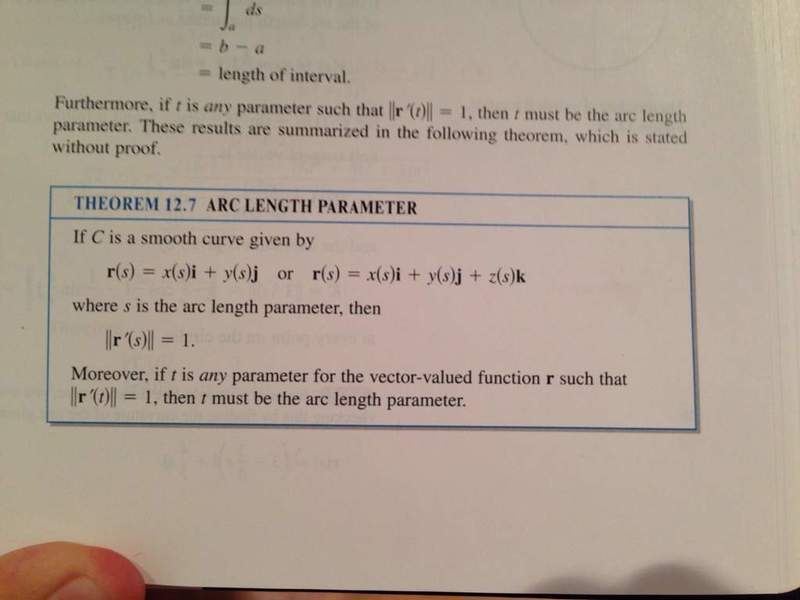
If C is a smooth curve given by
r(s)= x(s)i + y(s)j + z(s)k

Where s is the arc length parameter. Then

||r'(s)|| = 1.

My professor has stated that this is true for all cases the magnitude of r'(s) will always equal 1. But he wants me to PROVE it. ( of course not with an example)

2. Homework Equations

r(s)= x(s)i + y(s)j + z(s)k

r'(s)= x'(s)i + y'(s)j + z'(s)k

3. Attempt at the solution

To be quite honest, usually with math problems I will have some sort of attempt to try and solve it. But when it comes to proofs... I seem to get stuck.

Well I know I'm trying to prove that. ||r'(s)|| = 1

So the magnitude of r'(s)
Will be given by
SQRT[ x'(s)^2 + y'(s)^2 + z'(s)^2 ]

After this I don't know what I can do to make it equal 1. Any help will be greatly appreciated!
ImageUploadedByPhysics Forums1394824295.975449.jpg
 
Physics news on Phys.org
You know ##s## is the arc-length parameter, so what does that mean?
 
Um, That it is measuring the length along the Curve ..
 
yazz912 said:
Um, That it is measuring the length along the Curve ..

Can you express that mathematically?
 
Unfortunately no:/
 
How do you calculate the arc length of a curve?
 
micromass said:
How do you calculate the arc length of a curve?
by integrating from a to b
On the following
sqrt[ x'(t)^2 + y'(t)^2 + z'(t)^2 ] dt
 
yazz912 said:
by integrating from a to b
On the following
sqrt[ x'(t)^2 + y'(t)^2 + z'(t)^2 ] dt

Right, so the length from ##0## to ##s## is defined as

\int_0^s \sqrt{(x^\prime(t))^2 + (y^\prime(t))^2 + (z^\prime(t))^2}dt

by definition of arc-lenght parameter, this is equal to ##s##. So

s = \int_0^s \sqrt{(x^\prime(t))^2 + (y^\prime(t))^2 + (z^\prime(t))^2}dt

Now differentiate both sides.
 
Will differentiating on the side with the integral wipe out the integral completely? Or would I have to integrate and then differentiate?
 
  • #10
Differentiating on the side with the integral, use the fundamental theorem of Calculus:
\frac{d}{ds}\left(\int_a^s f(t)dt\right)= f(s)
 
  • #11
HallsofIvy said:
Differentiating on the side with the integral, use the fundamental theorem of Calculus:
\frac{d}{ds}\left(\int_a^s f(t)dt\right)= f(s)
Ok so by using that theorem, to find the derivative of an integral. I have to plug my upper limit back into the function.

Which would be
SQRT[ x'(s)^2 + y'(s)^2 + z'(s)^2 ]

How does this prove that ||r'(t)|| always =1 where t is any parameter?
 
  • #12
Here's a hint for an alternate (easier) way. Use the chain rule for$$
\frac d {ds} \vec r(t) = r'(t)\cdot (?)$$by the chain rule. Work that out and calculate its length. You don't have to consider components.
 
  • #13
yazz912 said:
Ok so by using that theorem, to find the derivative of an integral. I have to plug my upper limit back into the function.

Which would be
SQRT[ x'(s)^2 + y'(s)^2 + z'(s)^2 ]

So far you have
<br /> s = \int_0^s \sqrt{x&#039;(t)^2 + y&#039;(t)^2 + z&#039;(t)^2}\,dt<br />
and have differentiated with respect to s to find
<br /> 1 = \sqrt{x&#039;(s)^2 + y&#039;(s)^2 + z&#039;(s)^2}.<br />
But the right hand side is exactly \|r&#039;(s)\|!

How does this prove that ||r'(t)|| always =1 where t is any parameter?

It doesn't, becuase it's not true that \|r&#039;(t)\| = 1 for any parameter: consider the line from (0,0,0) to (1,1,1) with the parametrization
<br /> (x,y,z) = (t,t,t),\qquad 0 \leq t \leq 1<br />
and compare it with the parametrization
<br /> (x,y,z) = (2u,2u,2u),\qquad 0 \leq u \leq \tfrac 12.<br />
The result \|r&#039;(s)\| = 1 holds only when s is arclength.
 

Similar threads

Replies
2
Views
1K
  • · Replies 1 ·
Replies
1
Views
1K
Replies
1
Views
1K
Replies
3
Views
2K
  • · Replies 9 ·
Replies
9
Views
2K
  • · Replies 1 ·
Replies
1
Views
2K
  • · Replies 2 ·
Replies
2
Views
2K
  • · Replies 3 ·
Replies
3
Views
2K
  • · Replies 1 ·
Replies
1
Views
2K
Replies
7
Views
2K