Proof by Induction: Explained for Confused Readers

  • Thread starter Thread starter Instinctlol
  • Start date Start date
  • Tags Tags
    Induction Proof
Click For Summary

Homework Help Overview

The discussion revolves around understanding a proof by induction, specifically focusing on the inequalities and relationships involving powers of 2. Participants are trying to clarify the reasoning behind certain steps in the proof as presented in a textbook.

Discussion Character

  • Exploratory, Conceptual clarification, Assumption checking

Approaches and Questions Raised

  • Participants express confusion about specific elements of the proof, particularly regarding the use of the inductive hypothesis and the inequalities involving powers of 2. Questions arise about the assumptions made, such as the validity of 2 < 2^k for k ≥ 2.

Discussion Status

The discussion is active, with participants seeking clarification and offering insights into the reasoning behind the proof. Some have suggested that the comments in the textbook provide necessary explanations, while others are questioning the assumptions and relationships used in the proof.

Contextual Notes

There is a recurring theme of confusion regarding the specific inequalities and how they relate to the inductive step in the proof. Participants are grappling with the implications of these inequalities and the assumptions that underpin them.

Instinctlol
Messages
79
Reaction score
0
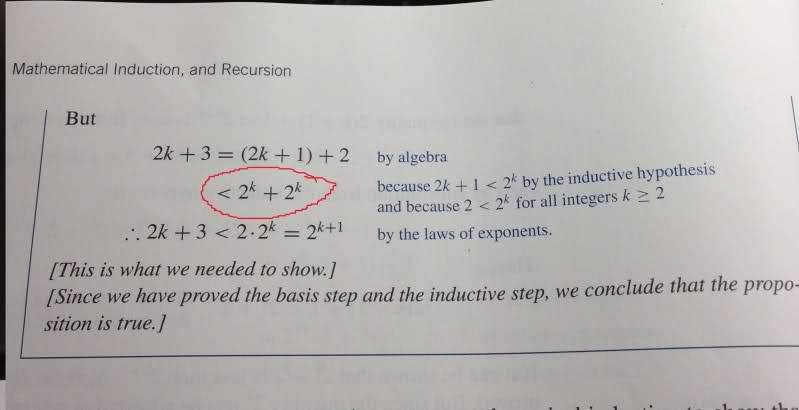
I am confused by what the book is saying, can someone explain how they got the thing I circled in red?

j0h6ye.jpg

2a6jlnn.jpg
 
Physics news on Phys.org
your book explains it on the side, it is using the inductive hypothesis and a fact about integers to say that (2^k+1)+2 < 2^k+2^k=2(2^k)=2^(k+1)
 
Instinctlol said:
I am confused by what the book is saying, can someone explain how they got the thing I circled in red?

What don't you understand? The thing circled in red is explained just to the right of that.

You're assuming that [itex]2k+1<2^k[/itex] .

It's also true that: [itex]\text{ for }\ k ≥ 2\,,\ \ 2 < 2^k[/itex]

Therefore, [itex]2k+1+2<2^k+2<2^k+2^k\,.[/itex]
 
Instinctlol said:
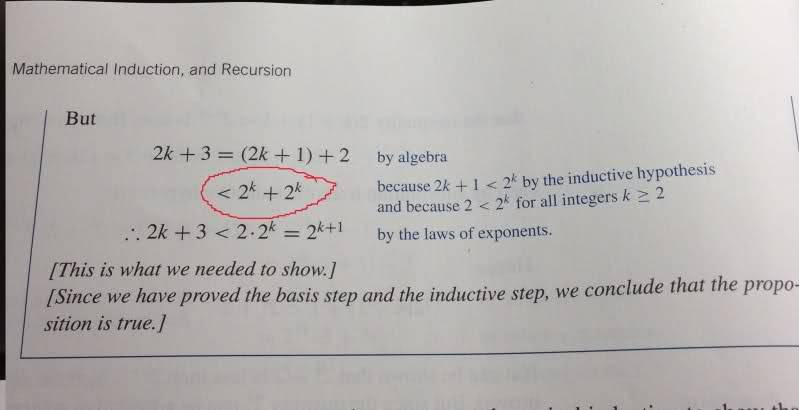
I am confused by what the book is saying, can someone explain how they got the thing I circled in red?

j0h6ye.jpg

2a6jlnn.jpg

Their comments in blue tell you exactly how they got it.

RGV
 
How did they decide 2 < 2k? Where did the 2 come from
 
they expanded 2(k+1), which is the thing you're trying to prove the relationship about, into (2k+1)+2 on the LHS, and then on the RHS they're just trying to make relatable to 2k+1 so they used the relationship 2 < 2k to facilitate it.
 
Oh I think I see it now. So when they use 2 < 2k its kinda like stating 2 = 2k so (2k+1) + 2 < 2k + 2k
 

Similar threads

  • · Replies 7 ·
Replies
7
Views
1K
  • · Replies 4 ·
Replies
4
Views
1K
  • · Replies 7 ·
Replies
7
Views
2K
Replies
5
Views
2K
  • · Replies 2 ·
Replies
2
Views
2K
  • · Replies 9 ·
Replies
9
Views
2K
  • · Replies 15 ·
Replies
15
Views
3K
  • · Replies 3 ·
Replies
3
Views
2K
Replies
1
Views
2K
  • · Replies 3 ·
Replies
3
Views
1K