Soren4
- 127
- 2
I do not get some points of this proof about the time derivative of a unit vector $\hat{u}$ (costant magnitude) which is following a precession motion. The picture is the following.
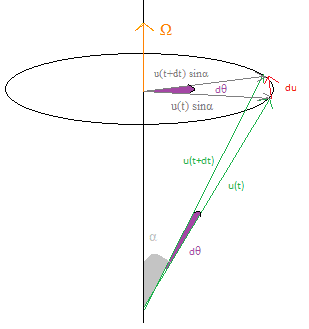
I want to prove that $$\frac{d\hat{u}}{dt}=\vec{\Omega}\wedge \hat{u}.$$
I'm ok with almost all the proof except the following points.
Consider the red vector [itex]d\hat{u}[/itex].
Since [itex]\hat{u}[/itex] has constant magnitude,[itex]d\hat{u}[/itex] must be orthogonal to [itex]\hat{u}[/itex].That's ok.
But why must [itex]d\hat{u}[/itex] be orthogonal to [itex]\vec{\Omega}[/itex] too (i.e. be tangential to a circle orthogonal to [itex]\vec{\Omega})[/itex]?
Secondly how can I geometrically prove that the angle [itex]d\theta[/itex] (the one in purple) that separates [itex]\hat{u}(t)[/itex] and [itex]\hat{u}(t+dt)[/itex] is the same that separates the projection of these two vectors on the circle orthogonal to [itex]\vec{\Omega}[/itex] (the projections are [itex]\hat{u}(t) Sin(\alpha)[/itex]and[itex]\hat{u}(t+dt) Sin(\alpha)[/itex])?
I want to prove that $$\frac{d\hat{u}}{dt}=\vec{\Omega}\wedge \hat{u}.$$
I'm ok with almost all the proof except the following points.
Consider the red vector [itex]d\hat{u}[/itex].
Since [itex]\hat{u}[/itex] has constant magnitude,[itex]d\hat{u}[/itex] must be orthogonal to [itex]\hat{u}[/itex].That's ok.
But why must [itex]d\hat{u}[/itex] be orthogonal to [itex]\vec{\Omega}[/itex] too (i.e. be tangential to a circle orthogonal to [itex]\vec{\Omega})[/itex]?
Secondly how can I geometrically prove that the angle [itex]d\theta[/itex] (the one in purple) that separates [itex]\hat{u}(t)[/itex] and [itex]\hat{u}(t+dt)[/itex] is the same that separates the projection of these two vectors on the circle orthogonal to [itex]\vec{\Omega}[/itex] (the projections are [itex]\hat{u}(t) Sin(\alpha)[/itex]and[itex]\hat{u}(t+dt) Sin(\alpha)[/itex])?