Proof of 1/(x^2) Not Having Limit at 0

  • Context: Undergrad 
  • Thread starter Thread starter vibha_ganji
  • Start date Start date
  • Tags Tags
    Limit Proof
Click For Summary
SUMMARY

The discussion centers on the proof in Apostol’s Calculus (Pg. 130) that demonstrates the function 1/(x^2) does not have a limit as x approaches 0. Participants clarify that to prove a limit does not exist, it suffices to show that for any neighborhood N(0), there exists at least one point x such that |f(x) - A| > 1, where A is any proposed limit. The right-hand limit approaches +∞, reinforcing that a finite limit cannot coexist with +∞. The proof relies on understanding the epsilon-delta definition of limits and the behavior of the function near zero.

PREREQUISITES
  • Epsilon-delta definition of limits
  • Understanding of neighborhoods in calculus
  • Concept of limits approaching infinity
  • Basic knowledge of functions and their behaviors
NEXT STEPS
  • Study the epsilon-delta definition of limits in detail
  • Explore the concept of neighborhoods in real analysis
  • Learn about limits approaching infinity and their implications
  • Review examples of functions without limits at specific points
USEFUL FOR

Students of calculus, educators teaching limit concepts, and mathematicians interested in the nuances of limit proofs and function behavior near critical points.

vibha_ganji
Messages
19
Reaction score
6
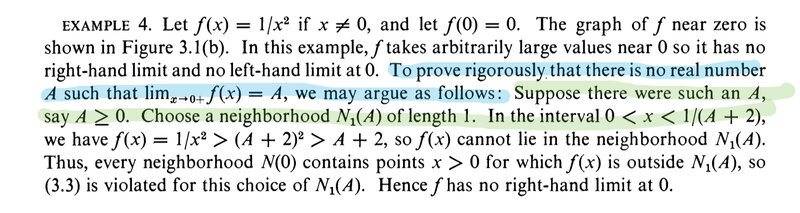
In Apostol’s Calculus (Pg. 130) they are proving that 1/(x^2) does not have a limit at 0. In the proof, I am unable to understand how they conclude from the fact that the value of f(x) when 0 < x < 1/(A+2) is greater than (A+2)^2 which is greater than A+2 that every neighborhood N(0) contains points
x > 0 for which f(x) is outside N1(A). I don’t get how they generalized the specific statement to all neighborhood of N(0). Thank you!
E5E3BEDE-EFD2-4808-80A2-72A27DA9A844.jpeg
 
Physics news on Phys.org
The proof is correct. Draw a picture:

1631227954378.png


There is no value ##f(x)## in ##N_1(A)## and you can do this for any ##A##, so ##\lim_{x \to 0^+}f(x) \neq A##. ##A=0## is also impossible, since ##0## isn't a limit point.
 
This is a subtle point and requires to have perfect understanding of the exist and for all quantifiers in the epsilon-delta definition of the limit. More specifically if one wants to prove that A is NOT a limit as x->0 then he has to prove that
$$\exists \epsilon>0 : \forall \delta>0 ,\exists x:0<|x-0|<\delta\Rightarrow |f(x)-A|>\epsilon$$

The epsilon is ##\epsilon=1## and the delta is any positive number because for any such delta there exists ##x<min(\delta,\frac{1}{A+2})## for which ##0<|x-0|<\delta## and ##|f(x)-A|>\epsilon=1##. We can choose any ##x<min(\delta,\frac{1}{A+2})## but for the proof we require to exist at least one such x (for every different delta).

So we don't actually have to prove that all the points of every neighborhood ##N(0)## are such that ##|f(x)-A)|>1##, but just that for every neighborhood## N(0)## there exists at least one point ##x ## such that ##|f(x)-A|>1##.
 
Last edited:
vibha_ganji said:
In Apostol’s Calculus (Pg. 130) they are proving that 1/(x^2) does not have a limit at 0. In the proof, I am unable to understand how they conclude from the fact that the value of f(x) when 0 < x < 1/(A+2) is greater than (A+2)^2 which is greater than A+2 that every neighborhood N(0) contains points
x > 0 for which f(x) is outside N1(A). I don’t get how they generalized the specific statement to all neighborhood of N(0). Thank you!

View attachment 288821
This seems like a slightly odd argument to me. The right-hand limit is clearly ##+\infty##, which can be proved quite easily. Then, you must have a general theorem that a limit cannot be both a finite number ##A## and ##+\infty##. That can be done once for all cases.

For the same effort, you could have a theorem rather than a statement about a single function at a single point.
 
vibha_ganji said:
In Apostol’s Calculus (Pg. 130) they are proving that 1/(x^2) does not have a limit at 0. In the proof, I am unable to understand how they conclude from the fact that the value of f(x) when 0 < x < 1/(A+2) is greater than (A+2)^2 which is greater than A+2 that every neighborhood N(0) contains points
x > 0 for which f(x) is outside N1(A). I don’t get how they generalized the specific statement to all neighborhood of N(0). Thank you!

View attachment 288821

The intersection of N(0) and (0, 1/(A + 2)) is (0, x_0) where x_0 = \min\{ \sup N(0), 1/(A + 2)\} &gt; 0 since both \sup N(0) and 1/(A + 2) are strictly positive. This intersection is never empty.
 
Last edited:
vibha_ganji said:
In Apostol’s Calculus (Pg. 130) they are proving that 1/(x^2) does not have a limit at 0. In the proof, I am unable to understand how they conclude from the fact that the value of f(x) when 0 < x < 1/(A+2) is greater than (A+2)^2 which is greater than A+2 that every neighborhood N(0) contains points
x > 0 for which f(x) is outside N1(A). I don’t get how they generalized the specific statement to all neighborhood of N(0). Thank you!

View attachment 288821
Because , as Delta2 suggested, to prove the limit A does not exist, you only need to provide one counterexample: A neighborhood of 0 here that does not map into an ##\epsilon##-neighborhood of the limit, for some value of ##\epsilon##. This is what was provided: a proof for ##\epsilon##=1: terms near 0 will map outside of any 1-neighborhood of any putative limit A.

In other words: we showed that for a neighborhood of a potential limit A there is no x-axis neighborhood neighborhood mappi ng into it. Any such x-axis 'hood will map outside of the neighborhood (A-1,A+1).
 
Last edited:

Similar threads

  • · Replies 5 ·
Replies
5
Views
3K
  • · Replies 5 ·
Replies
5
Views
3K
  • · Replies 4 ·
Replies
4
Views
2K
  • · Replies 14 ·
Replies
14
Views
2K
  • · Replies 4 ·
Replies
4
Views
2K
  • · Replies 3 ·
Replies
3
Views
2K
  • · Replies 1 ·
Replies
1
Views
2K
  • · Replies 5 ·
Replies
5
Views
1K
  • · Replies 9 ·
Replies
9
Views
3K
  • · Replies 3 ·
Replies
3
Views
2K