Undergrad Proof of ##F## is an orthogonal projection if and only if symmetric

Click For Summary
The discussion centers on proving that a linear transformation ##F## on an inner product space ##V## is an orthogonal projection if and only if it is symmetric and satisfies the projection condition ##F = F^2##. The symmetry condition is defined by the inner product relationship ##\langle F(\textbf{u}), \textbf{v} \rangle = \langle \textbf{u}, F(\textbf{v}) \rangle##. A key point raised is the justification for the equality ##\langle F(\textbf{v}), F(\textbf{v}) \rangle = \langle \textbf{v}, F(F(\textbf{v})) \rangle##, which relies on the symmetry of ##F##. The discussion also clarifies that for vectors in the orthogonal complement of the image of ##F##, the transformation satisfies ##F(\textbf{v}) = \textbf{v}##. Overall, the thread explores the conditions under which a linear transformation qualifies as an orthogonal projection.
schniefen
Messages
177
Reaction score
4
TL;DR
This is a proof of a linear transformation ##F## on an inner product space ##V## being an orthogonal projection if and only if ##F## is a projection and symmetric.
The given definition of a linear transformation ##F## being symmetric on an inner product space ##V## is

##\langle F(\textbf{u}), \textbf{v} \rangle = \langle \textbf{u}, F(\textbf{v}) \rangle## where ##\textbf{u},\textbf{v}\in V##.​

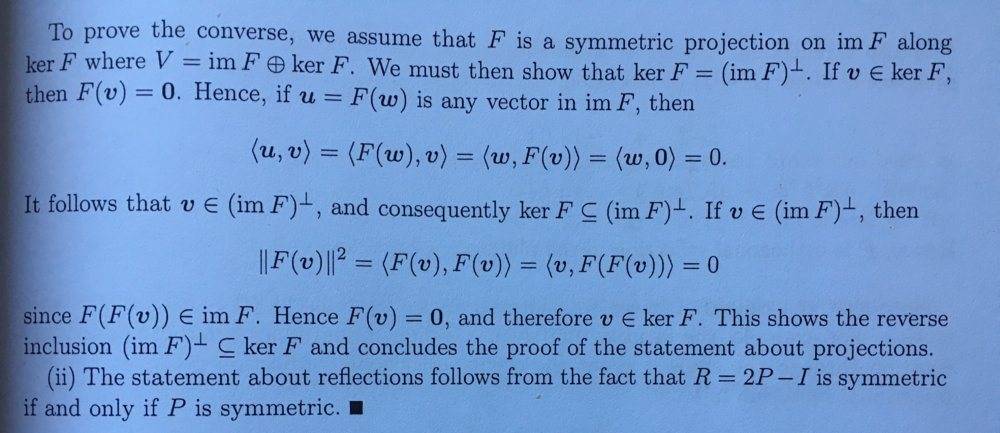
In the attached image, second equation, how is the second equality justified? That is, ##\langle F(\textbf{v}), F(\textbf{v}) \rangle = \langle \textbf{v}, F(F(\textbf{v})) \rangle##. For projections in general, ##F=F^2##, but why does ##F(\textbf{v})=\textbf{v}## for ##\textbf{v} \in (\text{im} \ F)^{\perp}##
IMG_3099.jpg
 
Physics news on Phys.org
schniefen said:
Summary: This is a proof of a linear transformation ##F## on an inner product space ##V## being an orthogonal projection if and only if ##F## is a projection and symmetric.

The given definition of a linear transformation ##F## being symmetric on an inner product space ##V## is

##\langle F(\textbf{u}), \textbf{v} \rangle = \langle \textbf{u}, F(\textbf{v}) \rangle## where ##\textbf{u},\textbf{v}\in V##.​

In the attached image, second equation, how is the second equality justified? That is, ##\langle F(\textbf{v}), F(\textbf{v}) \rangle = \langle \textbf{v}, F(F(\textbf{v})) \rangle##. For projections in general, ##F=F^2##, but why does ##F(\textbf{v})=\textbf{v}## for ##\textbf{v} \in (\text{im} \ F)^{\perp}##View attachment 250815

Apply the definition of symmetric linear map you quoted.
 
  • Like
Likes schniefen
Hi, for the second equality you've got : ##||F(v)||^2 = <v, F(F(v))>## (because ##F## is symmetric) and this equate ##0## since ##v \in Im(F)^{\perp}## and ##F(F(v)) \in Im(F)##. Where is the problem?

Perhaps I didn't understand the question.
 
Apply the definition of F you quoted for ##u=v##, ##v=F(v)## (those are replacement equations, not direct equations, i.e ##v## isn't something special such that ##v=F(v)##.
 
I am studying the mathematical formalism behind non-commutative geometry approach to quantum gravity. I was reading about Hopf algebras and their Drinfeld twist with a specific example of the Moyal-Weyl twist defined as F=exp(-iλ/2θ^(μν)∂_μ⊗∂_ν) where λ is a constant parametar and θ antisymmetric constant tensor. {∂_μ} is the basis of the tangent vector space over the underlying spacetime Now, from my understanding the enveloping algebra which appears in the definition of the Hopf algebra...

Similar threads

  • · Replies 10 ·
Replies
10
Views
2K
  • · Replies 0 ·
Replies
0
Views
2K
  • · Replies 4 ·
Replies
4
Views
2K
  • · Replies 3 ·
Replies
3
Views
3K
  • · Replies 1 ·
Replies
1
Views
2K
  • · Replies 2 ·
Replies
2
Views
2K
  • · Replies 3 ·
Replies
3
Views
4K
  • · Replies 7 ·
Replies
7
Views
1K
  • · Replies 2 ·
Replies
2
Views
1K
  • · Replies 1 ·
Replies
1
Views
2K