Proof of ##F## is an orthogonal projection if and only if symmetric

Click For Summary
SUMMARY

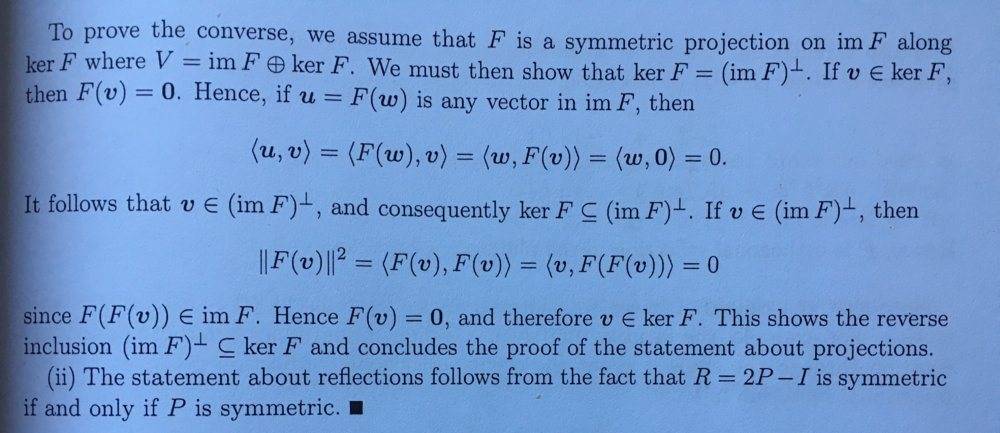
This discussion establishes that a linear transformation ##F## on an inner product space ##V## is an orthogonal projection if and only if ##F## is both a projection and symmetric. The symmetry is defined by the equation ##\langle F(\textbf{u}), \textbf{v} \rangle = \langle \textbf{u}, F(\textbf{v}) \rangle## for all ##\textbf{u}, \textbf{v} \in V##. The justification for the equality ##\langle F(\textbf{v}), F(\textbf{v}) \rangle = \langle \textbf{v}, F(F(\textbf{v})) \rangle## relies on the properties of symmetric linear maps and the relationship between the image and orthogonal complement of ##F##.

PREREQUISITES
  • Understanding of linear transformations and inner product spaces
  • Familiarity with the concept of symmetric operators
  • Knowledge of orthogonal projections in vector spaces
  • Basic proficiency in mathematical notation and proofs
NEXT STEPS
  • Study the properties of symmetric linear maps in depth
  • Learn about orthogonal projections and their applications in functional analysis
  • Explore the implications of the equation ##F=F^2## in linear algebra
  • Investigate the relationship between the image and kernel of linear transformations
USEFUL FOR

Mathematicians, students of linear algebra, and anyone interested in the theoretical foundations of linear transformations and their properties in inner product spaces.

schniefen
Messages
177
Reaction score
4
TL;DR
This is a proof of a linear transformation ##F## on an inner product space ##V## being an orthogonal projection if and only if ##F## is a projection and symmetric.
The given definition of a linear transformation ##F## being symmetric on an inner product space ##V## is

##\langle F(\textbf{u}), \textbf{v} \rangle = \langle \textbf{u}, F(\textbf{v}) \rangle## where ##\textbf{u},\textbf{v}\in V##.​

In the attached image, second equation, how is the second equality justified? That is, ##\langle F(\textbf{v}), F(\textbf{v}) \rangle = \langle \textbf{v}, F(F(\textbf{v})) \rangle##. For projections in general, ##F=F^2##, but why does ##F(\textbf{v})=\textbf{v}## for ##\textbf{v} \in (\text{im} \ F)^{\perp}##
IMG_3099.jpg
 
Physics news on Phys.org
schniefen said:
Summary: This is a proof of a linear transformation ##F## on an inner product space ##V## being an orthogonal projection if and only if ##F## is a projection and symmetric.

The given definition of a linear transformation ##F## being symmetric on an inner product space ##V## is

##\langle F(\textbf{u}), \textbf{v} \rangle = \langle \textbf{u}, F(\textbf{v}) \rangle## where ##\textbf{u},\textbf{v}\in V##.​

In the attached image, second equation, how is the second equality justified? That is, ##\langle F(\textbf{v}), F(\textbf{v}) \rangle = \langle \textbf{v}, F(F(\textbf{v})) \rangle##. For projections in general, ##F=F^2##, but why does ##F(\textbf{v})=\textbf{v}## for ##\textbf{v} \in (\text{im} \ F)^{\perp}##View attachment 250815

Apply the definition of symmetric linear map you quoted.
 
  • Like
Likes   Reactions: schniefen
Hi, for the second equality you've got : ##||F(v)||^2 = <v, F(F(v))>## (because ##F## is symmetric) and this equate ##0## since ##v \in Im(F)^{\perp}## and ##F(F(v)) \in Im(F)##. Where is the problem?

Perhaps I didn't understand the question.
 
Apply the definition of F you quoted for ##u=v##, ##v=F(v)## (those are replacement equations, not direct equations, i.e ##v## isn't something special such that ##v=F(v)##.
 

Similar threads

  • · Replies 25 ·
Replies
25
Views
3K
  • · Replies 10 ·
Replies
10
Views
2K
  • · Replies 4 ·
Replies
4
Views
2K
  • · Replies 0 ·
Replies
0
Views
2K
  • · Replies 3 ·
Replies
3
Views
4K
  • · Replies 2 ·
Replies
2
Views
2K
  • · Replies 1 ·
Replies
1
Views
2K
  • · Replies 3 ·
Replies
3
Views
4K
  • · Replies 7 ·
Replies
7
Views
2K
  • · Replies 7 ·
Replies
7
Views
1K