Propagator in the derivation of path integrals

Click For Summary

Discussion Overview

The discussion revolves around the derivation of path integrals in quantum mechanics, specifically focusing on the propagator and its formulation. Participants explore the mathematical expressions and operators involved, debating the correct application of the exponential operator with the Hamiltonian and the implications of delta functions in integrals.

Discussion Character

  • Technical explanation
  • Debate/contested
  • Mathematical reasoning

Main Points Raised

  • One participant questions why a specific expression for the propagator is not used, proposing an alternative involving the delta function and the exponential operator acting on the wave function.
  • Another participant agrees that the exponential operator acts on the variable within the delta function, suggesting that it should apply to any function containing that variable.
  • Some participants discuss the implications of the exponential operator acting on different variables, referencing specific equations from the text and noting potential typos in the equations.
  • There is a proposal to derive the propagator using braket notation, indicating a method to arrive at the same expression through a different approach.
  • Concerns are raised about the interpretation of the exponential operator's action on variables, with references to specific instances in the text where this may not align with initial assumptions.
  • Participants explore the completeness relation and its role in deriving expressions related to the propagator, emphasizing the importance of maintaining operator forms throughout the derivation.

Areas of Agreement / Disagreement

Participants express differing views on the application of the exponential operator and the correct formulation of the propagator. No consensus is reached, as multiple competing interpretations and methods are presented.

Contextual Notes

Participants note potential typos in the referenced equations and discuss the implications of these errors on their reasoning. The discussion remains focused on the mathematical intricacies without resolving the underlying assumptions or definitions that may affect the interpretations.

Happiness
Messages
686
Reaction score
30
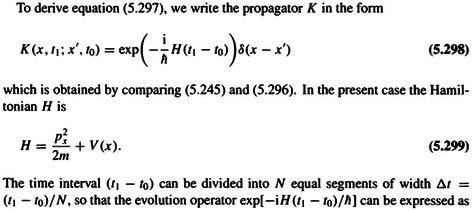
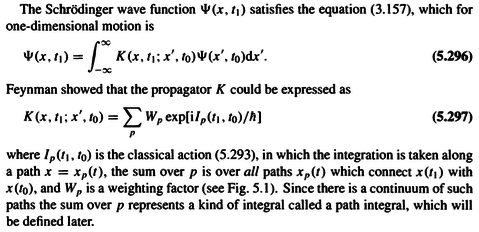
Why isn't (5.298) the following instead?

##K(x, t_1; x', t_0) = \delta(x-x')\,e^{-\frac{i}{\hbar}H(t_1-t_0)}##

My reasoning:

Since \Psi(x, t_1) = e^{-\frac{i}{\hbar}H(t_1-t_0)}\,\Psi(x, t_0)\\<br /> = e^{-\frac{i}{\hbar}H(t_1-t_0)}\,\int\delta(x-x&#039;)\Psi(x&#039;, t_0)\,dx&#039;

The exponential operator with ##H## is acting on the variable ##x##. So when it is pulled inside the integral, it should just be acting on ##\Psi(x', t_0)## so that after applying ##\delta(x-x')## and integrating, we get the same answer as the one when the exponential operator is acting on ##\Psi(x, t_0)##:

\Psi(x, t_1) =\int\delta(x-x&#039;)e^{-\frac{i}{\hbar}H(t_1-t_0)}\Psi(x&#039;, t_0)\,dx&#039;

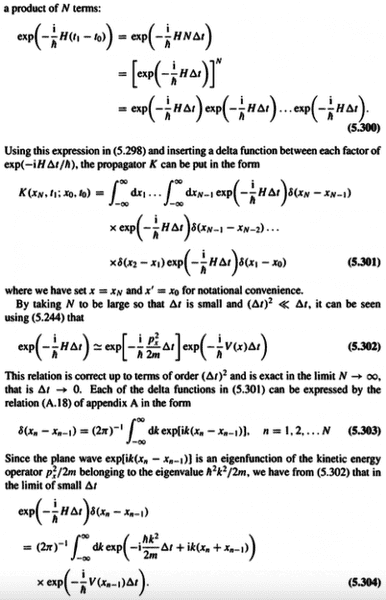
Edit: I believe there is a typo at (5.304). It should be ##(x_n - x_{n-1})## instead of ##(x_n + x_{n-1})##. Correct?

Screen Shot 2016-01-02 at 2.32.02 am.png

Screen Shot 2016-01-02 at 2.29.47 am.png

Screen Shot 2016-01-02 at 2.30.28 am.png

Screen Shot 2016-01-02 at 2.30.46 am.png
 
Last edited:
Physics news on Phys.org
Happiness said:
The exponential operator with ##H## is acting on the variable ##x##. So when it is pulled inside the integral, it should just be acting on ##\Psi(x', t_0)## so that after applying ##\delta(x-x')## and integrating, we get the same answer as the one when the exponential operator is acting on ##\Psi(x, t_0)##:
It should be acting on any function which contains ##x## which is in this case the delta function. You can also obtain the propagator by starting to work in the braket notation. Starting from
$$|\psi,t_1\rangle = \exp(i\hat{H}(t_1-t_0))|\psi,t_0\rangle$$.
Insert ##\int dx' |x'\rangle \langle x'|## just in front of ##|\psi,t_0\rangle## and multiply from the left with ##\langle x|##. So that you get
$$\langle x|\psi,t_1\rangle =\int dx' \langle x|\exp(i\hat{H}(t_1-t_0))|x'\rangle \langle x'|\psi,t_0\rangle$$.
Then use the property ##\langle x|\hat{H}|\phi\rangle = H(x)\langle x|\phi\rangle## for an arbitrary state ##|\phi\rangle## to arrive at the same expression for the propagator.
 
  • Like
Likes   Reactions: Happiness
blue_leaf77 said:
It should be acting on any function which contains ##x## which is in this case the delta function.

If the exponential operator turns ##f(x)## into ##g(x)## and if we allow it to act on ##x'## and hence ##f(x')##, it would turn ##f(x')## into ##g(x')##. And after applying ##\delta(x-x')## and integrating, we get back ##g(x)##.

You seem to suggest that the exponential operator can only act on ##x## and the variable that it acts on cannot be changed. I thought so too, until I saw (5.304), where it is not acting on ##x##, but on ##x_n## or ##x_{n-1}##. Also, ##V(x)## becomes ##V(x_{n-1})## in (5.304). So I guess that when ##V(x)## is pulled into the integral with respect to ##x_{n-1}##, ##V(x)## becomes ##V(x_{n-1})## and so the operator ##\hat{H}## acts on ##x_{n-1}## when it is inside the integral with respect to ##x_{n-1}##.

blue_leaf77 said:
You can also obtain the propagator by starting to work in the braket notation. Starting from
$$|\psi,t_1\rangle = \exp(i\hat{H}(t_1-t_0))|\psi,t_0\rangle$$.
Insert ##\int dx' |x'\rangle \langle x'|## just in front of ##|\psi,t_0\rangle## and multiply from the left with ##\langle x|##. So that you get
$$\langle x|\psi,t_1\rangle =\int dx' \langle x|\exp(i\hat{H}(t_1-t_0))|x'\rangle \langle x'|\psi,t_0\rangle$$.
Then use the property ##\langle x|\hat{H}|\phi\rangle = H(x)\langle x|\phi\rangle## for an arbitrary state ##|\phi\rangle## to arrive at the same expression for the propagator.

Do we deduce the propagator ##\ K=\int dx' \exp\big(iH(x)(t_1-t_0)\big)|\ x'\rangle \langle x'|\ ## from the fact that
##\langle x|\psi,t_1\rangle =\int dx' \exp\big(iH(x)(t_1-t_0)\big)\ \langle x|x'\rangle \langle x'|\psi,t_0\rangle\ ## is true for any ##\langle x|##?
 
Last edited:
Happiness said:
You seem to suggest that the exponential operator can only act on ##x## and the variable that it acts on cannot be changed. I thought so too, until I saw (5.304), where it is not acting on ##x##, but on ##x_n## or ##x_{n-1}##. Also, ##V(x)## becomes ##V(x_{n-1})## in (5.304). So I guess that when ##V(x)## is pulled into the integral with respect to ##x_{n-1}##, ##V(x)## becomes ##V(x_{n-1})## and so the operator ##\hat{H}## acts on ##x_{n-1}## when it is inside the integral with respect to ##x_{n-1}##.
I would rather choose to work out everything from the braket notation to know which comes from which. So, the equation ##\exp(-iH\Delta t) \delta(x_n-x_{n-1})## can be derived from the braket notation
$$
\langle x_n| \exp(-i\hat{H}\Delta t) |x_{n-1} \rangle
$$
which is approximately equal to
$$
\langle x_n| \exp(-i\frac{\hat{p}^2}{2m}\Delta t) \exp(-iV(\hat{x})\Delta t) |x_{n-1} \rangle
$$
Note that up to this point everything is still in the operator form. Then again use the completeness relation, this time for ##|k\rangle## in between the two exponential operators above. Then
$$
\langle x_n| \exp(-i\frac{\hat{p}^2}{2m}\Delta t) \exp(-i\hat{V}\Delta t) |x_{n-1} \rangle = \int dk \langle x_n| \exp(-i\frac{\hat{p}^2}{2m}\Delta t) |k\rangle \langle k|\exp(-iV(\hat{x})\Delta t) |x_{n-1} \rangle
$$
Now use ##\hat{p}^2 |k\rangle = k^2 |k\rangle## and ##V(\hat{x}) |x_{n-1} \rangle = V(x_{n-1}) |x_{n-1} \rangle## where ##k^2## and ##V(x_{n-1}) ## are just numbers (scalars) not operators anymore. The above equation will reduce to
$$
\int dk \exp(-i\frac{k^2}{2m}\Delta t) \langle x_n|k\rangle \langle k|x_{n-1} \rangle \exp(-iV(x_{n-1})\Delta t) = \frac{1}{2\pi} \int dk \exp(-i\frac{k^2}{2m}\Delta t + ik(x_n-x_{n-1})) \exp(-iV(x_{n-1})\Delta t)
$$
Note: I think there is another mistake in that book for writing ##ik(x_n+x_{n-1}) ## instead of ##ik(x_n-x_{n-1}) ##.
 
  • Like
Likes   Reactions: Happiness

Similar threads

  • · Replies 8 ·
Replies
8
Views
1K
  • · Replies 2 ·
Replies
2
Views
2K
  • · Replies 15 ·
Replies
15
Views
2K
  • · Replies 3 ·
Replies
3
Views
2K
  • · Replies 19 ·
Replies
19
Views
4K
  • · Replies 4 ·
Replies
4
Views
626
  • · Replies 14 ·
Replies
14
Views
2K
  • · Replies 6 ·
Replies
6
Views
2K
  • · Replies 1 ·
Replies
1
Views
2K
  • · Replies 15 ·
Replies
15
Views
3K