Properties of conditionally convergent series

Click For Summary
SUMMARY

This discussion focuses on the properties of conditionally convergent series, specifically examining the validity of statements (i), (ii), and (iii) in this context. Participants confirm that statement (ii) involves reordering, while (iii) does not. They demonstrate that if (ii) holds true for conditionally convergent series, then (i) can be proven for all rational and irrational values of k using the squeeze theorem. The conversation emphasizes the importance of understanding the implications of reordering in series and the conditions under which these properties hold.

PREREQUISITES
  • Understanding of conditionally convergent series
  • Familiarity with the squeeze theorem
  • Knowledge of series notation and limits
  • Basic principles of mathematical proofs
NEXT STEPS
  • Study the implications of reordering in conditionally convergent series
  • Learn about the squeeze theorem and its applications in analysis
  • Explore proofs related to the properties of series, particularly in the context of convergence
  • Investigate the differences between absolute and conditional convergence
USEFUL FOR

Mathematicians, students of advanced calculus, and anyone interested in the properties of series and convergence in mathematical analysis.
Happiness
Messages
686
Reaction score
30
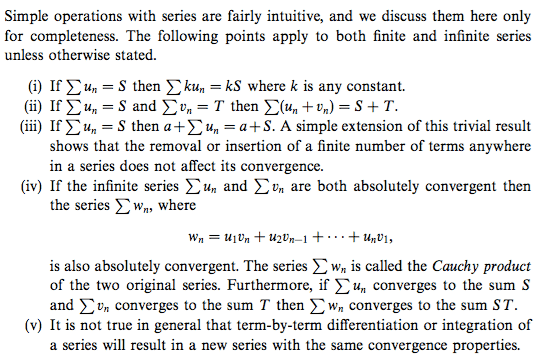
Do (i), (ii) and (iii) apply to conditionally convergent series as well? I feel like they don't. But the book seems to say that they do because it doesn't "state otherwise".

Screen Shot 2016-06-11 at 7.04.08 pm.png
 
Last edited:
Physics news on Phys.org
Happiness said:
I feel like they don't.
Why do you feel so, do you have a counterexample?
Is there any reordering involved in (i) to (iii)?
 
mfb said:
Is there any reordering involved in (i) to (iii)?

Yes there is. For (ii), it says ##u_1+u_2+...+v_1+v_2+...=u_1+v_1+u_2+v_2+...##.

There is no reordering in (iii). So we are left to prove that (ii) is true for conditionally convergent series.

If (ii) is true and if (i) is true for ##k=-1##, then (i) is true for all ##k##. Consider ##v_n=\frac{1}{2}u_n##, then using (ii), ##T=S-T##, so ##T=\frac{1}{2}S##. Similarly, we can prove (i) is true for all rational ##k##. Next, we use squeeze theorem to prove that (i) is true for all irrational ##k## too.
 
Last edited:
Happiness said:
Yes there is. For (ii), it says ##u_1+u_2+...+v_1+v_2+...=u_1+v_1+u_2+v_2+...##.
The first thing is not well-defined, and never appears in the problem.
If (ii) is true and if (i) is true for ##k=-1##, then (i) is true for all ##k##. Consider ##v_n=\frac{1}{2}u_n##, then using (ii), ##T=S-T##, so ##T=\frac{1}{2}S##. Similarly, we can prove (i) is true for all rational ##k##. Next, we use squeeze theorem to prove that (i) is true for all irrational ##k## too.
While that is correct, it is way more complicated than necessary. Also, I would think most proofs of the squeeze theorem use one of those properties in some way, making the argument circular.
 
mfb said:
The first thing is not well-defined, and never appears in the problem.

Is ##(u_1+u_2+...)+(v_1+v_2+...)=(u_1+v_1)+(u_2+v_2)+...## well defined? It says summing up all the ##u##'s and separately all the ##v##'s and then adding up the two sums is equal to summing up all the ##(u+v)##'s. So there is a rearrangement.
 
That is better, if the "..." are understood as limits.
There is still no rearrangement of the order of the elements in the series, e. g. u5 is always added after u4.
 
mfb said:
There is still no rearrangement of the order of the elements in the series, e. g. u5 is always added after u4.

But the order we do the sum is different in the RHS from that in the LHS. Isn't this generally not allowed for conditionally convergent series?
 
As I said, try to find a counterexample. And when you see that every attempt fails, you'll get some insight why the rule is also true for condionally convergent series, and then you can prove it.

Note: conditional doesn't mean every reordering has a different limit. Only some of them. And we still don't reorder within the series here.
 
mfb said:
Also, I would think most proofs of the squeeze theorem use one of those properties in some way, making the argument circular.

This (elementary, common) proof of squeeze theorem does not use (i), (ii) or (iii): https://proofwiki.org/wiki/Squeeze_Theorem/Sequences/Real_Numbers

My use of squeeze theorem for proving (i) is also true for irrational ##k##:

Suppose ##k_1<k<k_2##, where ##k_1## and ##k_2## are rational and ##k## is irrational. As before, let ##S=\Sigma u_n##.

Since (i) is true for rational ##k_1##,
##\lim_{k_1\rightarrow k}\Sigma k_1u_n=kS##. (And similarly true for ##k_2##.)

Thus,
##kS=\lim_{k_1\rightarrow k}\Sigma k_1u_n\leq \Sigma ku_n\leq\lim_{k_2\rightarrow k}\Sigma k_2u_n=kS##.

By squeeze theorem (or otherwise),
##\Sigma ku_n=kS##.
 
  • #10
Happiness said:
Since (i) is true for rational ##k_1##,
##\lim_{k_1\rightarrow k}\Sigma k_1u_n=kS##. (And similarly true for ##k_2##.)
How does this step work? You would have to show that you can take out the factor (which is directly what you want to prove) or that limit and sum commute (which is not trivial, and in general false).

Anyway, you are making this way more complicated by going that route. You can directly prove it via the definition of a limit.
 
  • #11
mfb said:
How does this step work? You would have to show that you can take out the factor (which is directly what you want to prove) or that limit and sum commute (which is not trivial, and in general false).

##\lim_{k_1\rightarrow k}\Sigma k_1u_n=\lim_{k_1\rightarrow k}k_1\Sigma u_n##, since (i) is true for rational ##k_1##
##=k\Sigma u_n=kS##
 
  • #12
mfb said:
Anyway, you are making this way more complicated by going that route. You can directly prove it via the definition of a limit.

I can't prove it directly.

Since ##\lim_{n\rightarrow\infty}\Sigma_{r=1}^nu_r=S##,

##\forall\epsilon>0, \exists N:\,\forall n>N, |\Sigma_{r=1}^nu_r-S|<\epsilon##

##|k|\,|\Sigma_{r=1}^nu_r-S|<|k|\epsilon##
##|k\,\Sigma_{r=1}^nu_r-kS|<|k|\epsilon##

but we want to show that

##|\Sigma_{r=1}^nku_r-kS|<|k|\epsilon,\,\forall n>N##.

This is true if ##k\,\Sigma_{r=1}^nu_r=\Sigma_{r=1}^nku_r,\,\forall n>N## including ##n=\infty##. But this is precisely what we want to prove.
 
  • #13
Happiness said:
##\lim_{k_1\rightarrow k}\Sigma k_1u_n=\lim_{k_1\rightarrow k}k_1\Sigma u_n##, since (i) is true for rational ##k_1##
##=k\Sigma u_n=kS##
That part works, but how do you prove it is equal to ##\lim_{n \to \infty} \sum_{i=0}^n k u_i##?

Happiness said:
I can't prove it directly.
You can. For a finite sum, ##k \sum u_r = \sum k u_r## is trivial (distributive law), and you don't need it for "n=∞" because that never appears in the proof.
 
  • #14
mfb said:
That part works, but how do you prove it is equal to ##\lim_{n \to \infty} \sum_{i=0}^n k u_i##?

##\sum_{i=0}^n k_1u_i\leq\sum_{i=0}^n k u_i\leq\sum_{i=0}^n k_2u_i##

By squeeze theorem,
##\lim_{n \to \infty} \sum_{i=0}^n k u_i=kS##

You can. For a finite sum, ##k \sum u_r = \sum k u_r## is trivial (distributive law), and you don't need it for "n=∞" because that never appears in the proof.

##\forall n>N## means we only need to consider finite values of ##n##?
 
  • #15
Happiness said:
##\forall n>N## means we only need to consider finite values of ##n##?
n is a natural number. Every natural number is finite.
 
  • Like
Likes   Reactions: Happiness

Similar threads

  • · Replies 7 ·
Replies
7
Views
2K
  • · Replies 2 ·
Replies
2
Views
2K
  • · Replies 17 ·
Replies
17
Views
5K
  • · Replies 5 ·
Replies
5
Views
2K
  • · Replies 11 ·
Replies
11
Views
5K
Replies
2
Views
1K
  • · Replies 8 ·
Replies
8
Views
2K
  • · Replies 5 ·
Replies
5
Views
3K
  • · Replies 3 ·
Replies
3
Views
2K
  • · Replies 6 ·
Replies
6
Views
4K