SUMMARY
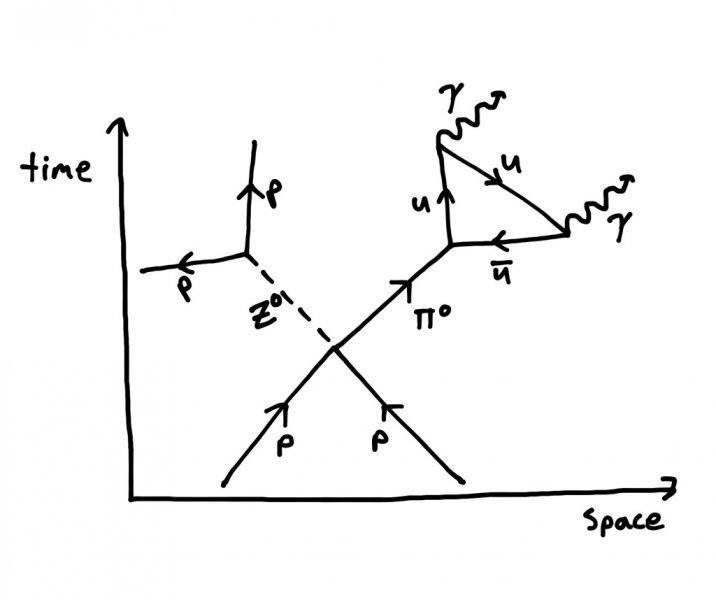
The forum discussion centers on the complexities of drawing a Feynman diagram for a relativistic proton-proton collision that produces a neutral pion (π0) and its subsequent decay into two photons. Participants emphasize the importance of accurately representing particle interactions, charge conservation, and the correct depiction of fermions and antifermions. The consensus is that the initial sketch does not conform to Feynman diagram standards and that pion production is more likely to occur through strong interactions rather than the depicted process. Additionally, the discussion highlights that pions typically emerge from the decay of high-mass baryon states in high-energy collisions.
PREREQUISITES
- Understanding of Feynman diagrams and their conventions
- Knowledge of particle physics, specifically proton-proton interactions
- Familiarity with the concept of charge conservation in particle interactions
- Basic principles of particle decay, particularly neutral pions and their decay into photons
NEXT STEPS
- Study the conventions of Feynman diagrams in particle physics
- Research the strong interaction and its role in pion production
- Learn about baryon states and their decay processes in high-energy collisions
- Examine the principles of charge conservation in particle physics
USEFUL FOR
Particle physicists, students of theoretical physics, and anyone interested in understanding the intricacies of Feynman diagrams and particle interactions in high-energy collisions.