Prove Angle of Diagonals in Quadrilateral is Degrees

  • Context: MHB 
  • Thread starter Thread starter maxkor
  • Start date Start date
  • Tags Tags
    Angle
Click For Summary
SUMMARY

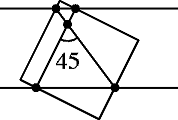
The discussion focuses on proving that the diagonals of a quadrilateral formed by the intersection points of a square's sides with a strip of width intersect at an angle of 90 degrees. The problem highlights the relationship between angles α and β, where α + β = 90 degrees. The geometric solution emphasizes the isosceles nature of triangles KNP and MLQ, leading to the conclusion that the angle γ, defined as (α + β)/2, equals 45 degrees. This establishes that the diagonals intersect at right angles.

PREREQUISITES
  • Understanding of basic geometric principles, particularly properties of quadrilaterals.
  • Familiarity with isosceles triangles and their angle properties.
  • Knowledge of angle relationships in geometry, specifically complementary angles.
  • Ability to visualize geometric configurations and their implications.
NEXT STEPS
  • Study the properties of isosceles triangles in greater detail.
  • Explore geometric proofs involving quadrilaterals and their diagonals.
  • Learn about complementary angles and their applications in geometric proofs.
  • Investigate advanced geometric constructions and their implications in proofs.
USEFUL FOR

Students of geometry, mathematics educators, and anyone interested in geometric proofs and properties of quadrilaterals.

maxkor
Messages
79
Reaction score
0
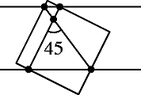
Two angles of a square with side
c7d457e388298246adb06c587bccd419ea67f7e8.png
protrude beyond a strip of width
c7d457e388298246adb06c587bccd419ea67f7e8.png
with parallel edges. The sides of the square intersect the edges of the strip at four points. Prove that the diagonals of the quadrilateral whose vertices are these points intersect at an angle of
f27da4fca6f3fecb215974023aad210b70ec3857.png
degrees.
rys.png
 

Attachments

  • rys.png
    rys.png
    1.2 KB · Views: 233
Mathematics news on Phys.org
As in a previous problem, here is an algebraic solution. I would like to see a geometric solution giving more insight into why this result holds.
We may as well take $a=1$. Tilt the diagram so that the square becomes the unit square, and suppose that the parallel lines make an angle $\theta$ with the $x$-axis.

[TIKZ][scale=1.25]
\draw [very thick] (0,0) -- (4,0) -- (4,4) -- (0,4) -- cycle ;
\draw [very thick] (-4,0.5) -- (4,6.5) ;
\draw [very thick] (0,-1.5) -- (8,4.5) ;
\coordinate [label=left:$A$] (A) at (0,3.5) ;
\coordinate [label=above:$B$] (B) at (0.667,4) ;
\coordinate [label=right:$C$] (C) at (4,1.5) ;
\coordinate [label=below:$D$] (D) at (2,0) ;
\draw [very thick] (A) -- (C) ;
\draw [very thick] (B) -- (D) ;
\draw (2.5,0.2) node {$\theta$} ;
\draw (1.3,2.6) node {$\phi$} ;
\draw (-0.5,0) node {$(0,0)$} ;
\draw (4.5,0) node {$(1,0)$} ;
\draw (-0.5,4) node {$(0,1)$} ;
\draw (4.5,4) node {$(1,1)$} ; [/TIKZ]
The equations of the parallel lines are then of the form $y = x\tan\theta + c+d$ and $y = x\tan\theta + c-d$ for some constants $c$ and $d$. The condition that the lines form a strip of width $1$ is $2d\cos\theta = 1$. So $2d = \sec\theta$.

The points where the lines cross the sides of the square are then $$ A = (0,c+d),\qquad B = ((1-c-d)\cot\theta,1), \qquad C = (1,\tan\theta + c-d), \qquad D = ((d-c)\cot\theta,0) .$$ The slope of the line $AC$ is therefore $\tan\theta - 2d = \tan\theta - \sec\theta$.

The slope of $BD$ is $\dfrac{-1}{(2d-1)\cot\theta} = \dfrac{-\tan\theta}{\sec\theta-1}$.

It follows from the formula $\tan(\alpha - \beta) = \frac{\tan\alpha -\tan\beta}{1+ \tan\alpha\tan\beta}$ that if $\phi$ is the angle between $AC$ and $BD$ then $$\begin{aligned} \tan\phi = \frac{(\tan\theta - \sec\theta) - \frac{-\tan\theta}{\sec\theta-1}}{1 + (\tan\theta - \sec\theta) \frac{-\tan\theta}{\sec\theta-1}} &= \frac{(\sec\theta - 1)(\tan\theta - \sec\theta) + \tan\theta}{(\sec\theta - 1) - \tan\theta (\tan\theta - \sec\theta)} \\ &= \frac{\sec\theta(\tan\theta - \sec\theta + 1)}{\sec\theta(1 - \sec\theta + \tan\theta)} \\ &= 1. \end{aligned}$$ It follows that $\phi = 45^\circ$.
 
Hint
156973.png

156973.png
 
1 / α + β = 90
2 / it is enough to note that the triangles
KNP and MLQ (they have two heights of length "a") so they are isosceles
so |∡NMQ| =90 - α/2 and |∡MNP| =90 - β/2
γ=(α + β)/2=45
 

Similar threads

Replies
3
Views
1K
  • · Replies 4 ·
Replies
4
Views
2K
  • · Replies 2 ·
Replies
2
Views
2K
  • · Replies 1 ·
Replies
1
Views
2K
  • · Replies 9 ·
Replies
9
Views
2K
  • · Replies 4 ·
Replies
4
Views
1K
  • · Replies 4 ·
Replies
4
Views
2K
  • · Replies 6 ·
Replies
6
Views
3K
  • · Replies 1 ·
Replies
1
Views
2K
  • · Replies 9 ·
Replies
9
Views
4K