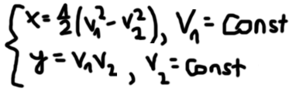
Prove orthogonality of these curves

Click For Summary

Homework Help Overview

The original poster attempts to prove the orthogonality of certain curves, expressing confusion regarding the definitions and methods involved. The problem involves checking the condition for orthogonality through derivatives, but the introduction of constants complicates their understanding.

Discussion Character

  • Exploratory, Assumption checking, Problem interpretation

Approaches and Questions Raised

  • Participants discuss the need to clarify the functions involved and the definition of orthogonality. There are attempts to parametrize the curves, but uncertainty about the correctness of the curves is noted. Questions arise about whether the curves are indeed surfaces and the implications of constants in the equations.

Discussion Status

The discussion is ongoing, with participants seeking clarification on the original poster's problem statement and the specifics of the curves. Some guidance has been offered regarding the need for clearer context and better presentation of the work, but no consensus has been reached on the problem itself.

Contextual Notes

The original poster has been encouraged to provide a clearer description of the problem, as the current information is deemed insufficient for effective assistance. There are also concerns about the readability of attached materials, which may hinder the discussion.

berlinvic
Messages
9
Reaction score
0
Homework Statement
Prove orthogonality of curves
Relevant Equations
Orthogonality condition for curves
I am asked to prove orthogonality of these curves, however my attempts are wrong and there's something I fundamentally misunderstand as I am unable to properly find the graphs (I have only found for a, but I doubt the validity).

Furthermore, I am familiar that to check for othogonality (based on the video ), I need to find both derivatives and make sure their multiplication is equal to -1. However, the introduction of constant a, b in my case doesn't help that at all and I am unable to check for orthogonality.

This has been bugging me for days, I would highly appreciate if someone could put me on the right path to solve this problem
 

Attachments
  • Work.png
    Work.png
    11 KB · Views: 112
  • Equations.png
    Equations.png
    5.1 KB · Views: 102
Physics news on Phys.org
:welcome:

You've posted a 26-minute videos and some equations without much context. Please be more specific about what are your functions and how orthogonality is defined in this case.

Also, the homework guidelines require that you show us your best effort before we can help.
 
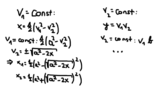
I think I posted everything that I've worked so far. The main equation for othogonality is the multiplication of derivatives of the curves equal to minus one, I mentioned it in the post as well. Additionally, I attached the photo where I show my work trying to parametrize the curves, but I'm stuck with curve y (not sure about the correctness of curve x). This is all I can think of, if you have any more inqueries I will try my best to provide more information.
 
berlinvic said:
I think I posted everything that I've worked so far. The main equation for othogonality is the multiplication of derivatives of the curves equal to minus one, I mentioned it in the post as well. Additionally, I attached the photo where I show my work trying to parametrize the curves, but I'm stuck with curve y (not sure about the correctness of curve x). This is all I can think of, if you have any more inqueries I will try my best to provide more information.
Are the curves: ##x^3 = 3(y -1)## and ##x(3y - 29) = 3##?
 
PeroK said:
Are the curves: ##x^3 = 3(y -1)## and ##x(3y - 29) = 3##?
No, sorry for confusion. In the picture I attached those are ##x=\frac{1}{2}(v_1^2-v_2^2), v_1=const## and ##y=v_1v_2, v_2=const##
 
berlinvic said:
No, sorry for confusion. In the picture I attached those are ##x=\frac{1}{2}(v_1^2-v_2^2), v_1=const## and ##y=v_1v_2, v_2=const##
Aren't those surfaces? Above the ##v_1, v_2## plane?
 
PeroK said:
Aren't those surfaces? Above the ##v_1, v_2## plane?
I don't think so based on that, v_1 and v_2 here are some constants not volumes.
 
Thread closed.

@berlinvic, please start a new thread with a clear problem description. Not counting this post, we're up to 7 posts in this thread and the members here still don't know exactly what the question is asking. The video you posted, as already noted, is 26 minutes long. It is unreasonable for you to expect members to watch the whole video to understand what you need to do.
Also, the attachments you posted are virtually unreadable. When I attempted to expand them, the writing is black text against a very dark background, as if what you took a picture was very dimly lit. Many posts with photos of work are similarly difficult or impossible to read, and this is why we discourage including photos of the work.
 
  • Like
Likes   Reactions: PhDeezNutz

Similar threads

  • · Replies 4 ·
Replies
4
Views
2K
  • · Replies 7 ·
Replies
7
Views
3K
  • · Replies 13 ·
Replies
13
Views
4K
  • · Replies 22 ·
Replies
22
Views
3K
  • · Replies 6 ·
Replies
6
Views
4K
  • · Replies 13 ·
Replies
13
Views
6K
  • · Replies 2 ·
Replies
2
Views
3K
  • · Replies 9 ·
Replies
9
Views
3K
  • · Replies 10 ·
Replies
10
Views
6K
Replies
13
Views
19K