Prove: Poincare Model I-1 Holes for Every Two Points of E

  • Thread starter Thread starter mathstudent88
  • Start date Start date
  • Tags Tags
    Model Poincare
Click For Summary

Homework Help Overview

The discussion revolves around proving a property of the Poincaré model, specifically that for any two points P and Q inside the unit circle, there exists a unique L-line containing them. The context involves concepts from analytic geometry and hyperbolic geometry.

Discussion Character

  • Exploratory, Conceptual clarification, Mathematical reasoning

Approaches and Questions Raised

  • Participants discuss the nature of L-lines and their definitions, questioning the necessity of proving that points P and Q are not at the origin. There is an exploration of the conditions under which a hyperbolic line can be defined, including the implications of one or both points being at the origin.

Discussion Status

Some participants have offered insights into the characteristics of hyperbolic lines and the conditions for circles orthogonal to the unit circle. There is an ongoing exploration of the concepts of inverse points and the mathematical expressions needed to prove the properties of L-lines.

Contextual Notes

Participants note the need for clarity on certain mathematical terms and expressions, indicating a potential gap in shared understanding of the concepts involved in the proof.

mathstudent88
Messages
25
Reaction score
0
Incidence Postualte I-1 holes for the Poincare Model: Every two points of E lie on exactly one L-Line.
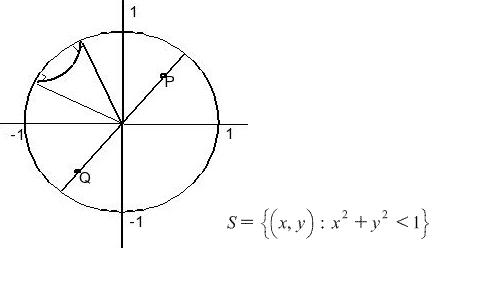
Prove: Given any two points P and Q inside the unit circle C, there exists a unique L-line l containing them. (this will require the use of analytic geometry.)
poincare.jpg


L-lines:arcs of circles perpendicular to the unit circle in S and the diameter of S.

How would i solve this? I know that i need to prove and P,Q are not equal to the orgin and that either one is at the orgin, but how?

Thanks for the help!
 
Physics news on Phys.org
mathstudent88 said:
Incidence Postualte I-1 holes for the Poincare Model: Every two points of E lie on exactly one L-Line.
Prove: Given any two points P and Q inside the unit circle C, there exists a unique L-line l containing them. (this will require the use of analytic geometry.)

poincare.jpg


L-lines:arcs of circles perpendicular to the unit circle in S and the diameter of S.

How would i solve this? I know that i need to prove and P,Q are not equal to the orgin and that either one is at the orgin, but how?

Thanks for the help!

You don't prove that neither P nor Q is at the origin- there is no reason for that to be true. However, a "hyperbolic line" in the Poincare circle model is either
1) A Euclidean line through the center of the bounding circle (here the origin) or
2) A circle orthogonal to the bounding circle.

IF is P or Q is the origin, then it is easy: the Euclidean line from P to Q is a hyperbolic line. You should also be able to prove, with Analytic geometry, that a circle passing through the origin cannot be orthogonal to the unit circle.

If neither P nor Q are at the origin, then you need to show that there is exactly one circle through both P and Q that is orthogonal to the unit circle. How you would do that, I can't say because I don't know what concepts you know that you can use. I myself would use the fact that the inverse points to P and Q must also be on that circle. Do you know what an "inverse point" in this sense is?
 
HallsofIvy said:
You don't prove that neither P nor Q is at the origin- there is no reason for that to be true. However, a "hyperbolic line" in the Poincare circle model is either
1) A Euclidean line through the center of the bounding circle (here the origin) or
2) A circle orthogonal to the bounding circle.

IF is P or Q is the origin, then it is easy: the Euclidean line from P to Q is a hyperbolic line. You should also be able to prove, with Analytic geometry, that a circle passing through the origin cannot be orthogonal to the unit circle.

If neither P nor Q are at the origin, then you need to show that there is exactly one circle through both P and Q that is orthogonal to the unit circle. How you would do that, I can't say because I don't know what concepts you know that you can use. I myself would use the fact that the inverse points to P and Q must also be on that circle. Do you know what an "inverse point" in this sense is?

Do you mean like P' and Q' are inverse points?
 
HallsofIvy said:
IF is P or Q is the origin, then it is easy: the Euclidean line from P to Q is a hyperbolic line. You should also be able to prove, with Analytic geometry, that a circle passing through the origin cannot be orthogonal to the unit circle.
QUOTE]


To prove this, i would just have to show x^2+y^2+ax+by+1=0, given the points P and Q?
 
mathstudent88 said:
Do you mean like P' and Q' are inverse points?
I have no idea because I have no idea what YOU mean by P' and Q'.
 
mathstudent88 said:
HallsofIvy said:
IF is P or Q is the origin, then it is easy: the Euclidean line from P to Q is a hyperbolic line. You should also be able to prove, with Analytic geometry, that a circle passing through the origin cannot be orthogonal to the unit circle.
QUOTE]


To prove this, i would just have to show x^2+y^2+ax+by+1=0, given the points P and Q?
Again, since you have not said what a and b are, I have no idea what you are talking about!
 

Similar threads

  • · Replies 2 ·
Replies
2
Views
3K
Replies
2
Views
2K
  • · Replies 2 ·
Replies
2
Views
4K
  • · Replies 2 ·
Replies
2
Views
2K
Replies
2
Views
3K
  • · Replies 4 ·
Replies
4
Views
3K
  • · Replies 1 ·
Replies
1
Views
3K
  • · Replies 51 ·
2
Replies
51
Views
2K
  • · Replies 1 ·
Replies
1
Views
3K
Replies
7
Views
2K