SUMMARY
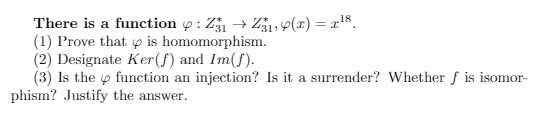
The discussion centers on proving that the function $$\varphi(x) = x^{18}$$ is a homomorphism within the group $$\mathbb{Z}_{31}^*$$. Participants confirm that the equation $$\varphi(x\cdot_{31}y) = \varphi(x)\cdot_{31}\varphi(y)$$ holds true, provided the justification for the intermediate step $$ (x\cdot_{31}y)^{18} = x^{18}\cdot_{31}y^{18}$$ is adequately supported. The conversation emphasizes the importance of understanding the underlying assumptions and definitions related to ring homomorphisms and modular arithmetic.
PREREQUISITES
- Understanding of abstract algebra concepts, particularly homomorphisms.
- Familiarity with modular arithmetic, specifically $$\mathbb{Z}_{31}^*$$.
- Knowledge of the properties of exponentiation in modular systems.
- Ability to work with LaTeX for mathematical expressions.
NEXT STEPS
- Study the properties of ring homomorphisms in abstract algebra.
- Learn about modular arithmetic and its applications in group theory.
- Explore the significance of the group $$\mathbb{Z}_{31}^*$$ in number theory.
- Practice proving mathematical identities using LaTeX for clarity.
USEFUL FOR
Students and educators in mathematics, particularly those focusing on abstract algebra and group theory, as well as anyone interested in the properties of modular arithmetic.