Proving Element In Union of Two Infinite Sets Not Necessarily In Intersection

Click For Summary

Discussion Overview

The discussion revolves around proving that an element in the union of two infinite sets does not necessarily belong to their intersection. Participants explore different methods of proof, including the use of counter-examples.

Discussion Character

  • Debate/contested

Main Points Raised

  • The original poster (OP) presents a proof and asks for validation of their approach.
  • One participant agrees with the OP's proof, indicating it looks good.
  • Another participant acknowledges the OP's proof as correct but describes it as awkward, suggesting that a counter-example is a better method to demonstrate the claim.
  • This participant provides a counter-example using the sets A and B, which are infinite sets with a specific intersection.
  • A later reply challenges the characterization of awkwardness, arguing that the OP's method is equally valid and may even be more straightforward since their sets do not intersect at all.
  • This participant suggests that finding two infinite sets that do not intersect could be seen as a more obvious counter-example.

Areas of Agreement / Disagreement

Participants generally agree on the validity of the OP's proof but express differing opinions on the method's clarity and effectiveness. There is no consensus on which proof method is superior.

Contextual Notes

Some assumptions about the nature of the sets and their intersections may not be explicitly stated, and the discussion does not resolve the nuances of proof methods.

woundedtiger4
Messages
188
Reaction score
0
Problem:
Prove that if an element is in the union of two infinite sets then it is not necessarily in their intersection:

Proof:
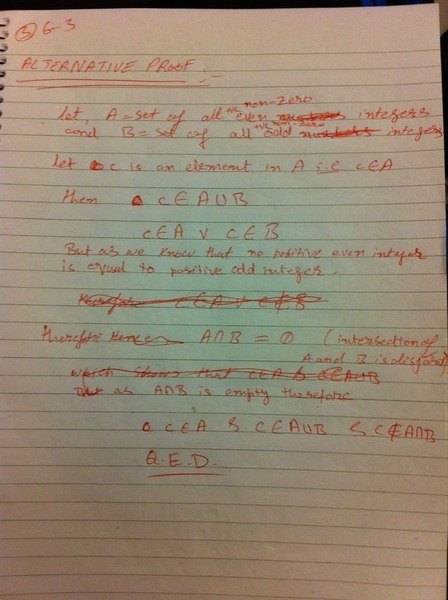
ImageUploadedByPhysics Forums1371044407.002411.jpg


Have I solved it correctly?
 
Physics news on Phys.org
Looks good.
 
Correct but awkward. The best way to prove something is NOT true is to give a counter-example. Let A= {(x, 0)}, the set of all points on the x-axis. Let B= {(0, y)}, the set of all points on the y-axis. Those are both infinite sets and their union is the set of all pairs of numbers in which at least one of the pair is 0. But their intersection is just {(0, 0)}.
 
HallsofIvy said:
Correct but awkward.
I don't see the OP's method being any more or less awkward than yours, really.

The best way to prove something is NOT true is to give a counter-example.
That is exactly what the OP did; just using a different couple of sets. The main difference was that the OP's two sets didn't even intersect at all, which is fine.

In fact, you could argue that that is a more obvious way to find a counter-example. Surely it is easier to find two infinite sets that do not intersect in the first place?

However, I'm not saying your answer was awkward either. :smile:
 

Similar threads

  • · Replies 4 ·
Replies
4
Views
3K
  • · Replies 3 ·
Replies
3
Views
4K
  • · Replies 2 ·
Replies
2
Views
2K
  • · Replies 2 ·
Replies
2
Views
4K
  • · Replies 2 ·
Replies
2
Views
2K
  • · Replies 2 ·
Replies
2
Views
2K
  • · Replies 1 ·
Replies
1
Views
2K
  • · Replies 21 ·
Replies
21
Views
4K
  • · Replies 8 ·
Replies
8
Views
2K
  • · Replies 2 ·
Replies
2
Views
3K