Proving optimal substructure for Sherlock and Cost problem

Join the discussion
Registration is free. Ask a follow-up in this thread, or start your own.
17 replies · 3K views
CGandC
Messages
326
Reaction score
34
TL;DR
How to prove the existence of optimal substructure for the dynamic programming problem "Sherlock and Cost"?
I was attempting to solve the "Sherlock and Cost" problem from HackerRank using DP:
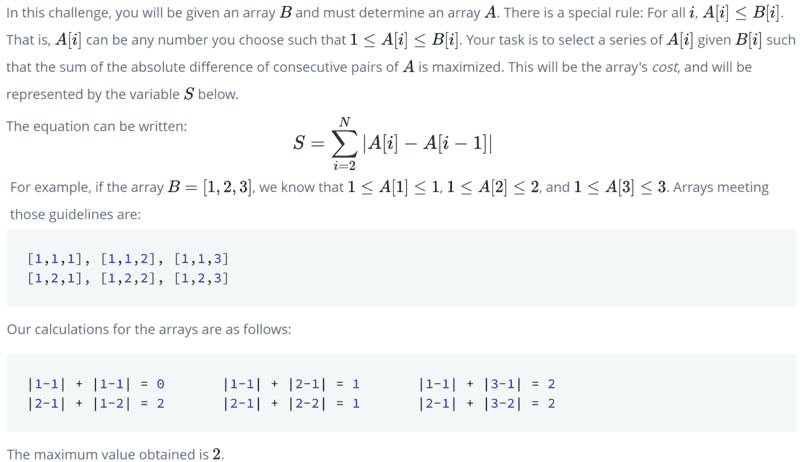
1630849631539.png

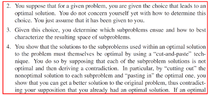
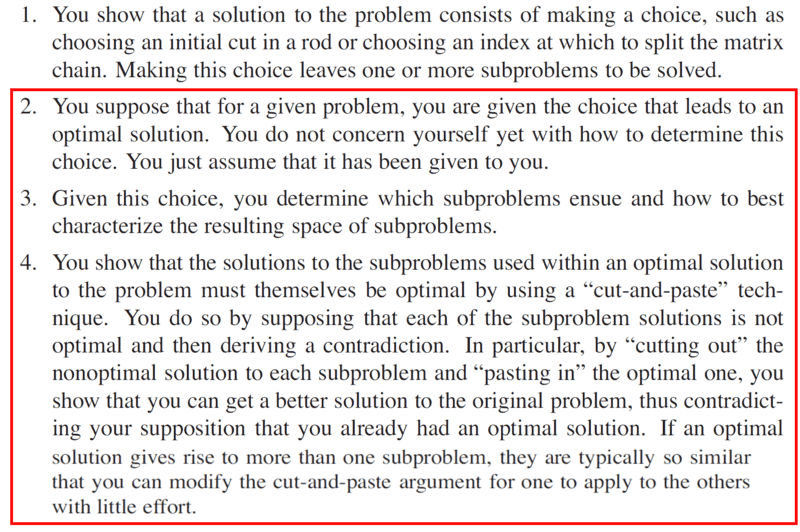
But before I went to come up with a recursive relation, I wanted to find if the problem possesses an optimal substructure, and I was following these steps as written at CLRS book:
1630852375417.png

Mentor note: Inline images of mathematical expressions have been replaced by LaTeX.
I did step 1 as follows:
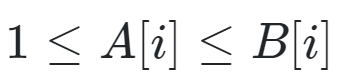
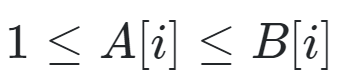
Define ## T = \{ \} ~~ . \forall i ## choose ## a \in B ## s.t. we define ## A = a ## s.t. ##1 \le A[ i] \le B[ i]## . After creating array ## A ## perform ## T.add(A) ##.
Continue adding arrays to set ## T ## until all possible added arrays ## A ## that satisfy ##1 \le A[ i] \le B[ i]## have been exhausted. Define the set ## SUMS = \{ \} ## . Afterwards, ## \forall j ## we look at the ## jth ## array ## A_j \in T ## , define ##S_j = \sum_{i = 1} (A_j[ i] - A_j[ i + 1])## and perform ## SUMS.add(S_j) ##.
Take ## max(SUMS) ## and we're finished. We showed the problem indeed consists of making a choice.Now, I want to prove steps 2+3+4 , this is done by taking an arbitrary object which you wish to optimize and assume that to optimize the object then ## X ## will occur, from this assumption subproblems should ensure and you show the solution to each one of them is an optimal solution.
Now, going back to proving steps 2+3+4 in the "Sherlock and Cost" problem, I have no idea what to do, I started with:
" Suppose that in order to find the array ## \hat{ A} ## s.t. ## S_{ \hat{ A} } ## is ##S_{ \hat{ A} } = \sum_{i = 1}({ \hat{ A} }_j[ i] - { \hat{ A} }_j[ i + 1])## is maximal ... [ stuff to be added ] "
but I have no idea how to continue, how would you proceed to formally proving steps 2+3+4 ( which is proving an optimal substructure exists for the problem )?

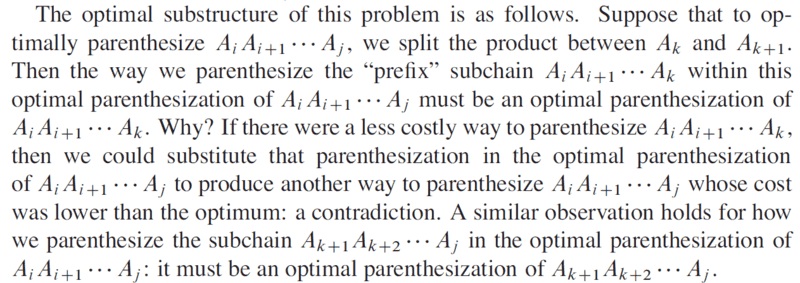
Note: Here's an example of how the existence of an optimal substructure is proved for the matrix parenthization problem ( from CLRS chapter 15.2 ) -

1630852755665.png


Thanks in advance for any help!
 

Attachments
  • 1630849600570.png
    1630849600570.png
    66.1 KB · Views: 196
  • 1630852220518.png
    1630852220518.png
    49.4 KB · Views: 193
  • 1630854294054.png
    1630854294054.png
    3.4 KB · Views: 238
  • 1630854420583.png
    1630854420583.png
    1.3 KB · Views: 202
  • 1630854430441.png
    1630854430441.png
    1.3 KB · Views: 210
  • 1630854538030.png
    1630854538030.png
    3.4 KB · Views: 200
Last edited:
Physics news on Phys.org
Formatting comment -- It looks like you were getting flummoxed by your LaTeX expressions, particularly with the array indexes. In a browser, an expression such as A is interpreted to mean to display A, and then display any subsequent text in italics. A workaround is to insert a space between the left bracket and the index i.

I have replaced most of your attached images, replacing them with Inline LaTeX.
 
  • Like
Likes   Reactions: CGandC and sysprog
Thanks, I had an issue with displaying array indexes as it seemed to dox my entire text and I couldn't preview correctly before I posted the question ( for some reason, if there are many LaTex expressions the preview won't load them ).
 
CGandC said:
I had an issue with displaying array indexes as it seemed to dox my entire text
Yes. As I mentioned, if you use i for an array index, when it directly follows a left bracket, the browser interprets this to mean "convert all following text to italics." No problem if you use j or k for an array index, or if you insert a space between [ and i. Some other index choices could cause similar problems, such as b (for bold) or u (for underline).
CGandC said:
if there are many LaTex expressions the preview won't load them ).
I haven't run into this, except that LaTeX expressions that are very long will cause problems. How long "very long" is I don't know.
 
Mark44 said:
Formatting comment -- It looks like you were getting flummoxed by your LaTeX expressions, particularly with the array indexes. In a browser, an expression such as A is interpreted to mean to display A, and then display any subsequent text in italics. A workaround is to insert a space between the left bracket and the index i.

I have replaced most of your attached images, replacing them with Inline LaTeX.

It's not specifically the browser that causes the expression to be interpreted as 'italics on'; it's the bbcode interpreter in the forum software (on PF, that's xenforo) ##-## (I used the ['color=black'] tag between the first bracket and the i to suppress the interpretation of the outer expression as bbcode).
 
Last edited:
If I type [ i] the space is shown, right? How did you get it it to not be shown, @Mark44?
 
CGandC said:
yes
In post #5 I told of one way to do it; I'm curious as to how @Mark44 did it.
 
sysprog said:
If I type [ i] the space is shown, right?
Not in ## \LaTeX : a[ i] ## which is where it was causing the problem. For code, wrap it in [code] or [icode] tags: a[i].

You only need the ..[/color] hack in plain text.
 
  • Like
Likes   Reactions: sysprog
pbuk said:
Not in ## \LaTeX : a[ i] ## which is where it was causing the problem. For code, wrap it in [code] or [icode] tags: a[i].

You only need the ..[/color] hack in plain text.
I see your point, but in post #2, @Mark44 did something that allowed him to show A without it looking like your ##\LaTeX## version.
 
Last edited:
I managed to concieve of an attempt for proof of the existence of an optimal substructure:

Denote ## SEQ ## as the set of all sequences ## A ## s.t. ## \forall 1 \leq i \leq n ## , ## 1 \leq A[ i] \leq B[ i] ##. For all ## A \in SEQ ## define ## S_A = \sum_{i=2}^{n}{ | A[ i] - A[ i-1] |} ## .

Let ## \hat{A} \in SEQ ## s.t. for every ## \hat{A'} \in SEQ ##, ## S_\hat{A'} \leq S_\hat{A} ##.
Thus, there exist a sequence of optimal choices ## \langle o_1,o_2,...,o_n \rangle ## s.t. for all ## 1 \leq i \leq n ## we chose ## 1 \leq \alpha \leq B[ i] ## s.t. ## \alpha \in B ## and we define ## \hat{A}[ i] = \alpha ##, and this is the ## o_i ## choice.
Looking at the sequence of choices ## \langle o_1,o_2,...,o_{n-1} \rangle ## and looking at the sequence ## \tilde A ## that derives from these choices, ## \tilde A ## must be optimal. Otherwise, there exist a sequence of choices ## \langle o_1,...,o_l \rangle ## s.t. ## l < n-1 ## and note that the sequence of choices ## \langle o_1,...,o_l, o_n \rangle ## give ## \hat{A} ##. Notice that we have ## l+1 ## choices in the sequence ## \langle o_1,...,o_l \rangle ## and notice that ## \langle o_1,o_2,...,o_n \rangle ## is an optimal sequence of choices, but ## l+1 < n ## and since every sequence of choices that yields ## \hat{A} ## must have at-least ## n## choices, this means ## n \leq l+1 < n ## , a contradiction.
 
Last edited:
sysprog said:
I see your point, but in post #2, @Mark44 did something that allowed him to show A without it looking like your ##\LaTeX## version (n.b.: you can wrap [size] . . . [/size] tags around . . . tags to unshrink the inline code).

If you reply to the message and select 'Toggle BB Code' (the [ ] icon) you can see that he used a variant of the hack: A[i].

 
  • Like
Likes   Reactions: sysprog
pbuk said:
If you reply to the message and select 'Toggle BB Code' (the [ ] icon) you can see that he used a variant of the hack: A[i].
Yeah, I had forgotten about that ##-## thanks for the reminder.
 
CGandC said:
I managed to concieve of an attempt for proof of the existence of an optimal substructure:

Denote ## SEQ ## as the set of all sequences ## A ## s.t. ## \forall 1 \leq i \leq n ## , ## 1 \leq A[ i] \leq B[ i] ##. For all ## A \in SEQ ## define ## S_A = \sum_{i=2}^{n}{ | A[ i] - A[ i-1] |} ## .

Let ## \hat{A} \in SEQ ## s.t. for every ## \hat{A'} \in SEQ ##, ## S_\hat{A'} \leq S_\hat{A} ##.
Thus, there exist a sequence of optimal choices ## \langle o_1,o_2,...,o_n \rangle ## s.t. for all ## 1 \leq i \leq n ## we chose ## 1 \leq \alpha \leq B[ i] ## s.t. ## \alpha \in B ## and we define ## \hat{A}[ i] = \alpha ##, and this is the ## o_i ## choice.
Looking at the sequence of choices ## \langle o_1,o_2,...,o_{n-1} \rangle ## and looking at the sequence ## \tilde A ## that derives from these choices, ## \tilde A ## must be optimal. Otherwise, there exist a sequence of choices ## \langle o_1,...,o_l \rangle ## s.t. ## l < n-1 ## and note that the sequence of choices ## \langle o_1,...,o_l, o_n \rangle ## give ## \hat{A} ##. Notice that we have ## l+1 ## choices in the sequence ## \langle o_1,...,o_l \rangle ## and notice that ## \langle o_1,o_2,...,o_n \rangle ## is an optimal sequence of choices, but ## l+1 < n ## and since every sequence of choices that yields ## \hat{A} ## must have at-least ## n## choices, this means ## n \leq l+1 < n ## , a contradiction.

I don't quite understand the approach with showing ## n \leq l+1 < n ##. The logic doesn't quite make sense to me. But I think that the thing you're trying to prove isn't true anyways.

In particular, it isn't true that if ##A_{0:n}## is an optimal solution to the problem of size ##n##, then ##A_{0:n-1}## is an optimal solution to the subproblem of size ##n-1##.

Here is a counter example,

B = [1, 3, 9]
A = [1, x, 9 ] gives an optimal score which is x-1 + 9 - x = 8, for all valid x.

Meaning the choice of x doesn't matter for deriving the optimal solution, and A = [1,1,9] is optimal.

However, for the sub-problem that choice does matter,

B = [1, 3]
A = [1, x ]

x must be 3 to be optimal (A = [1,1] is not optimal).

Note that this doesn't prove that there is no optimal substructure. I think you will need to define the choices and existence of sub-problems more carefully. E.g. maybe something like using cases, and showing that either this is an optimal sub-problem or that is an optimal sub-problem. Then you can maximize over the choices.
 
Last edited:
  • Like
Likes   Reactions: CGandC
I think you are right because in my proof I don't use any specific property of ##
S = \sum_{i = 2} |A[ i] - A[ i - 1]| ##
and I also think that it's not entirely clear what the subproblems are and how they are used to create a solution to the main problem.
By the way, how could one define the subproblems? and how are they used to create a solution to the larger problem?
 
From a brief inspection of the problem and the way the value function compares each element of a candidate solution with its predecessor I do not see that it is possible to define independent subproblems: whenever you break before ## A_j ## you are not including ## A_j - A_{j - 1} ## anywhere.
 
Last edited:
CGandC said:
How could one define the subproblems? and how are they used to create a solution to the larger problem?
Perhaps you should have started with this: there is not much point trying to prove that something is optimal if you have no idea what that something looks like.
 
pbuk said:
From a brief inspection of the problem and the way the value function compares each element of a candidate solution with its predecessor I do not see that it is possible to define independent subproblems: whenever you break before ## A_j ## you are not including ## A_j - A_{j - 1} ## anywhere.
Like Jarvis above said, I'd have to find another way to define the subproblems because the way I've defined them does not allow the creation of a solution to a larger subproblem. In general, the definitions of subproblems are not unique thus we could define the subproblems in many ways but it can be a very difficult task.

pbuk said:
Perhaps you should have started with this: there is not much point trying to prove that something is optimal if you have no idea what that something looks like.
I don't fully agree, sometimes when you are not sure about the trueness of a theorem then attempting to prove it might give you more insight.

One might ask: since the number of subproblems is not necessarily unique, what is the number of possibilities to define subproblems for a DP problem?
Is it even possible to answer this question?