Proving the result of the following limit

  • Thread starter Thread starter Rikudo
  • Start date Start date
  • Tags Tags
    Limit
Join the discussion
Registration is free. Ask a follow-up in this thread, or start your own.
10 replies · 2K views
Rikudo
Messages
120
Reaction score
26
Homework Statement
Proving value of this limit. (see the picture below)
Relevant Equations
euler's limit identity
Right now, I am trying to prove this :
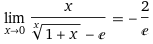
lim_(x->0) x/((1 + x)^(1/x) - e) = -2/e

I tried to use this identity to solve it:
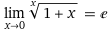
lim_(x->0) (1 + x)^(1/x) = e

Then, the limit will become ##\frac {x}{e-e}##
However, the result is still ##\frac 0 0 ##

Could you please give me hints to solve this problem?
 
Physics news on Phys.org
We are effectively computing derivative at ##t=0## by definition for ## f(x) := (1+x)^{1/x} ##
[tex] \lim _{x\to 0} \frac{f(x)-f(0)}{x} = \lim _{x\to 0} \frac{(1+x)^{1/x} - e}{x}[/tex]
The map ##f## is differentiable since it's a composition of differentiable maps (i.e the above limit exists). Expressions of the form ## \frac{d}{dx}a(x)^{b(x)}## can be tackled with logarithmic differentiation.

Seems like a fancy way of saying "use L'Hopital's rule".
 
nuuskur said:
We are effectively computing derivative at ##t=0## by definition for ## f(x) := (1+x)^{1/x} ##
[tex] \lim _{x\to 0} \frac{f(x)-f(0)}{x} = \lim _{x\to 0} \frac{(1+x)^{1/x} - e}{x}[/tex]
The map ##f## is differentiable since it's a composition of differentiable maps (i.e the above limit exists). Expressions of the form ## \frac{d}{dx}a(x)^{b(x)}## can be tackled with logarithmic differentiation.

Seems like a fancy way of saying "use L'Hopital's rule".
Ok. so, I tried to differentiate the ##(1+x)^{1/x}##, and using the rule, I get:

$$\lim _{x\to 0} \frac{x}{(1+x)^{1/x} - e} = \frac{1}{\frac{x(1+x)^{-1+\frac{1}{x}}\,\,-\,\,(1+x)^{\frac 1 x}\,\,ln(1+x)}{x^2}}$$

Then, all I need to do is to substitute the value of ##x## as zero, right?
The answer is quite strange...The denominator will be ##\frac 0 0##
 
Your denominator is
[tex]\lim_{x \rightarrow 0}(1+x)^{\frac{1}{x}}[\frac{1}{x}(1- \ln (1+x)^{\frac{1}{x}})-\frac{1}{1+x}][/tex]
[tex]=e \lim_{x \rightarrow 0}[\frac{1}{x}(1- \ln (1+x)^{\frac{1}{x}})-1][/tex]
Maclaulin expansion formula of log (1+x) seems helpful for investigation of this limit.
 
Last edited:
anuttarasammyak said:
Maclaulin expansion formula of log (1+x) seems helpful for investigation of this limit.
Ah. I see.. Now I managed to prove it.

There are some things that is bothering me,though..
1. Why my method in post 1 does not work?

2. I tried a different way to transform the term ##ln(1+x)##, but I only get the first term of the maclaurin series.
Here is what I did:
let ##y= ln(1+x)##

Then, we can rewrite this equation as $$e^y=(1+x)$$
Now, since x->0, we can use the identity of euler number
$$e^{\frac y x}= (1+x)^{\frac 1 x} $$
$$e^{\frac y x} = e$$
$$y = ln(1+x) = x $$
As we can see, this result slightly different from the maclaurin's (##x-\frac {x^2}{2}##)
 
1.[tex]\frac{x^2}{x},\frac{x}{x},\frac{x}{x^2}[/tex]
are all 0/0. We need to investigate orders to zero in denominator and numerator to get the limit value. L'Hopital rule is a popular one to do it.
2.[tex]y(x)=\ln (1+x)[/tex]
[tex]y(0)=0[/tex]
[tex]y^{(1)}(x)=\frac{1}{1+x}[/tex]
[tex]y^{(1)}(0)=1[/tex]
[tex]y^{(2)}(x)=-\frac{1}{(1+x)^2}[/tex]
[tex]y^{(2)}(0)=-1[/tex]
Thus we get Taylor series of
[tex]y(x)=\ln (1+x)=x-\frac{x^2}{2}+...[/tex]
 
Last edited:
I would write ##f(x) = \exp (\ln(1+x)/x)##. Then
[tex] f'(x) = (1+x)^{1/x}\left (\frac{1}{x^2+x} - \frac{1}{x^2}\ln (1+x) \right ) \xrightarrow[x\to 0]{} - \frac{e}{2}[/tex]
The right term converges to ##-\frac{1}{2}## so the result follows.

Rikudo said:
Ok. so, I tried to differentiate the ##(1+x)^{1/x}##, and using the rule, I get:

$$
\lim _{x\to 0} \frac{x}{(1+x)^{1/x} - e} = \frac{1}{\frac{x(1+x)^{-1+\frac{1}{x}}\,\,-\,\,(1+x)^{\frac 1 x}\,\,ln(1+x)}{x^2}}
$$

Then, all I need to do is to substitute the value of ##x## as zero, right?
The answer is quite strange...The denominator will be ##\frac 0 0##
Write ##\lim_ {x\to 0}## on the RHS as well (the derivative is incorrect, though). Substitution might work, but doesn't have to. In the event of "##\frac{0}{0}##", apply L'Hopital.
 
Last edited:
nuuskur said:
We are effectively computing derivative at ##t=0## by definition for ## f(x) := (1+x)^{1/x} ##
[tex] \lim _{x\to 0} \frac{f(x)-f(0)}{x} = \lim _{x\to 0} \frac{(1+x)^{1/x} - e}{x}[/tex]
Why can't we just substitute ##(1+x)^{1/x}## as ##e?##

then, this equation will become:
$$\lim _{x\to 0} \frac{f(x)-f(0)}{x} = \lim _{x\to 0} \frac {e- e}{x}$$
Since x is near zero, then we can make it like this:
$$\lim _{x\to 0} \frac{f(x)-f(0)}{x} = \lim _{x\to 0} \frac{0}{x}$$
So, the answer to this limit equation which I have quoted from your reply is ##0##
 
You can assume [itex]|x| < 1[/itex] and expand [itex](1 + x)^{1/x}[/itex] as a binomial expansion:
[tex]\begin{split}<br /> \frac{(1 + x)^{1/x} - e}{x} &= \frac{1}{x}\left( 1 - e + \sum_{n=1}^\infty \frac{x^n}{n!} \prod_{k=0}^{n-1}<br /> \left( \frac 1x - k \right) \right) \\<br /> &= \frac{1}{x} \left(2 - e + \sum_{n=2}^\infty \frac{1}{n!} \prod_{k=1}^{n-1} (1 - kx) \right) \end{split}.[/tex] The only terms you need from [itex]\prod_{k=1}^{n-1} (1 - kx)[/itex] are the O(1) and O(x) terms; everything else will vanish in the limit [itex]x \to 0[/itex].
 
Rikudo said:
Why can't we just substitute ##(1+x)^{1/x}## as ##e?##

then, this equation will become:
$$\lim _{x\to 0} \frac{f(x)-f(0)}{x} = \lim _{x\to 0} \frac {e- e}{x}$$
Since x is near zero, then we can make it like this:
$$\lim _{x\to 0} \frac{f(x)-f(0)}{x} = \lim _{x\to 0} \frac{0}{x}$$
So, the answer to this limit equation which I have quoted from your reply is ##0##
Alright, I'll bite. You claim that the derivative of every differentiable function at ##0## is equal to ##0##. That's obviously false.

You can't just limit the expression piece by piece. It's not valid in general. While it is true that ##\lim _{x\to 0} f(x)-e =0##, the quantity ##\frac{1}{x}## is not bounded as ##x\to 0##. So you can't claim the limit of the whole thing is zero.

Your argument is akin to claiming something like
[tex] \lim _{x\to\infty} \left ( 1+\frac{1}{x} \right )^x = \lim _{x\to\infty} 1^x = 1 .. \quad\text{(this is false!)}[/tex]
it doesn't work like that.
 
Rikudo said:
Why can't we just substitute ##(1+x)^{1/x}## as ##e?##
Because they're not equal. The limit of the first expression, as x approaches zero, is the number e.
nuuskur said:
Your argument is akin to claiming something like $$\lim _{x\to\infty} \left ( 1+\frac{1}{x} \right )^x = \lim _{x\to\infty} 1^x = 1 .. \quad\text{(this is false!)}$$
What he said.
The limit above is another indeterminate form; namely ##[1^\infty]##. It's indeterminate because limits of this form can have arbitrary values.