Proving time constant formulas of a capacitor using Kirchoff's laws

Click For Summary
SUMMARY

This discussion focuses on proving the time constant formulas for a capacitor using Kirchhoff's laws. The key equations are (7) t_c=(R_1 R_2)/(R_1+R_2) C for charging and (8) t_d=R_2 C for discharging. The participants emphasize the importance of correctly interpreting the signs in the equations, particularly when analyzing the direction of current flow through resistors. The derivation of equation (8) requires careful consideration of the voltage source's state, specifically treating it as an open circuit during discharge.

PREREQUISITES
  • Understanding of Kirchhoff's laws
  • Familiarity with capacitor charging and discharging concepts
  • Knowledge of basic calculus for integration
  • Ability to interpret circuit diagrams
NEXT STEPS
  • Study the derivation of the time constant for RC circuits
  • Learn about the implications of open circuit conditions in circuit analysis
  • Explore the mathematical properties of logarithmic functions in relation to charge decay
  • Review common mistakes in sign conventions when applying Kirchhoff's laws
USEFUL FOR

Students and educators in electrical engineering, physics enthusiasts, and anyone seeking to deepen their understanding of capacitor behavior in circuits.

estudent1371
Messages
5
Reaction score
1
Homework Statement
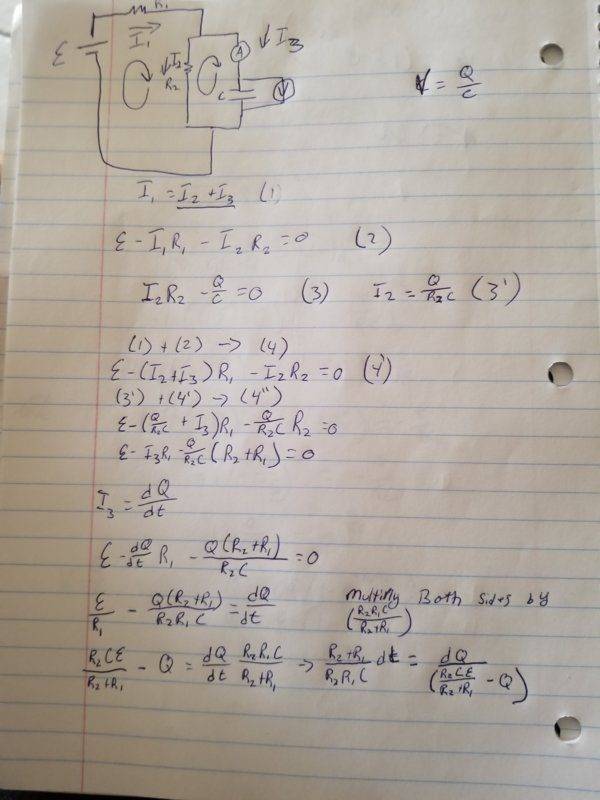
Using R1, R2, ℰ and C along with Kirchhoff’s laws, prove the formulas in equations (7) and (8).
Relevant Equations
time constant charging
(7) t_c=(R_1 R_2)/(R_1+R_2 ) C
time constant discharging
(8) t_d=R_2 C
the attached files are a diagram of the circuit. also I believe I figured out how to proof equation (7) but I'm lost on how to proof (8)
20200412_090506.jpg
20200412_090510.jpg
 

Attachments

Physics news on Phys.org
Welcome to the PF. :smile:
estudent1371 said:
Homework Statement:: Using R1, R2, ℰ and C along with Kirchhoff’s laws, prove the formulas in equations (7) and (8).
Relevant Equations:: time constant charging
(7) t_c=(R_1 R_2)/(R_1+R_2 ) C
time constant discharging
(8) t_d=R_2 C

I'm lost on how to proof (8)
For equation 8, in order for the capacitor to discharge, what has to happen to the voltage source? (Hint: think "open circuit" for the source when it's off in this problem)
 
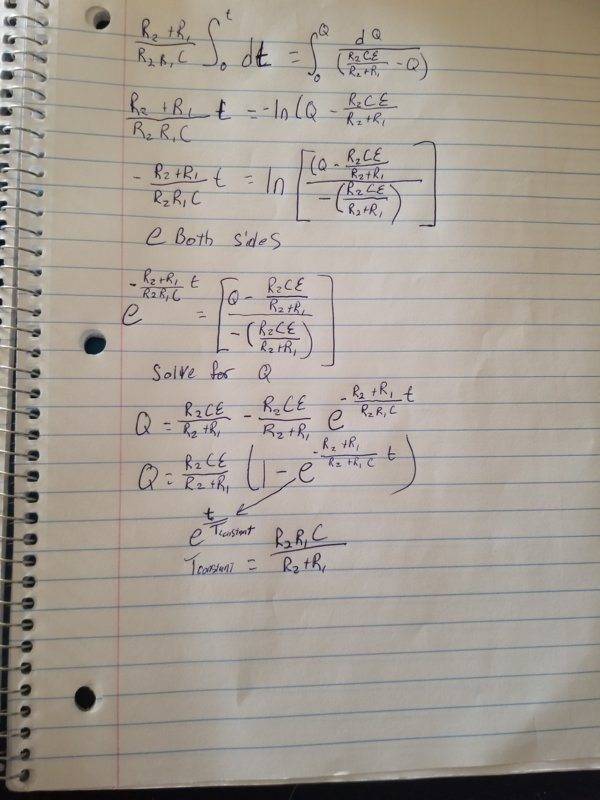
Your derivation of (7) looks good to me. The second line of the second page could be fixed up a bit. It is missing a parenthesis on the right-hand side and the limits of integration are not indicated.
 
thank you for the help so I have made some head way but I feel like i may have made a mistake in my math?
solution.jpg
 
  • Like
Likes nuruddeen
Looks like you were a little sneaky with inserting a negative sign on the left side of the third equation below the crossed-out box. :oldsmile: How can you justify that?

I would go back to the equations at the top of the page and think about signs. Are you still considering I2 to be positive if it flows downward through R2? Are you still considering Q to be the charge on the upper plate of C?
 
TSny said:
Looks like you were a little sneaky with inserting a negative sign on the left side of the third equation below the crossed-out box. :oldsmile: How can you justify that?

I would go back to the equations at the top of the page and think about signs. Are you still considering I2 to be positive if it flows downward through R2? Are you still considering Q to be the charge on the upper plate of C?
I didn't show the step but my integral on the left side is going from charged Q to completely discharged. but I used the integral property to switch them and put a negative in ∫ 0Q=-∫Q0. However, I do see your point in that the current of the mini loop would flow in the opposite direction.
 
Your equation ##\frac{dQ}{Q} = \frac{dt}{R_2C}## should actually be ##\frac{dQ}{Q} = -\frac{dt}{R_2C}##. Without the negative sign, the equation would yield a solution in which ##Q## grows exponentially with time rather than decays.

Integrating ##\frac{dQ}{Q} = -\frac{dt}{R_2C}## gives $$\int_{Q_0}^{Q(t)} \frac{dQ}{Q} = -\int_0^t\frac{dt}{R_2C}$$

At time ##t = 0##, the charge on the capacitor is ##Q_0##. At the later time ##t##, the charge is ##Q(t)##.

Note that your integral ##-\int_{0}^{Q} \frac{dQ}{Q}## leads to trouble with the lower limit of ##0## since ##\ln{0}## is undefined. This is related to the fact that it takes an infinite amount of time for the charge to decay to zero.
 

Similar threads

Replies
6
Views
614
  • · Replies 11 ·
Replies
11
Views
2K
Replies
9
Views
2K
  • · Replies 9 ·
Replies
9
Views
4K
Replies
4
Views
2K
  • · Replies 4 ·
Replies
4
Views
2K
  • · Replies 6 ·
Replies
6
Views
3K
  • · Replies 3 ·
Replies
3
Views
3K
  • · Replies 10 ·
Replies
10
Views
2K
  • · Replies 2 ·
Replies
2
Views
2K