Pump has a suction lift of more than 10.3 m

  • Thread starter Thread starter suryanarayan
  • Start date Start date
  • Tags Tags
    Lift Pump Suction
Click For Summary

Discussion Overview

The discussion revolves around the operational limits of a centrifugal pump, particularly focusing on the suction lift and the implications of atmospheric pressure on water column height. Participants explore the mechanics of fluid movement, the role of check valves, and the phenomenon of cavitation in the context of pump operation.

Discussion Character

  • Technical explanation
  • Debate/contested
  • Conceptual clarification

Main Points Raised

  • Some participants assert that a fluid cannot be pulled and must be pushed, emphasizing that atmospheric pressure can only support a water column of about 10.3 m.
  • Others argue that while a fluid cannot be pulled indefinitely, it can be drawn up to a certain height (e.g., 1 m) before issues arise, such as cavitation.
  • One participant suggests that when the pump is activated, a partial vacuum is created at the eye of the impeller, which could lead to a flow discontinuity if the weight of the water column exceeds atmospheric pressure.
  • Another participant counters that the check valve will remain closed if the suction leg is full, indicating that the water will not drain to the tank as suggested.
  • Concerns are raised about the practical challenges of priming a centrifugal pump, particularly in achieving suction lift even at low heights.
  • Clarifications are made regarding the use of absolute pressure versus negative pressure in discussing suction, with some noting that colloquial terms may not accurately reflect physical realities.

Areas of Agreement / Disagreement

Participants express differing views on the mechanics of pump operation, particularly regarding the behavior of water in the suction line and the role of atmospheric pressure. There is no consensus on the implications of these factors for pump performance.

Contextual Notes

Limitations include assumptions about the conditions under which the pump operates, the definitions of pressure used in the discussion, and the practical challenges of achieving suction lift in real-world applications.

suryanarayan
Messages
20
Reaction score
0
As I was going through a course on Hydraulics, there was a brief explanation about how the atmospheric pressure can only support a water column of 10.3 m.A few more points that are prerequisite to the discussion are as follows

1)A fluid cannot be pulled;it has to be pushed.
2)A centrifugal pump's impeller ,on rotation,throws fluid away from the eye(due to the centrifugal force) and creates a partial vacuum at the eye.

So ,consider the following situation given in the figure
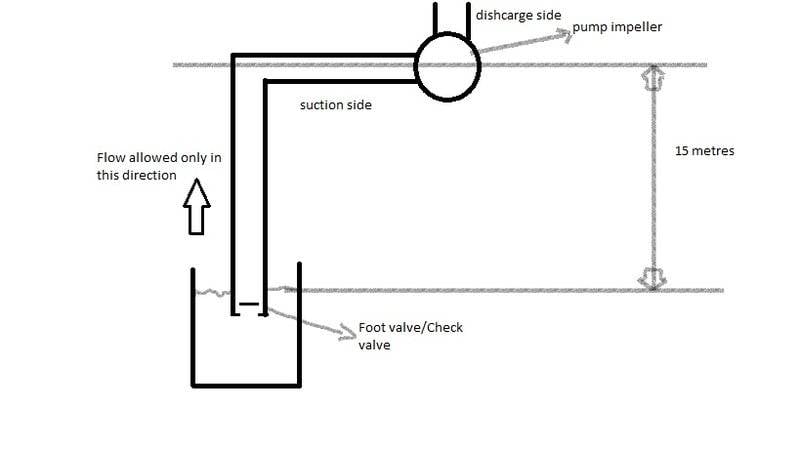
Untitled.jpg

The experiment is conducted in normal atmospheric conditions
1)We fill the suction side and the discharge with water completely.This is possible because the check valve prevents the fluid from escaping.Now the impeller is completely immersed in water.
2)The pump is started runs at a very high rpm.

What is going to happen in the situation?

My thoughts are as follows:
The impeller throws the fluid to the discharge ,partial vacuum is created at eye,the check valve opens and since the weight of the water column is higher than what the atmospheric pressure can hold,the water drains to the tank.This creates a flow discontinuity in the suction side.

Will that be the case or will something else happen?
 

Attachments

  • Untitled.jpg
    Untitled.jpg
    16.7 KB · Views: 6,380
Engineering news on Phys.org
Hi,
suryanarayan said:
the check valve opens and since the weight of the water column is higher than what the atmospheric pressure can hold,the water drains to the tank
that valve opens only if the pressure outside is higher than inside. That never happens: the pump can't go further than 'zero pressure' at the inlet of the pump.
 
suryanarayan said:
What is going to happen in the situation?

My thoughts are as follows:
The impeller throws the fluid to the discharge ,partial vacuum is created at eye,the check valve opens and since the weight of the water column is higher than what the atmospheric pressure can hold,the water drains to the tank.This creates a flow discontinuity in the suction side.

Will that be the case or will something else happen?
The purpose of the check valve is to prevent flow down the pipe and your answer as the water flows down the pipe?

What I see happening here is essentially nothing: when you turn on the pump, the water expands a little until the pump starts cavitating.
 
suryanarayan said:
...since the weight of the water column is higher than what the atmospheric pressure can hold...
Since this the foot valve will remain closed. In this setup if the suction leg is full then there is no way that valve will ever open.
 
suryanarayan said:
1)A fluid cannot be pulled;it has to be pushed.

I think you misunderstand. It can be pulled a little, but if water is pulled more than about 10m it begins to boil and turn into a gas. That causes what @russ_watters mentioned, as "pump cavitation" But you can use a pump to suck water up 1m, no problem.
 
anorlunda said:
I think you misunderstand. It can be pulled a little, but if water is pulled more than about 10m it begins to boil and turn into a gas. That causes what @russ_watters mentioned, as "pump cavitation" But you can use a pump to suck water up 1m, no problem.
Quick clarification; from a practical standpoint we often consider the suction pressure to be negative, but for this problem it probably helps to use absolute pressure, which can only be positive (save for the tiny effect of intermollecular forces). Either is fine as long as the OP understands that "pull" is more a colloquialism than a physical reality.
 
  • Like
Likes   Reactions: sandy stone
If the centrifugal pump here is designed for water only then it is unlikely the level of water in the suction pipe will rise even a meter. Try getting a centrifugal pump to prime in this manner even with only a meter of lift. It is all but impossible. Once the pump is primed things are different and it will work.
 

Similar threads

Replies
2
Views
2K
Replies
4
Views
2K
  • · Replies 10 ·
Replies
10
Views
6K
Replies
9
Views
8K
  • · Replies 7 ·
Replies
7
Views
7K
Replies
18
Views
9K
  • · Replies 43 ·
2
Replies
43
Views
14K
  • · Replies 5 ·
Replies
5
Views
3K
  • · Replies 3 ·
Replies
3
Views
2K
  • · Replies 13 ·
Replies
13
Views
6K