Pumping Lemma proof for L=0^p 1^p 0^p 1^p-: Review my proof please-:

  • Context: MHB 
  • Thread starter Thread starter shivajikobardan
  • Start date Start date
  • Tags Tags
    Proof Review
Click For Summary
SUMMARY

The forum discussion centers on the proof of the Pumping Lemma for the language L = 0^p 1^p 0^p 1^p. The original proof is critiqued for ambiguities and violations of the lemma's conditions, particularly in cases where the segments of the string are defined. Specific issues include the handling of cases where v = 0^p and y = ε, as well as the clarity of case descriptions. The discussion emphasizes the need for a more structured and detailed proof, including explicit definitions and clear case analysis.

PREREQUISITES
  • Understanding of the Pumping Lemma for regular languages
  • Familiarity with formal language theory and context-free grammars
  • Knowledge of string manipulation and decomposition in proofs
  • Ability to analyze and critique mathematical proofs
NEXT STEPS
  • Review the formal definition of the Pumping Lemma for regular languages
  • Study examples of proofs involving the Pumping Lemma
  • Learn about common pitfalls in proof writing and mathematical clarity
  • Explore case analysis techniques in formal proofs
USEFUL FOR

Students of theoretical computer science, mathematicians focusing on formal languages, and anyone involved in writing or analyzing mathematical proofs will benefit from this discussion.

shivajikobardan
Messages
637
Reaction score
54
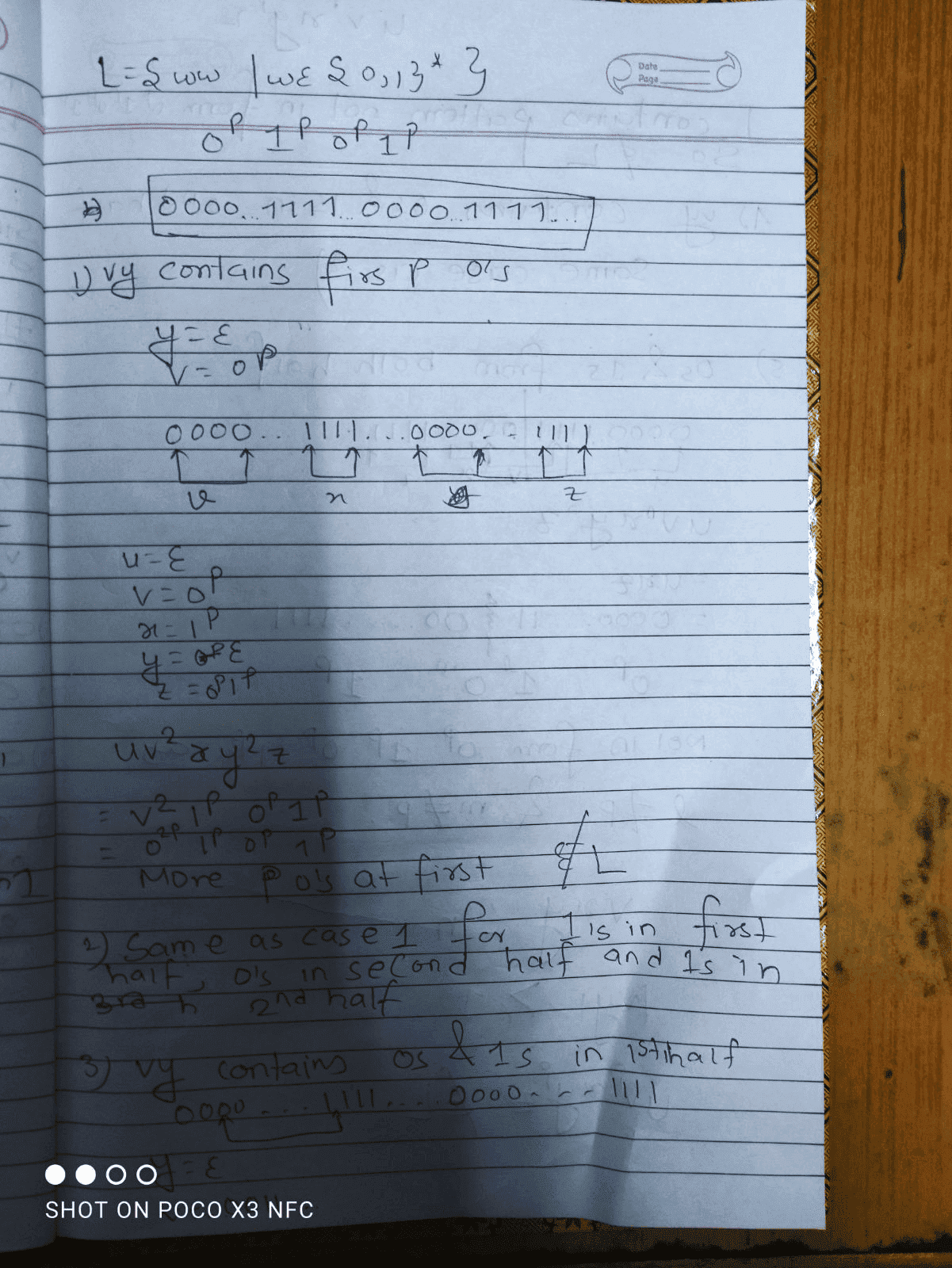
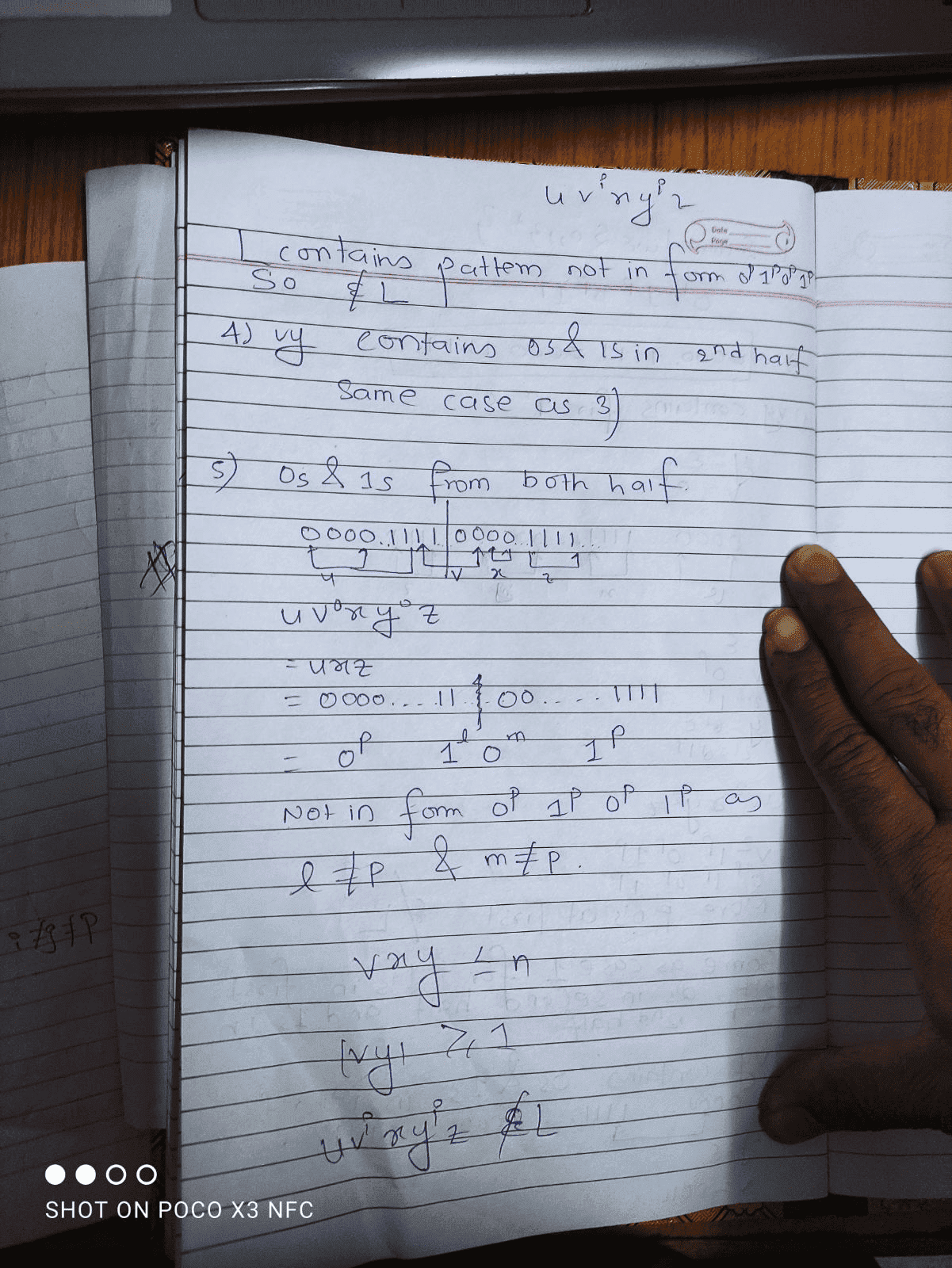
Please review my proof. Is this correct or not?
1636814677938.png


1636815724413.png
1636815703046.png
 
Technology news on Phys.org
Why do you consider case 1) where $v=0^p$, $x=1^p$ and $y=\varepsilon$? It is prohibited by condition (2) of the lemma.

In case 3) you write: "$L$ contains pattern not in form $0^p1^p0^p1^p$". This is true: $L$ contains words that do not have this form and do not even have the form $0^n1^n0^n1^n$ for any $n$. What conclusion do you draw from this? Then you write: "So $\notin L$. What exactly does not belong to $L$? It's a bad style to write such ambiguous claims in a proof. Finally, case 3) assumes that $y=\varepsilon$. What if this is not so?

The description of case 5) is not clear (does $y$ have to be empty? does $x$ has to end on the boundary between zeros and ones?), but it seems that it is again prohibited by condition 2 of the lemma.

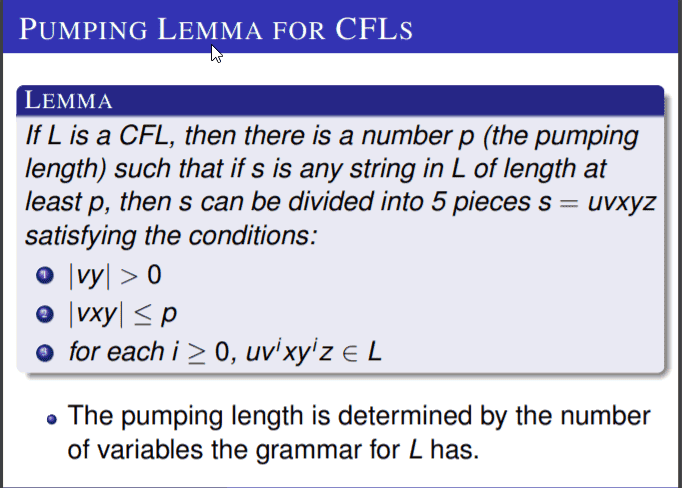
A proof should contain more words. For example, this proof should start like this: "Let $p$ be the number whose existence is stated in the lemma. Let $w=0^p1^p0^p1^p$. Consider the following five exhaustive cases".

Please type you proof in the body of the forum post. Pictures can easily be described, for example: "$vxy$ spans the first boundary between 0s and 1s" (the diagram at the bottom of page 1). The bottom of page 1 is far too dark for comfortable reading.
 

Similar threads

Replies
2
Views
2K
  • · Replies 24 ·
Replies
24
Views
4K
  • · Replies 30 ·
2
Replies
30
Views
3K
  • · Replies 4 ·
Replies
4
Views
1K
Replies
6
Views
3K
  • · Replies 5 ·
Replies
5
Views
2K
Replies
3
Views
1K
  • · Replies 2 ·
Replies
2
Views
3K
  • · Replies 6 ·
Replies
6
Views
5K
  • · Replies 1 ·
Replies
1
Views
2K