-qEx for a vertical spring in a constant Electric field

Click For Summary

Homework Help Overview

The discussion revolves around a massless spring with a spring constant, a charged particle, and its interaction with a constant electric field. The problem involves determining the speed of the particle as it passes through the equilibrium point after being released from rest.

Discussion Character

  • Exploratory, Assumption checking, Mathematical reasoning

Approaches and Questions Raised

  • Participants discuss the placement of the electric potential energy term in the conservation of energy equation and question the sign of the term -qEy. There are attempts to clarify the relationship between the forces acting on the particle and the equilibrium position.

Discussion Status

Some participants have provided guidance on the placement of terms in the conservation equation, while others have raised concerns about the numerical outcomes and the feasibility of the results based on the parameters given. The discussion reflects a mix of confirmations and further inquiries about the calculations involved.

Contextual Notes

There is an indication that the parameters for mass, charge, electric field, and spring constant may need adjustment to yield physically meaningful results. The electric force is noted to be greater than the gravitational force, suggesting a potential upward movement of the particle.

Albertgauss
Gold Member
Messages
297
Reaction score
37
A massless spring of spring constant k = 13 Newtons per meter hangs purely vertically. A 20 Newton, 5(10-3) Coulombs charged particle is attached to the spring and released from rest. Besides all this, there is also a constant, external Electric Field of 9000 Newtons per Coulomb pointing upwards. See figure below. After the release point, and assuming the particle only travels downwards and vertical, what is the speed of the particle as it passes through the equilibrium point? See the attached figure called "Figure_for_Problem.jpg"

Homework Equations


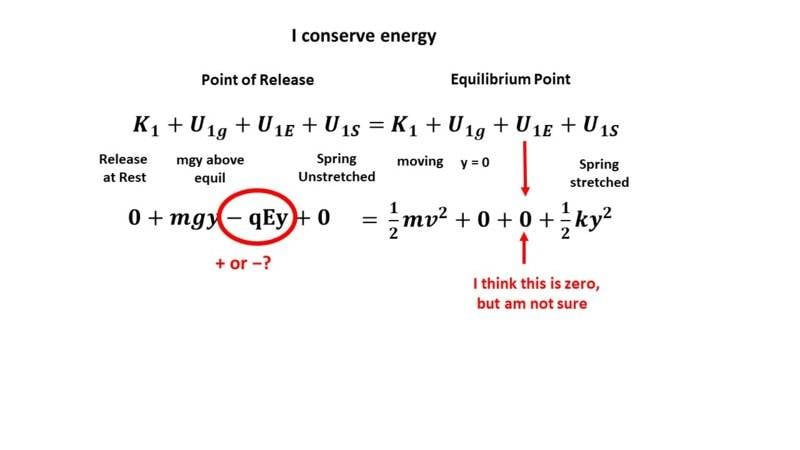
Conservation of energy, except that now we have a -qEx mixed in with the kinetic energy, mgy, and the spring potential energy.

The Attempt at a Solution


I am only having some trouble knowing what the sign on -qEy should be, and/or which side of the conservation of energy this term goes on.

A few thoughts: since the charge is +Q, it has lower (more negative) potential energy at the Release Point. Thus, on the equilibrium side of the equation, I would put y = 0. On the “release” point of the equation, I would write in –qEy, where q is +, E is +, and y is +. Is this correct? I can't get the latex on this website to work on my computer, so I uploaded a jpeg of where I am so I can keep all my symbols and subscripts.
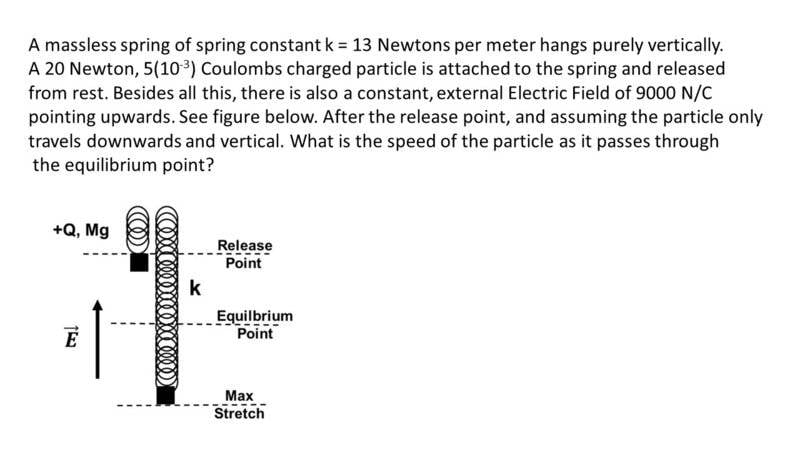
Figure_for_Problem.jpg
MyAttemptedSolution.jpg
 

Attachments

  • Figure_for_Problem.jpg
    Figure_for_Problem.jpg
    39.2 KB · Views: 508
  • MyAttemptedSolution.jpg
    MyAttemptedSolution.jpg
    20.3 KB · Views: 651
Last edited:
Physics news on Phys.org
Albertgauss said:
I would write in –qEy, where q is +, E is +, and y is +. Is this correct?
Looks right to me.
But are you encountering a problem when you try to solve it numerically? If so, consider what the electric force is on the particle.
 
Ok, sounds good to me. I can take it from there. I've already worked through the numbers a few times and this was the only part I was unsure about. Thank you for your help.
 
Albertgauss said:
Ok, sounds good to me. I can take it from there. I've already worked through the numbers a few times and this was the only part I was unsure about. Thank you for your help.
And you didn't notice anything strange? What answer did you get? What was the value of y?
 
The "y" was 1.9 meters. You can find that from the equilibrium position of the particle. You do Newton's Laws, ∑F = ma. That gives +QE -mg +ky = 0

So then y = ( mg - QE ) / k = (20-45)/ 13 = -25/13.

There is also a problem in that, if you keep going with the numbers in the energy conservation of the slide, the velocity turns out to be impossible because you end up, after some algebra, with something like: negative number = v^2. So, the numbers make the problem unable to be solved like this. I realize the parameters for m, Q, E, and k have to be adjusted so that the numbers make sense.

That's okay, though. I did get the help I needed, and that was to check where to place -QEy on the correct side of the conservation equation. This was the main issue I was having. I can fix the numbers later. I certainly appreciate this site's help on this.
 
Albertgauss said:
the parameters for m, Q, E, and k have to be adjusted so that the numbers make sense.
Yes, the electric force is greater then the gravitational force, so it will move up.
 

Similar threads

Replies
3
Views
1K
Replies
5
Views
2K
  • · Replies 5 ·
Replies
5
Views
1K
  • · Replies 3 ·
Replies
3
Views
2K
Replies
1
Views
1K
  • · Replies 10 ·
Replies
10
Views
3K
Replies
29
Views
3K
  • · Replies 31 ·
2
Replies
31
Views
2K
Replies
24
Views
4K
  • · Replies 4 ·
Replies
4
Views
2K