Quadratic discriminant with tricky algebra

  • Thread starter Thread starter sooyong94
  • Start date Start date
  • Tags Tags
    Algebra Quadratic
Click For Summary

Homework Help Overview

The discussion revolves around the quadratic discriminant and its application in solving equations. Participants are exploring the algebraic complexities involved in manipulating the discriminant expression and addressing potential misprints in the equations provided.

Discussion Character

  • Exploratory, Assumption checking, Problem interpretation

Approaches and Questions Raised

  • Participants discuss the expression b^2 - 4ac and its implications, noting difficulties in algebraic manipulation. Some express uncertainty about the correctness of the equations, particularly regarding the presence of a constant d in one equation but not in another. Others mention misprints and seek clarification on the relationships between the variables a, b, c, and d.

Discussion Status

The discussion is ongoing, with participants sharing their attempts and questioning the validity of the equations. Some have identified algebraic errors in their work, while others are still grappling with the implications of the equations and the discriminant. There is a recognition of potential misprints, which may affect the interpretation of the problem.

Contextual Notes

Participants are working under the constraints of homework rules, which may limit the information available for solving the problem. The presence of misprints in the provided equations is a point of contention that affects the discussion.

sooyong94
Messages
173
Reaction score
2

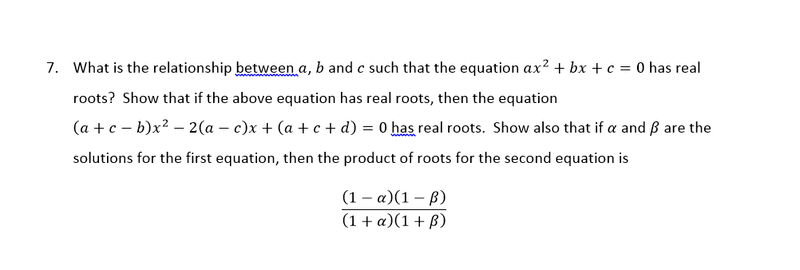
Homework Statement


Capture.png


Homework Equations


Quadratic discriminant

The Attempt at a Solution


I did b^2 -4ac>=0, but the algebra becomes prohibitively difficult.
 
Physics news on Phys.org
sooyong94 said:

Homework Statement


Capture.png


Homework Equations


Quadratic discriminant

The Attempt at a Solution


I did b^2 -4ac>=0, but the algebra becomes prohibitively difficult.

Sometimes there are just no shortcuts, and lengthy algebra cannot be avoided. That being said, I am not sure the result sought is correct; in particular, in your second equation you have a constant ##d## appearing in it, but there is no ##d## in the first equation.
 
I got something like
ab-4ac-ad+bc+bd-cd but I can't seem to work around that.
 
In the second equation there is a misprint
The correct equation is
(a+c-b)x2-2(a-c)x+(a+c+b) = 0
The proof is not difficult. Just find the discriminant.
 
sooyong94 said:
I got something like
ab-4ac-ad+bc+bd-cd but I can't seem to work around that.

What about the issue I raised? There is a ##d## in the second equation, but no ##d## in the first one. The relation between ##a,b,c## arising from the first equation does not involve any ##d## at all.
 
Irene Kaminkowa said:
In the second equation there is a misprint
The correct equation is
(a+c-b)x2-2(a-c)x+(a+c+b) = 0
The proof is not difficult. Just find the discriminant.
Thanks - I guess there's a misprint in my book after all.
 
Strangely enough I got -b^2 -4ac, which isn't right.

Update - I found an algebraic slip in my working.
 
I have managed to work the first part - but I don't have a clue on tackle the second part.

Update - I managed to work this out.
 
Last edited:

Similar threads

Replies
7
Views
2K
  • · Replies 11 ·
Replies
11
Views
3K
  • · Replies 6 ·
Replies
6
Views
3K
  • · Replies 6 ·
Replies
6
Views
2K
  • · Replies 6 ·
Replies
6
Views
2K
Replies
16
Views
3K
  • · Replies 19 ·
Replies
19
Views
2K
  • · Replies 2 ·
Replies
2
Views
2K
Replies
3
Views
2K
  • · Replies 5 ·
Replies
5
Views
2K