Quadratic discriminant with tricky algebra

7 replies · 3K views · last reply
sooyong94
Messages
173
Reaction score
2

Homework Statement


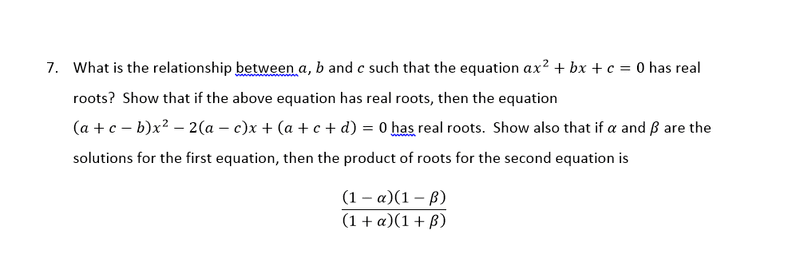
Printed homework problem 7: asks the relationship between a, b and c so that ax^2 + bx + c = 0 has real roots, then to show a related quadratic (a+c-b)x^2 - 2(a-c)x + (a+c+d) = 0 has real roots, and that the product of roots of the second equation is (1-α)(1-β)/((1+α)(1+β)).


Homework Equations


Quadratic discriminant

The Attempt at a Solution


I did b^2 -4ac>=0, but the algebra becomes prohibitively difficult.
 
sooyong94 said:

Homework Statement


Printed homework problem 7: asks the relationship between a, b and c so that ax^2 + bx + c = 0 has real roots, then to show the second quadratic (a + c - b)x^2 - 2(a - c)x + (a + c + d) = 0 has real roots, and that the product of roots equals (1 - alpha)(1 - beta) over (1 + alpha)(1 + beta).


Homework Equations


Quadratic discriminant

The Attempt at a Solution


I did b^2 -4ac>=0, but the algebra becomes prohibitively difficult.

Sometimes there are just no shortcuts, and lengthy algebra cannot be avoided. That being said, I am not sure the result sought is correct; in particular, in your second equation you have a constant ##d## appearing in it, but there is no ##d## in the first equation.
 
I got something like
ab-4ac-ad+bc+bd-cd but I can't seem to work around that.
 
In the second equation there is a misprint
The correct equation is
(a+c-b)x2-2(a-c)x+(a+c+b) = 0
The proof is not difficult. Just find the discriminant.
 
sooyong94 said:
I got something like
ab-4ac-ad+bc+bd-cd but I can't seem to work around that.

What about the issue I raised? There is a ##d## in the second equation, but no ##d## in the first one. The relation between ##a,b,c## arising from the first equation does not involve any ##d## at all.
 
Irene Kaminkowa said:
In the second equation there is a misprint
The correct equation is
(a+c-b)x2-2(a-c)x+(a+c+b) = 0
The proof is not difficult. Just find the discriminant.
Thanks - I guess there's a misprint in my book after all.
 
Strangely enough I got -b^2 -4ac, which isn't right.

Update - I found an algebraic slip in my working.
 
I have managed to work the first part - but I don't have a clue on tackle the second part.

Update - I managed to work this out.
 
Last edited: