Quadratic equation with roots of opposite signs

Click For Summary
SUMMARY

The quadratic equation given by ##2x^2-(a^3+8a-1)x+a^2-4a = 0## requires the determination of the values of ##a## for which the roots are of opposite signs. The necessary condition for this is that the product of the roots, represented as ##\alpha \beta = \frac{a^2-4a}{2}##, must be negative. The analysis concludes that the valid range for ##a## is ##a \in (0;4)##, aligning with the book's answer.

PREREQUISITES
  • Understanding of quadratic equations and their properties
  • Familiarity with the concepts of roots and their relationships
  • Knowledge of the quadratic formula and its application
  • Ability to analyze inequalities and their implications
NEXT STEPS
  • Study the properties of quadratic equations, focusing on root behavior
  • Learn about the implications of the discriminant in determining root types
  • Explore the relationship between coefficients and roots in polynomial equations
  • Investigate the graphical representation of quadratic functions and their roots
USEFUL FOR

Mathematicians, students studying algebra, educators teaching quadratic equations, and anyone interested in the properties of polynomial roots.

brotherbobby
Messages
756
Reaction score
170
Homework Statement
At what values of ##a## does the equation ##2x^2-(a^3+8a-1)x+a^2-4a = 0## possess roots of opposite signs?
Relevant Equations
For a quadratic equation ##ax^2+bx+c=0## having roots ##\alpha,\beta##, the sum of the roots ##\alpha+\beta = -\frac{b}{a}## and product of the roots ##\alpha\beta = \frac{c}{a}##.
Given : The equation ##2x^2-(a^3+8a-1)x+a^2-4a = 0## with roots of opposite signs.

Required : What is the value of ##a## ?

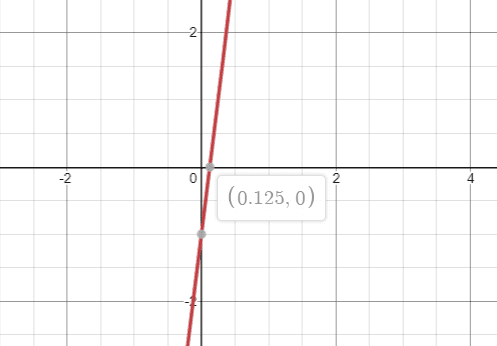
Attempt : The roots of the equation must be of the form ##\alpha, -\alpha##. The sum of the roots ##0 = a^3+8a-1##.

I do not know how to solve this equation.
1611072811658.png
However, on plotting the graph of this function [##f(x) = x^3+8x-1##], I find that ##a = 0.125##.

However, this is not the answer in the book.

Answer : ##a \in (0;4)## (from book)

Any help would be welcome.
 
Physics news on Phys.org
brotherbobby said:
What is the value of a ?
It asks for a range, not a value!
brotherbobby said:
The roots of the equation must be of the form ##\alpha, -\alpha## The sum of the roots ##0=a^3+8a−1##.
You make that up ! Nowhere is said that the absolute values should be equal !

What is a sufficient condition that two real numbers ##\alpha, \beta ## are of opposite sign ?
 
  • Like
Likes   Reactions: docnet and Delta2
You should look for values of ##a## such that the product of the roots becomes negative.
 
  • Like
Likes   Reactions: docnet
brotherbobby said:
Homework Statement:: At what values of ##a## does the equation ##2x^2-(a^3+8a-1)x+a^2-4a = 0## possesses roots of opposite signs?
Relevant Equations:: For a quadratic equation ##ax^2+bx+c=0## having roots ##\alpha,\beta##, the sum of the roots ##\alpha+\beta = -\frac{b}{a}## and product of the roots ##\alpha\beta = \frac{c}{a}##.
You have ##a## already in the original equation, so you shouldn't really use ##a## for the first coefficient here as well. You can and should simply write ##2x^2 + bx + c## here.

Hint: perhaps focus on ##c## and the quadratic forumula.
 
Last edited:
  • Like
Likes   Reactions: docnet
brotherbobby said:
Given : The equation ##2x^2-(a^3+8a-1)x+a^2-4a = 0## with roots of opposite signs.

Required : What is the value of ##a## ?

Written in standard form the quadratic equation becomes

##x^2-\frac{(a^3+8a-1)}{2}x+\frac{a^2-4a}{2}=0##

The rule is, if the constant term is ##<0## then the roots have opposite signs.

So for which values of a does the constant term ##\frac{a^2-4a}{2}<0##?
 
  • Like
Likes   Reactions: Delta2
BvU said:
What is a sufficient condition that two real numbers α,β are of opposite sign ?

That their product is negative?
 
  • Like
Likes   Reactions: BvU
docnet said:
Written in standard form the quadratic equation becomes

##x^2-\frac{(a^3+8a-1)}{2}x+\frac{a^2-4a}{2}=0##

The rule is, if the constant term is ##<0## then the roots have opposite signs.

So for which values of a does the constant term ##\frac{a^2-4a}{2}<0##?

Thank you for your help. I have got it. Let me do the problem still for completeness' sake.

We have the equation ##2x^2-(a^3+8a-1)x+a^2-4a = 0## possessing roots of opposite signs.

We are asked for what values of ##a## will they do so?

Let the roots be ##\alpha, \beta##. They are of opposite signs, hence ##\alpha \beta = -\text{ve}##.

Original equation can be simplified to : ##x^2 - \frac{a^3+8a-1}{2}x + \frac{a^2-4a}{2} = 0##.

Product of the roots ##\alpha \beta = \frac{a^2-4a}{2} = -\text{ve}##.

Thus we have to find the value of ##a## for which ##a^2-4a = -\text{ve}## (since 2 times a negative number is negative.)

Continuing from above : ##a(a-4) = -\text{ve} \Rightarrow 0\le a \le 4\Rightarrow \boxed{a \in (0;4)}##, matching the answer from the book.

Thank you all very much.
 
  • Like
Likes   Reactions: docnet and PeroK

Similar threads

  • · Replies 2 ·
Replies
2
Views
2K
  • · Replies 20 ·
Replies
20
Views
3K
  • · Replies 12 ·
Replies
12
Views
3K
  • · Replies 22 ·
Replies
22
Views
3K
Replies
1
Views
2K
Replies
7
Views
2K
Replies
6
Views
2K
Replies
3
Views
2K
  • · Replies 6 ·
Replies
6
Views
2K
  • · Replies 14 ·
Replies
14
Views
2K