Quadratic Polynomials and Irreducibles and Primes ....

Click For Summary
SUMMARY

The discussion revolves around the proof of Theorem 1.2.2 from "Introductory Algebraic Number Theory" by Saban Alaca and Kenneth S. Williams, specifically addressing the factorization of quadratic polynomials in integral domains. The theorem asserts that if a polynomial \( f(X) \) can be expressed as \( f(X) = (cX + s)(dX + t) \) in \( D[X] \), then certain conditions must hold regarding the roots and coefficients. The participants clarify that the contradiction arises when \( d^{-1}t \) is shown to belong to \( D \) while simultaneously not belonging to \( D \), leading to the conclusion that \( f(X) \) cannot factor into linear factors in \( D[X] \).

PREREQUISITES
  • Understanding of integral domains and polynomial factorization
  • Familiarity with quadratic polynomials and their properties
  • Knowledge of fields and units in algebraic structures
  • Ability to interpret mathematical proofs and theorems
NEXT STEPS
  • Study the properties of integral domains and their implications on polynomial factorization
  • Learn about the concept of irreducibility in algebraic structures
  • Explore the relationship between fields and their corresponding polynomial rings
  • Investigate the implications of Theorem 1.2.2 in various algebraic contexts
USEFUL FOR

Mathematicians, algebra students, and educators interested in algebraic number theory, particularly those focusing on polynomial factorization and properties of integral domains.

Math Amateur
Gold Member
MHB
Messages
3,920
Reaction score
48
I am reading "Introductory Algebraic Number Theory"by Saban Alaca and Kenneth S. Williams ... and am currently focused on Chapter 1: Integral Domains ...

I need some help with the proof of Theorem 1.2.2 ...

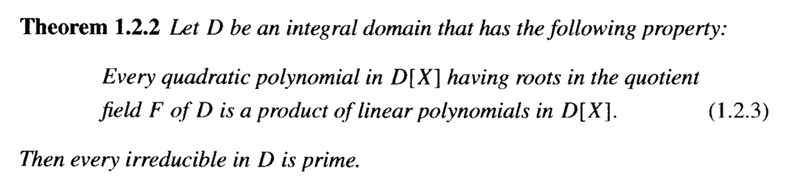
Theorem 1.2.2 reads as follows:
?temp_hash=bf44d3fe3806f5b5360d520962884fa0.png

?temp_hash=bf44d3fe3806f5b5360d520962884fa0.png

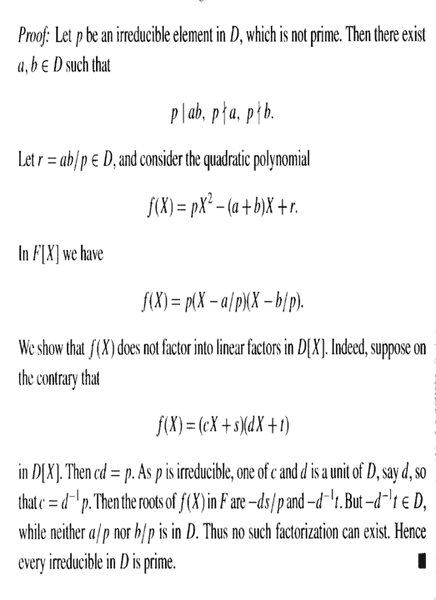
In the above text from Alaca and Williams, we read the following:

"... ... Then the roots of ##f(X)## in ##F## are ##-ds/p## and ##-d^{-1} t ##. But ##d^{-1} t \in D## while neither ##a/p## nor ##b/p## is in ##D##. Thus no such factorization exists. ...I am unsure of how this argument leads to the conclusion that ##f(X)## does not factor into linear factors in ##D[X]## ... ... in other words how does the argument that " ... ##d^{-1} t \in D## while neither ##a/p## nor ##b/p## is in ##D## ... " lead to the conclusion that no such factorization exists. ...

Indeed ... in particular ... how does the statement "neither ##a/p## nor ## b/p## is in ##D##" have meaning in the assumed factorization ##f(X) = (cX + s) ( dX + t )## ... ... ? ... What is the exact point being made about the assumed factorization ... ?
I am also a little unsure of what is going on when Alaca and Williams change or swap between ##D[X]## and ##F[X]## ...Can someone help with an explanation ...

Help will be appreciated ...

Peter
 

Attachments

  • A&W _ Theorem 1.2.2.png
    A&W _ Theorem 1.2.2.png
    15.2 KB · Views: 594
  • A&W - 2 - _ Theorem 1.2.2.png
    A&W - 2 - _ Theorem 1.2.2.png
    20.3 KB · Views: 604
Last edited:
Physics news on Phys.org
We have ##0=f(-d^{-1}t)=p(-d^{-1}t-a/p)(-d^{-1}t-b/p)## in the field ##F##. What does this mean for the factors?
 
  • Like
Likes   Reactions: Math Amateur
fresh_42 said:
We have ##0=f(-d^{-1}t)=p(-d^{-1}t-a/p)(-d^{-1}t-b/p)## in the field ##F##. What does this mean for the factors?
Hi fresh_42...

It seems that if we consider the polynomial ##f(X) = fp (X - a/p) (X - b/p)## in ##F[X]##

then we must have that ##d^{-1} t = a/p## or ##d^{-1} t = b/p## in the field ##F## ...

But these cannot be solutions in ##D## ...

But how do I relate this to the factorization ##f(X) = (cX + s) ( dX + t )## in ##D[X]## ... ... ?

PeterEDIT ... oh ... the ##d^{-1} t## comes from ##f(X) = (cX + s) ( dX + t )## ! Maybe what I have said then means there is no factorization of the form ##f(X) = (cX + s) ( dX + t )## .
 
Last edited:
##f(x)=p(x-\frac{a}{p})(x-\frac{b}{p}) \in F[x]## is simply set. It's a polynomial that is chosen on purpose. Since the condition (1.2.3) applies to all quadratic polynomials in ##D[x]##, it also applies to ##f(x)=px^2-(a+b)x+\frac{ab}{p} \in D[x]##. ##f(x)## is in ##D[x]## because ##p,a,b,r=\frac{ab}{p}## are all in ##D##.

The factorization ##f(x)=(cx+s)(dx+t)## in ##D[x]## is the assumption we want to show cannot hold. It leads to ##d^{-1}t \in D \;\wedge \; d^{-1}t \notin D## which is obviously false. Thus ##f(x)## doesn't split over ##D##. But according to condition (1.2.3) it has to split over ##D##. Therefore ##f(x)## cannot be in ##D[x]##. But the only way, that ##f(x) \notin D[x]## is by ##r \notin D##. But then ##p \nmid (ab)##, which means ##p## isn't irreducible and non-prime. Since ##p## is chosen irreducible, it has to conflict the other property, being non-prime, which was our first assumption. But non-non-prime means ##p## is prime, what had to be shown.

There's a lot of rollback in this proof. If it were a source code, I would insist on at least a three-level indent:
1. ##p## is not prime.
##\Longrightarrow r \in D##
2. ##f(x)## splits over ##D##
##\Longrightarrow \textrm{ w.l.o.g. } d^{-1}t \in D##
3. w.l.o.g. ##a/p \in D##
contradiction​
##\Longrightarrow d^{-1}t \notin D##
##\Longrightarrow f(x)## doesn't split over ##D## // <-1 indent>
##\Longrightarrow r \notin D## // <-2 indent>
##\Longrightarrow p## not not prime // <-3 indent>
##\Longrightarrow p## prime // <-3 indent>
 
Last edited:
  • Like
Likes   Reactions: Math Amateur
fresh_42 said:
##f(x)=p(x-\frac{a}{p})(x-\frac{b}{p}) \in F[x]## is simply set. It's a polynomial that is chosen on purpose. Since the condition (1.2.3) applies to all quadratic polynomials in ##D[x]##, it also applies to ##f(x)=px^2-(a+b)x+\frac{ab}{p} \in D[x]##. ##f(x)## is in ##D[x]## because ##p,a,b,r=\frac{ab}{p}## are all in ##D##.

The factorization ##f(x)=(cx+s)(dx+t)## in ##D[x]## is the assumption we want to show cannot hold. It leads to ##d^{-1}t \in D \;\wedge \; d^{-1}t \notin D## which is obviously false. Thus ##f(x)## doesn't split over ##D##. But according to condition (1.2.3) it has to split over ##D##. Therefore ##f(x)## cannot be in ##D[x]##. But the only way, that ##f(x) \notin D[x]## is by ##r \notin D##. But then ##p \nmid (ab)##, which means ##p## isn't irreducible and non-prime. Since ##p## is chosen irreducible, it has to conflict the other property, being non-prime, which was our first assumption. But non-non-prime means ##p## is prime, what had to be shown.

There's a lot of rollback in this proof. If it were a source code, I would insist on at least a three-level indent:
1. ##p## is not prime.
##\Longrightarrow r \in D##
2. ##f(x)## splits over ##D##
##\Longrightarrow \textrm{ w.l.o.g. } d^{-1}t \in D##
3. w.l.o.g. ##a/p \in D##
contradiction​
##\Longrightarrow d^{-1}t \notin D##
##\Longrightarrow f(x)## doesn't split over ##D## // <-1 indent>
##\Longrightarrow r \notin D## // <-2 indent>
##\Longrightarrow p## not not prime // <-3 indent>
##\Longrightarrow p## prime // <-3 indent>
Thanks fresh_42 ... really appreciate your help ...

... BUT ... just a clarification ...You write:"... ... It leads to ##d^{-1}t \in D \;\wedge \; d^{-1}t \notin D## ... ... "I can see that ##d^{-1}t \in D## ... ... since ##d## is a unit of ##D## we have ##d^{-1} \in D## and also we have ##t \in D## ... so ##d^{-1}t \in D## ...But in what way do we show that ##d^{-1}t \notin D## ... ... ? How do you argue that ##a/p \in D## ... ? Don't Alaca and Williams only argue that ##a/p \in F##?

Can you help ...

Peter
 
Last edited:
fresh_42 said:
We have ##0=f(-d^{-1}t)=p(-d^{-1}t-a/p)(-d^{-1}t-b/p)## in the field ##F##.
So one factor has to be zero. Since ##p\neq 0##, w.l.o.g. (the argument in the other case is the same) ##d^{-1}t = -\frac{a}{p} \notin D## because ##p\nmid a## in ##D##.
 
  • Like
Likes   Reactions: Math Amateur

Similar threads

  • · Replies 2 ·
Replies
2
Views
2K
  • · Replies 6 ·
Replies
6
Views
2K
  • · Replies 2 ·
Replies
2
Views
2K
  • · Replies 6 ·
Replies
6
Views
1K
  • · Replies 5 ·
Replies
5
Views
2K
  • · Replies 0 ·
Replies
0
Views
2K
Replies
48
Views
5K
  • · Replies 1 ·
Replies
1
Views
2K
  • · Replies 7 ·
Replies
7
Views
2K
  • · Replies 1 ·
Replies
1
Views
4K