Quantum Chemistry - Particle in a box

2 replies · 3K views · last reply
Amblambert
Messages
1
Reaction score
1
Homework Statement
For the particle in a box, sketch ψn(x) and ψn2(x) for n = 5. Is ψn(x) an eigenfunction of the momentum operator?

If the state of the system is ψn, what is the probability of finding the particle in the
left quarter of the box between 0 and L/4? What happens when n is large?
Relevant Equations
ψn = sqrt(2/l) sin (npix/l)
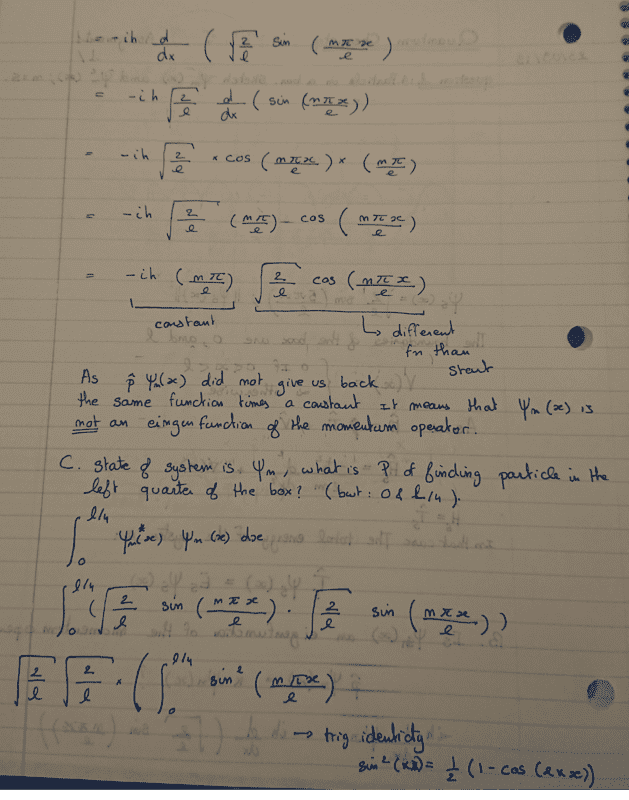
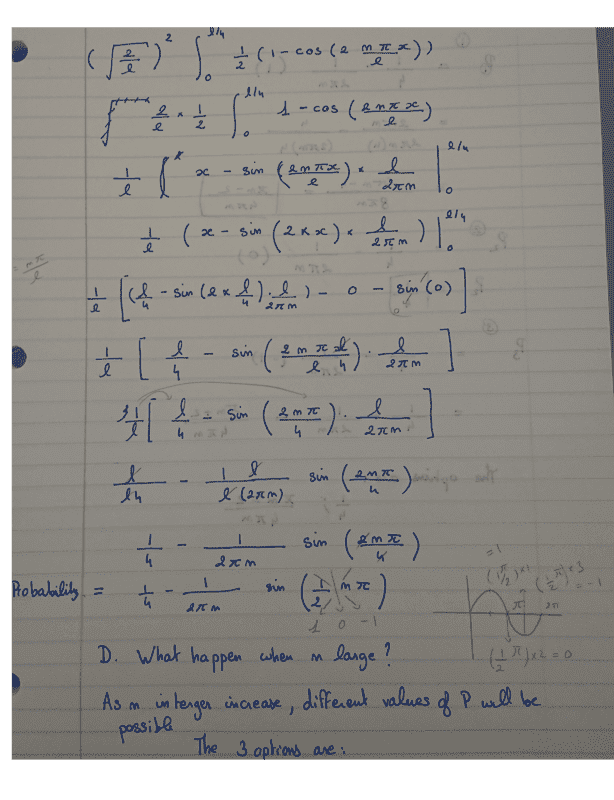
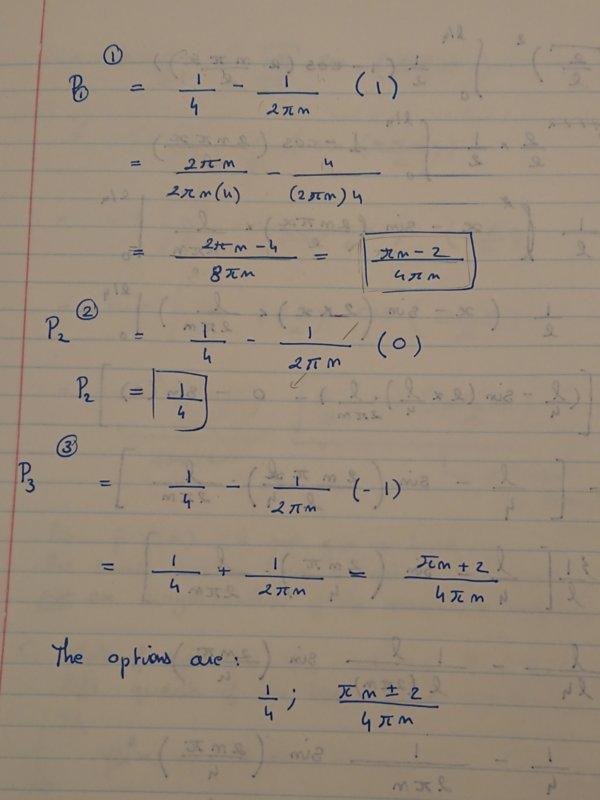
Here is my attempt at a solution. The thing I am not sure about is the final result of the Shrodinger equation and the n-values that are offered?

Did I make a math mistake?

Thank you so much for reading through this!
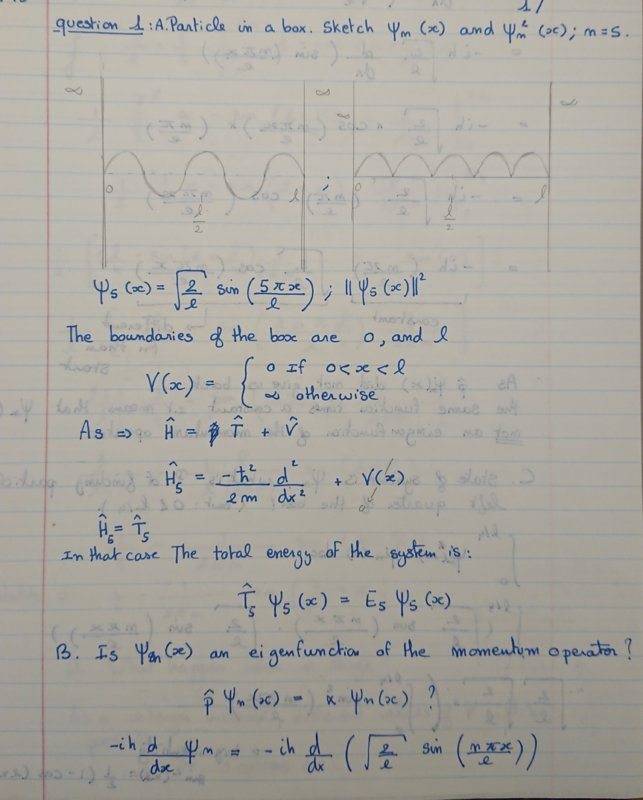
Handwritten notes on lined paper for a particle-in-a-box problem: sketches of the wavefunctions psi_m(x) and |psi_m(x)|^2 for n=5 between walls at 0 and l, the potential V(x) defined piecewise, and the Hamiltonian and momentum operator equations.
Handwritten working on lined notebook paper: momentum operator applied to sqrt(2/l) sin(n pi x / l), then the integral from 0 to l/4 of the conjugate wavefunction times the wavefunction, with a trig identity sin^2(x) = (1 - cos 2x)/2 noted.
Handwritten derivation on lined paper of the integral of (2/l) times sin squared over the interval 0 to l/4, reduced step by step to a probability expression 1/4 minus sin(m pi/2)/(2 pi m), with a small sine-curve sketch and notes D. What happens when n is large.
Handwritten working on lined paper for a particle-in-a-box probability calculation, with numbered steps P1, P2, P3 showing fractions with pi and m, boxed results, and a final line listing the options as 1/4 and (pi m plus or minus 2)/(4 pi m).
 
Apply l'Hospital's rule to deduce that
\begin{align*}
\lim_{m\rightarrow\infty}\frac{m\pi \pm 2}{4m\pi} &= \frac{1}{4}
\end{align*}
and conclude that the probability for finding the particle in the leftmost quarter of the box is ##1/4## at high energies (i.e. large ##m##).
 
Last edited: