Quantum Computing for Beginners: Understanding Double Hadamard Gates

Join the discussion
Ask a follow-up here, or get your own question answered by working scientists, mathematicians and engineers — people, not an autocomplete.
Real named experts · corrections over time · the nuance an AI answer skips
2 replies · 2K views
Quark Effect
Messages
9
Reaction score
4
TL;DR
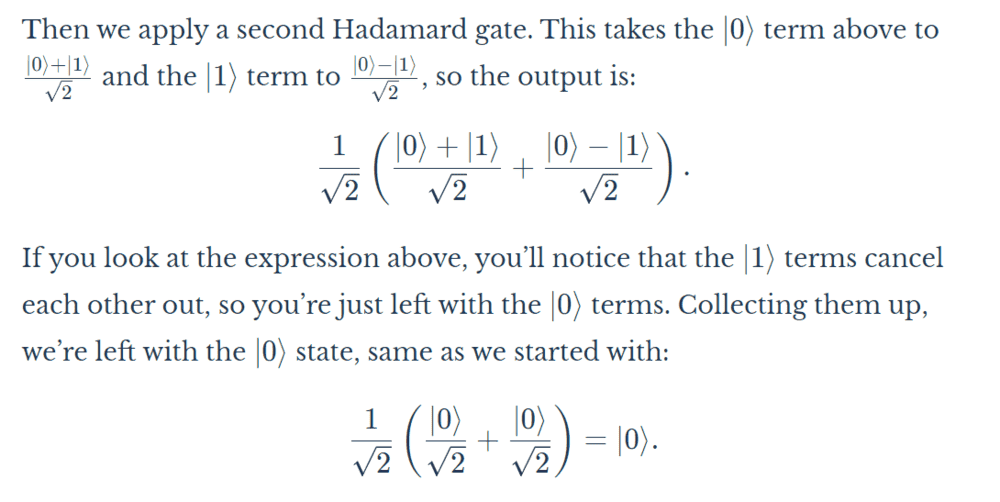
Cannot entirely understand why some of the terms cancel each other out while double Hadamard gates are applied.
Hi guys, I am an absolute beginner in quantum computing. I am really curious about its mechanics but my lack of knowledge in mathematics makes me struggle. I cannot entirely understand why numbers |1> cancel each other out while double Hadamard gates are applied. If the rule is to cancel out the same numbers, why then |0> stays the same, as well as the √2? Thanks
cancelling out0.png
 
Physics news on Phys.org
Quark Effect said:
I cannot entirely understand why numbers |1> cancel each other out while double Hadamard gates are applied.

The ##0## and ##1## inside the kets ##|0\rangle## and ##|1\rangle## are not numbers; they're labels for basis vectors in a vector space. You could just as well call them ##|A\rangle## and ##|B\rangle##, or ##|\text{Laurel}\rangle## and ##|\text{Hardy}\rangle## for that matter, and everything would be the same.

The rule for adding vectors is that you add them component by component, i.e., you add up all the terms involving each basis vector separately. So you have:

$$
\frac{1}{\sqrt{2}} \left( \frac{|0\rangle + |1\rangle}{\sqrt{2}} + \frac{|0\rangle - |1\rangle}{\sqrt{2}} \right)
$$

equals

$$
\frac{1}{\sqrt{2}} \left( \frac{|0\rangle}{\sqrt{2}} + \frac{|1\rangle}{\sqrt{2}} + \frac{|0\rangle}{\sqrt{2}} - \frac{|1\rangle}{\sqrt{2}} \right)
$$

equals

$$
\frac{1}{\sqrt{2}} \left( (1 + 1) \frac{|0\rangle}{\sqrt{2}} + (1 - 1) \frac{|1\rangle}{\sqrt{2}} \right)
$$

equals

$$
\frac{1}{\sqrt{2}} \left( 2 \frac{|0\rangle}{\sqrt{2}} \right)
$$

equals

$$
|0\rangle
$$
 
  • Like
  • Love
Likes   Reactions: Quark Effect and vanhees71
PeterDonis said:
The ##0## and ##1## inside the kets ##|0\rangle## and ##|1\rangle## are not numbers; they're labels for basis vectors in a vector space. You could just as well call them ##|A\rangle## and ##|B\rangle##, or ##|\text{Laurel}\rangle## and ##|\text{Hardy}\rangle## for that matter, and everything would be the same.

The rule for adding vectors is that you add them component by component, i.e., you add up all the terms involving each basis vector separately. So you have:

$$
\frac{1}{\sqrt{2}} \left( \frac{|0\rangle + |1\rangle}{\sqrt{2}} + \frac{|0\rangle - |1\rangle}{\sqrt{2}} \right)
$$

equals

$$
\frac{1}{\sqrt{2}} \left( \frac{|0\rangle}{\sqrt{2}} + \frac{|1\rangle}{\sqrt{2}} + \frac{|0\rangle}{\sqrt{2}} - \frac{|1\rangle}{\sqrt{2}} \right)
$$

equals

$$
\frac{1}{\sqrt{2}} \left( (1 + 1) \frac{|0\rangle}{\sqrt{2}} + (1 - 1) \frac{|1\rangle}{\sqrt{2}} \right)
$$

equals

$$
\frac{1}{\sqrt{2}} \left( 2 \frac{|0\rangle}{\sqrt{2}} \right)
$$

equals

$$
|0\rangle
$$
Ahh, I see! I really appreciate your help, it's not the first time you are spending your time and patiently explaining me things. Thanks a lot man