mplummer said:
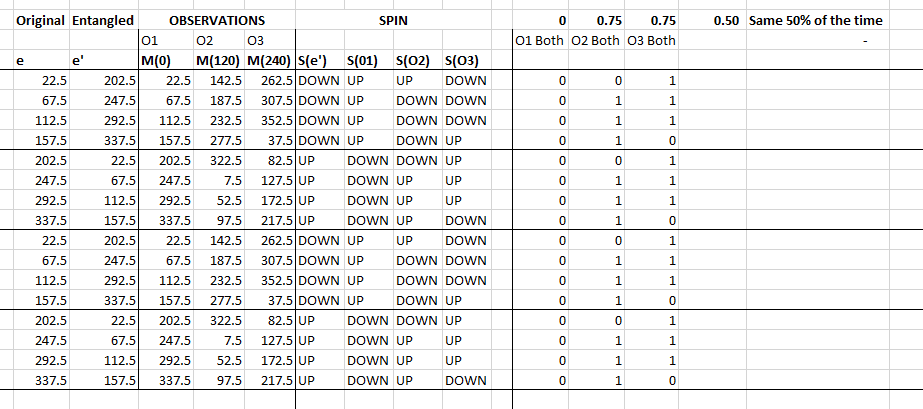
There were 3 "tests" whereby the measurements of Bob (e') were always at 0 degrees and the measurements of Alice were at 0, 120 and 240 degrees respectively (for the three tests O1, O2, and O3).
OK, upon re-reading, I can see how you got to this - and also why I read it a different way. So here are a few comments.
a. My 1st and 2nd comments I made (post #8) about mixing the Product state situation and the Entangled state situation still apply. If you have known spin values (left side), you don't get the outcomes you show (on the right side). For example: if you take your first line, where e=22.5 and e'=202.5 and perform tests on e' at 0 degrees and e at 120 degrees (your O2 case): The actual outcome will be closer to .75 rather than the 0 you show. For the O3 case, the actual outcome will be closer to .75 rather than the 1 you show.
My point here is that your premise ["Spin" is measured as 0<=e<180 then UP else DOWN"] is falsified before you ever get started. So it makes it difficult to consider any conclusion which includes that premise.b. However, we can get past that obstacle. First we need to modify your chart a bit. Normally, what is your O1 case is called the "Perfect Correlations" case. You need this to be true, and it is in your scenario. So let's skip that for now, and consider only your O2 and O3 cases. By your reasoning, they produce an average of .75. That's correct, that matches the Entangled State statistics when theta (the difference in angle settings) is 120 degrees. For entangled electrons, the formula is:
Entangled State Formula:
MatchRate=1-(cos^2(theta/2))
For 120 degrees:
1-(cos(120/2))^2 = 1-cos(60)^2 = 1-((.5)^2) = 1-.25=.75
But now let's add a new case, we'll call that O4. In the O4 case, you measure e at 120 degrees (like your O2 case) but you measure e' at 240 degrees (instead of 0 degrees). Since this is 120 degrees apart, your model should also yield a value of .75 just like the O2 and O3 cases (which also have 120 degrees difference). But if you actually run it out on your model (using your same algorithm), you will see that the value is closer to .50. This demonstrates that your model is not internally consistent (not rotationally invariant). Of course: it wouldn't be, because your algorithm for spin uses a fixed 180 degrees for its constant.c. As others have pointed out, you must consider Bell's Theorem. That's what I applied above. It turns out that ANY algorithm you select will run into this problem. In fact you can hand pick the outcomes - no algorithm needed - and you still cannot get the Entangled State stats when you consider 3 cases instead of 2 (again we ignore the O1 case). Yes, you were able to do it with your table. But without you realizing it, it is a "cherry picked" example. Our conclusion: no hidden variables model (which is what yours is, even though you call it public) can reproduce all of the Entangled State quantum statistics. Bell taught us this.