Quantum well laser diodes - Operation and design

Click For Summary

Discussion Overview

The discussion centers around the operation and design of quantum well laser diodes, specifically focusing on how light generated within the quantum well escapes the device. Participants explore concepts related to semiconductors, band gaps, and the mechanisms that allow light to exit the diode, as well as the materials used in these devices.

Discussion Character

  • Exploratory
  • Technical explanation
  • Conceptual clarification

Main Points Raised

  • One participant questions how light created in the quantum well can escape without being trapped by the surrounding semiconductor material, which is typically opaque.
  • Another participant explains that semiconductors are opaque for energies above their band gap but can be transparent for emissions below that energy, suggesting that quantum wells emit at energies that allow for transparency in the surrounding material.
  • It is noted that GaAs-based VCSELs operate in the infrared range, making the material transparent for that emission, while other materials like InP, ZnO, and ZnSe are suggested for visible light applications.
  • Discussion includes the idea that the quantum well is small, leading to a low probability of absorption, and emphasizes the role of stimulated emission over absorption in the lasing process.
  • Participants mention that the high reflectivity of DBR structures is necessary for lasing, and that VCSELs are designed with asymmetric structures to favor emission in one direction.
  • One participant expresses a lack of comprehensive online resources about VCSELs and suggests specific books for deeper understanding, noting their focus on technology and fundamental physics.
  • A later reply indicates that visualizing semiconductors in crystal form clarified previous confusion about their transparency, and expresses optimism about future developments in photonics research.

Areas of Agreement / Disagreement

Participants do not reach a consensus on all aspects of the discussion, particularly regarding the mechanisms of light escape and the transparency of materials used in quantum well laser diodes. Multiple viewpoints and clarifications are presented without resolution.

Contextual Notes

Participants highlight the complexity of the topic, including the dependence on specific material properties and the conditions under which light can escape the quantum well. There is an acknowledgment of the limitations in available resources for comprehensive understanding.

Who May Find This Useful

This discussion may be useful for individuals interested in semiconductor physics, laser technology, and photonics research, particularly those seeking to understand the operational principles of quantum well laser diodes.

manueldois
Messages
8
Reaction score
0
Quantum laser diodes.
How does light escape?
I recently became very interested on the functioning of these amazing devices and so I read online about the topic of quantum wells, semiconductors and lasers.
After much reading I believe I can now understand the basics of lasers, resonant chambers, semiconductors, band-gaps and quantum wells and how they produce light.

Only one point is missing in the puzzle:
After visible light has been created in the thin quantum well layer, how can it escape to the outside world?

How is the light not trapped immediately after it is created, by colliding with the quantum well material? How does it exit the thin quantum well layer? How does light move inside the diode, being it's semiconductor materials opaque? Shouldn't the opaque semiconductor stop and absorb the light like a normal opaque material?

I am aware there are various types of quantum laser diode design but in none I can comprehend: How the light created in the well travels from the quantum well through all the semiconductor material bounding the well to reach outside.

The typical materials used are aluminium gallium arsenide and gallium arsenide for the walls and Indium gallium arsenide for the quantum well.
Are these semiconductors used transparent? Or is a material's transparency not applicable to very small films? Or is there some other mechanism to evacuate light out of the device?


A simple quantum well laser diode:
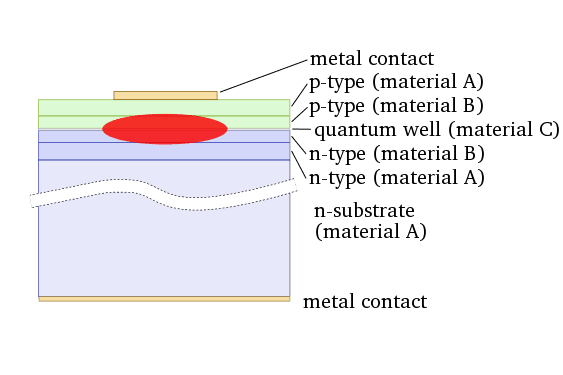
563px-Simple_sch_laser_diode.svg.png


A Vertical emmiting laser diode:

http://upload.wikimedia.org/wikipedia/en/thumb/4/43/Real_vcsel.svg/720px-Real_vcsel.svg.png

How does light penetrate through all the layers?
There is little information online about quantum lasers, hence why I come to you. If you can provide me with a resource to explain me the inner workings of quantum laser diodes in more detail that'll suffice.
Thank you.
 
Last edited by a moderator:
Physics news on Phys.org
Since I'm not getting any answers, please let me know if you do not understand my question so I can try and reformulate.
 
manueldois said:
How is the light not trapped immediately after it is created, by colliding with the quantum well material? How does it exit the thin quantum well layer? How does light move inside the diode, being it's semiconductor materials opaque? Shouldn't the opaque semiconductor stop and absorb the light like a normal opaque material?

Semiconductors are opaque for energies above their band gap and transparernt below. Typically quantum wells emit at an energy below the band gap of the bulk wetting layer material which means that the bulk material is transparent for the emission.

manueldois said:
The typical materials used are aluminium gallium arsenide and gallium arsenide for the walls and Indium gallium arsenide for the quantum well.
Are these semiconductors used transparent? Or is a material's transparency not applicable to very small films? Or is there some other mechanism to evacuate light out of the device?

The low temperature band gap of bulk GaAs is around 1.42 eV. GaAs based VCSELs are infrared devices which means that the material is indeed transparent. Obviously GaAs-based devices are therefore not suitable for building lasers that emit in the visible regime. There you might rather use InP (visible red), ZnO (blue) or ZnSe (green).

manueldois said:
How does light penetrate through all the layers?

Which layer are you interested in? The quantum well layer is tiny, so the interaction probability is not too large anyway. In addition, you want the quantum well population to be inverted, so upon interaction with light the predominant interaction occurring will not be absorption, but stimulated emission. Light obviously does not transmit well through the DBR structures. They typically have a reflectivity on the order of 99.9999%. This huge reflectivity is needed to achieve lasing as the size of the active medium (the quantum well) is quite tiny. The small part which is not reflected gives the VCSEL emission. Typically VCSELs are grown with asymmetric DBR structures, so that the emission is preferentially leaving the VCSEL at one end.


manueldois said:
There is little information online about quantum lasers, hence why I come to you. If you can provide me with a resource to explain me the inner workings of quantum laser diodes in more detail that'll suffice.
Thank you.

Hmm, I do not think there are really good and exhaustive resources on VCSELs available online. If you have access to a good library, the book by Bimberg and Ledentsov is a good reading, but a bit focused on technology aspects. The book on microcavities by Kavokin, Malpuech, Laussy and Baumberg is also a good choice and more focused on the fundamental physics side.
 
Just the first sentence cleared most of my confusion!
I saw a couple of photos of semiconductors on Wikipedia in powder form, only now I give special attention to search for a whole crystal are the ones used to make LED's and laser's are indeed transparent.
Noticed there are many promising materials still waiting in line to photonics research. We'll have a very well lit future.
Damn google books have less than 10 pages per book. Anyway I should cover this in a couple of years in college.
Thank's!
 

Similar threads

  • · Replies 0 ·
Replies
0
Views
749
  • · Replies 16 ·
Replies
16
Views
3K
  • · Replies 5 ·
Replies
5
Views
418
  • · Replies 3 ·
Replies
3
Views
2K
  • · Replies 1 ·
Replies
1
Views
2K
  • · Replies 2 ·
Replies
2
Views
3K
  • · Replies 1 ·
Replies
1
Views
2K
  • · Replies 2 ·
Replies
2
Views
9K
  • · Replies 58 ·
2
Replies
58
Views
5K
  • · Replies 46 ·
2
Replies
46
Views
6K