Question 3B Part II: Buckling or Crushing? Joe Seeks an Explanation

Click For Summary

Discussion Overview

The discussion revolves around determining the failure mode of a column under compression, specifically whether it will buckle or crush based on its slenderness ratio and critical slenderness ratio. Participants explore the implications of these concepts in the context of a specific homework problem.

Discussion Character

  • Homework-related
  • Technical explanation
  • Debate/contested

Main Points Raised

  • Joe presents calculations indicating that the slenderness ratio of the column is 237.6, which is greater than the effective slenderness ratio (E.S.R) of 118.74, leading him to conclude that the mode of failure would be crushing.
  • Joe questions whether the situation could be interpreted as either buckling or crushing, given that the column length is exactly at the minimum length for buckling.
  • Some participants note that there are two modes of compression failure: buckling for long columns and crushing for short columns, emphasizing the critical slenderness ratio as a threshold.
  • One participant clarifies that if the column length is slightly less than the minimum for buckling, it will crush, while if it is slightly more, it will buckle, highlighting the sensitivity of the failure mode to the column length.
  • Joe expresses concern about the lack of responses, wondering if his question is poorly posed or if the solution is too obvious.

Areas of Agreement / Disagreement

Participants generally agree on the concepts of buckling and crushing as failure modes, but there is no consensus on the specific application to Joe's problem, particularly regarding the interpretation of the critical slenderness ratio and its implications for the column's behavior.

Contextual Notes

There are unresolved assumptions regarding the definitions of slenderness ratios and critical slenderness ratios, as well as the specific conditions under which buckling or crushing occurs.

Joe85
Messages
29
Reaction score
3
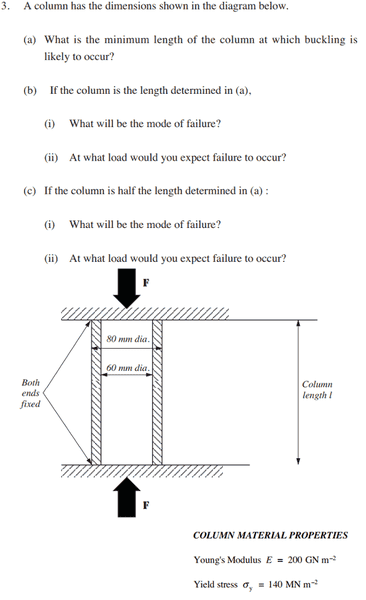
Hi all, the question has been posed many times, unfortunetly, there does not seem to be any explanation for finding the mode of buckling in Question 3B part ii, hence we i am posting.

1. Homework Statement

Below in image

Homework Equations


Also elow in image

media%2Fd57%2Fd578cc6e-8d58-4c40-913b-f911e6a65574%2Fphpu5gNoh.png

The Attempt at a Solution


The lesson mentions that:

The minimum E.S.R. for which buckling occurs, is the one when the critical stress σc equal to the yield stress of the material σy. For a mild steel with E=200GPa and σc=σy=240MPa, the slenderness ratio is about 91. That means when effective slenderness ratios are less than 91 crushing is the failure mode, for values above 91 buckling is the mode.

I hvae taken this to mean:

E.S.R = 118.74

Slenderness Ration = L/K = 5.94/25*10^-3 = 237.6

Since the Slenderness Ratio of the column is 237.6 and the ESR is <237.6 the column is short and the mode of failure would be Crushing.

Am i barking up the wrong tree with this?

I have
A = 2199.11*10-6M2
K= 25x10-3M
I=1374446.9*10-12M4
E=200*109Nm-2
Oy=140*106Nm-2

E.S.R = √π2(200*109)/140*106 = 118.74

OR

Is it really as simple as saying that it could be either, since the minimum length that buckling can occur is 5.94m, which just so happens to be the length of our column.

Similarly for Part C, since we have now halved the length of the column, we are well below the minimum length for buckling, so it must be crushing?Thanks in advance.

Joe.
 

Attachments

  • media%2Fd57%2Fd578cc6e-8d58-4c40-913b-f911e6a65574%2Fphpu5gNoh.png
    media%2Fd57%2Fd578cc6e-8d58-4c40-913b-f911e6a65574%2Fphpu5gNoh.png
    21 KB · Views: 887
Last edited:
Physics news on Phys.org
Since i’m new here I’m not sure what to make of the lack of replies. Is the solution that obvious that people aren’t wasting effort explaining it or that my question is so poorly posed that people don’t want to waste time trying to decipher it ... :) Probably the latter.

Sorry to come across as ungrateful and impatient but i stumbled across the formula for the “critical slenderness ratio” and am wondering if it is at all relavant to the question?
main-qimg-3cc88b846182422b32ceb85ebc35ed0f.jpg


Thanks in advance.
 

Attachments

  • main-qimg-3cc88b846182422b32ceb85ebc35ed0f.jpg
    main-qimg-3cc88b846182422b32ceb85ebc35ed0f.jpg
    2.6 KB · Views: 441
Sorry I can't solve your first post, definitely not my field!

As for the second post, it often takes a few days for someone with specific knowledge to notice and answer any given post, especially on a weekend!

Meanwhile you might look at the information under the "INFO" link that is in the banner at the top of each page. It may explain the organization here a little bit better.

Anyhow, Welcome To PF Joe, glad to have you.

Cheers,
Tom
 
Last edited:
  • Like
Likes   Reactions: PhanthomJay and Joe85
Tom.G said:
Sorry I can't solve your first post, definitely not my field!

As for the second post, it often takes a few days for someone with specific knowledge to notice and answer any given post, especially on a weekend!

Meanwhile you might look at the information under the "INFO" link that is in the banner at the top of each page. It may explain the organization here a little bit better.

Anyhow, Welcome To PF Joe, glad to have you.

Cheers,
Tom

Top man, thanks Tom.
 
Your questions are well founded.

There are 2 modes of compression failure, either by buckling if the column is long enough, or crushing if it is short enough.

When the problem asks for minimum length for buckling to occur, it means that the critical buckling stress is right at the yield stress. That answer is 5.94 m which I assume you are comfortable with. That means that the column is right on the verge of either buckling or crushing. If it is 5.93 m, it will crush, if it is 5.95 m, it will buckle. Well at least in theory. No need to get back into slenderness ratios. When the length is halved, it is much smaller than the min length for buckling, so it will crush when that load is applied. That load is simply the load at yield stress...cross section area times yield stress.
 
  • Like
Likes   Reactions: Joe85 and berkeman
Thank you, PhantomJay. Very much appreciated.
 
  • Like
Likes   Reactions: berkeman

Similar threads

  • · Replies 4 ·
Replies
4
Views
3K
  • · Replies 7 ·
Replies
7
Views
10K