Question about a boundary-value problem (electrostatics)

Click For Summary

Homework Help Overview

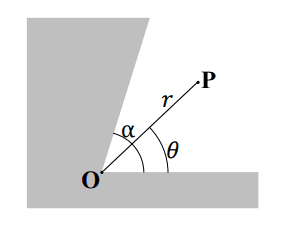
The discussion revolves around a boundary-value problem in electrostatics, specifically involving the Laplacian in polar coordinates and the potential due to a wedge-shaped metallic conductor. The original poster explores the implications of Dirichlet boundary conditions on the potential function.

Discussion Character

  • Exploratory, Assumption checking, Problem interpretation

Approaches and Questions Raised

  • The original poster attempts to solve the Laplace equation by separating variables, leading to a potential function expressed in terms of boundary conditions. They express confusion regarding the uniqueness of the solution and the determination of constants when the boundary potential is set to zero.
  • Some participants question the sufficiency of boundary conditions provided, suggesting that additional conditions are necessary to fully determine the solution.
  • Others suggest reconsidering the form of the solution for the radial component and the implications of the boundary conditions at infinity and zero.

Discussion Status

The discussion is ongoing, with participants providing insights into the boundary conditions required for the problem. There is a recognition of the need for additional conditions to resolve the uniqueness of the solution, and some guidance has been offered regarding the treatment of the zeroth-order term in the potential function.

Contextual Notes

Participants note that the original poster's approach may not account for all possible forms of the radial function, and there is a discussion about the implications of setting the boundary potential to zero. The need for a unique solution is emphasized, but the current conditions are seen as insufficient.

Sum Guy
Messages
21
Reaction score
1
Laplacian for polars:

$$\frac{1}{r}\frac{\partial}{\partial r}\left( r\frac{\partial \phi}{\partial r}\right) + \frac{1}{r^{2}}\frac{\partial^{2} \phi}{\partial \theta^{2}} = 0$$

This is in relation to a problem relating to a potential determined by the presence of a wedge shaped metallic conductor (see image).
kajx4g.png

Working through the problem:

$$\phi (r,\theta) = R(r)\psi (\theta )$$ with $$R(r) \propto r^{v}$$ and Dirichlet boundary conditions $$\phi (r,0) = \phi (r,\alpha ) = V_{0}$$

Substituting into the Laplacian:
$$\frac{1}{r}\frac{\partial}{\partial r}\left( rvr^{v-1}\psi (\theta)\right) + \frac{1}{r^2}r^{v}\psi^{''}(\theta )$$
$$ = r^{v-2}\left( \psi^{''}(\theta ) + v^{2}\psi (\theta )\right) = 0$$
Therefore
$$\psi^{''}(\theta ) + v^{2}\psi (\theta ) = 0$$
Solution is of the form
$$\psi (\theta) = Acos(v\theta ) + Bsin(v\theta )$$
Applying BCs:
$$\phi (r,\theta ) = r^{v}\left(Acos(v\theta ) + Bsin(v\theta )\right)$$
$$\phi (r,0) = V_0 \rightarrow A = V_{0}r^{-v}$$
$$\phi (r,\alpha) = V_0 \rightarrow B = \frac{V_{0}r^{-v}(1-cos(v\alpha ))}{sin(v\alpha )}$$ ...which leaves me with utter crap.

However if we choose V0 such that it is zero then we can reapply the BCs:
$$\phi (r,0) = V_0 \rightarrow A = 0$$
$$\phi (r,\alpha) = V_0 \rightarrow sin(v\alpha ) = 0 \rightarrow v = \frac{n\pi }{\alpha}$$

Resulting in a more pleasant $$\phi(r,\theta ) = Br^{\frac{n\pi }{\alpha}}sin(\frac{n\pi }{\alpha}\theta )$$

So there a few things here that I'm struggling to understand:
If I don't set V0 = 0 then how can I solve the problem?
I should have a unique solution, yet B isn't determined?
How might I correct my solution so that the potential was V0 on the boundaries?
 
Physics news on Phys.org
Notice you're short two boundary conditions to solve this problem. Add in ##\phi(r,\theta) < \infty## everywhere on the region of integration. First, test that condition as r goes to infinity: ##\phi(r,\theta) < \infty## as ##r \to \infty## implies ##\nu \leq 0##. Second, test the same condition as r goes to zero: ##\phi(r,\theta) < \infty## as ##r \to 0## implies ##\nu \geq 0##. Meaning, there's only one term in the solution: the 0th order term, simply ##\phi(r,\theta)=A=V_{0}##, ##\nu = 0##. The reason you didn't see it when you performed separation of variables is because ##\nu = 0## makes ##\frac{\partial}{\partial r}\phi(r,\theta) = 0##. If you had handled the zeroth-order term separately, you would've gotten ##\frac{\partial^{2}}{\partial\theta^{2}}\psi(\theta) = 0##, which implies ##\frac{\partial}{\partial\theta}\psi(\theta) = \frac{\psi(\alpha) - \psi(0)}{\alpha}=\frac{V_{0} - V_{0}}{\alpha} = 0##. That tells you that ##\psi(\theta) = \psi(0) = V_{0}##.
 
Twigg said:
Notice you're short two boundary conditions to solve this problem. Add in ##\phi(r,\theta) < \infty## everywhere on the region of integration. First, test that condition as r goes to infinity: ##\phi(r,\theta) < \infty## as ##r \to \infty## implies ##\nu \leq 0##. Second, test the same condition as r goes to zero: ##\phi(r,\theta) < \infty## as ##r \to 0## implies ##\nu \geq 0##. Meaning, there's only one term in the solution: the 0th order term, simply ##\phi(r,\theta)=A=V_{0}##, ##\nu = 0##. The reason you didn't see it when you performed separation of variables is because ##\nu = 0## makes ##\frac{\partial}{\partial r}\phi(r,\theta) = 0##. If you had handled the zeroth-order term separately, you would've gotten ##\frac{\partial^{2}}{\partial\theta^{2}}\psi(\theta) = 0##, which implies ##\frac{\partial}{\partial\theta}\psi(\theta) = \frac{\psi(\alpha) - \psi(0)}{\alpha}=\frac{V_{0} - V_{0}}{\alpha} = 0##. That tells you that ##\psi(\theta) = \psi(0) = V_{0}##.
Thank you for your reply.

Wouldn't that lead to the conclusion that ##\phi (r,\theta ) = V_{0}## everywhere? The solution must have some ##r## dependence..? Shouldn't the solution be of the form that I provided when ##V_{0} = 0##?
 
If having the unbounded powers of r weren't an issue, you'd have a superposition of solutions like you got for different values of n, plus the constant ##V_{0}##. There wouldn't be a unique solution because you're still short at least one boundary condition for r at infinity.
 
Sum Guy said:
$$\phi (r,0) = V_0 \rightarrow A = V_{0}r^{-v}$$
##A## is required to be a constant in the process of solving by separation of variables. It cannot be a function of ##r##.

When you write ##R(r) = r^{\nu}##, you are not allowing for all possible forms of ##R(r)##.

I suggest you go back through the process of separation of variables to find the differential equation that ##R(r)## must satisfy and see if you can find a solution that is not of the form ##r^{\nu}##.
 
Last edited:
  • Like
Likes   Reactions: Sum Guy

Similar threads

  • · Replies 12 ·
Replies
12
Views
2K
  • · Replies 9 ·
Replies
9
Views
4K
Replies
29
Views
2K
Replies
10
Views
2K
  • · Replies 8 ·
Replies
8
Views
1K
Replies
13
Views
4K
Replies
13
Views
2K
  • · Replies 0 ·
Replies
0
Views
2K
  • · Replies 4 ·
Replies
4
Views
2K
  • · Replies 4 ·
Replies
4
Views
1K