Glenn G
- 113
- 12
- TL;DR
- Question into mass loss converted to ke alpha and Po nucleus BUT what about extra ke gained from the now repelling +charge Po and alpha particle (since not bonded by strong nuclear force now) !!! Please help
Hi community,
I've been looking through this question
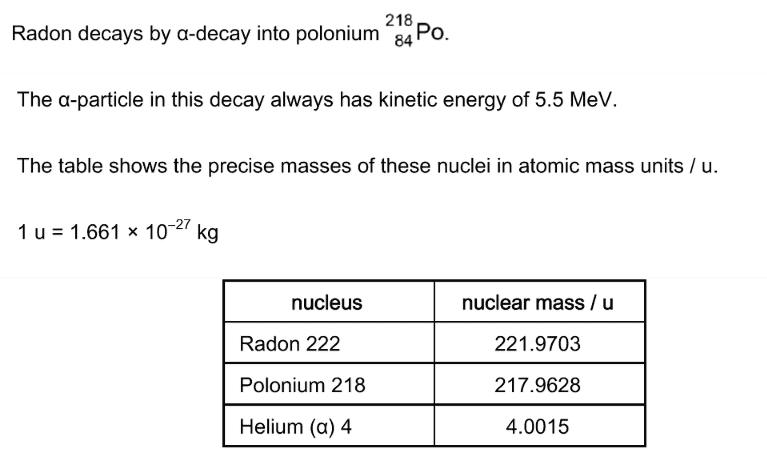
And I have a conceptual if I may (this is not homework I'm a 52 year old programmer just trying to learn and understand).
You can calculate the mass loss of 0.006 u when you go from the Radon nucleus to the Polonium and alpha particle.
You can calculate that this equates to an energy of 5.61MeV ( so this change of mass that now has become energy has to go somewhere right? and so let's give the He and Po k.e. after the interaction)
So all this is fine the 5.61MeV is enough to give the alpha the 5.5MeV mentioned above (with 0.11MeV left over for the recoiling Po nucleus)
What then confused me was ... well hang on we now could think of the Po and He being next to each other for an instant (but no longer bound by the strong nuclear force) but NOW there is the electrostatic repulsion between the protons in the He and the Po SO wouldn't this mean that this initial 5.61MeV ke (that comes at the expense of the mass loss) that the products share starts to now increase due to the electrostatic repulsive forces SO would that mean that the final sum of the kinetic energies of the alpha and Po is LARGER than the 5.61MeV (because they've gained extra at the expense of some stored electrical potential energy)
Consequently if the alpha is recorded as having 5.5MeV at some distance from the Polonium then we can assume that the extra ke from the electrostatic repulsion has kind of pretty much happened such that the recoiled Po would have a recoil KE of bigger than 0.11MeV.
I hope I've explained my confusion OK and i would really appreciate help with this.
kind regards,
Glenn.
I've been looking through this question
And I have a conceptual if I may (this is not homework I'm a 52 year old programmer just trying to learn and understand).
You can calculate the mass loss of 0.006 u when you go from the Radon nucleus to the Polonium and alpha particle.
You can calculate that this equates to an energy of 5.61MeV ( so this change of mass that now has become energy has to go somewhere right? and so let's give the He and Po k.e. after the interaction)
So all this is fine the 5.61MeV is enough to give the alpha the 5.5MeV mentioned above (with 0.11MeV left over for the recoiling Po nucleus)
What then confused me was ... well hang on we now could think of the Po and He being next to each other for an instant (but no longer bound by the strong nuclear force) but NOW there is the electrostatic repulsion between the protons in the He and the Po SO wouldn't this mean that this initial 5.61MeV ke (that comes at the expense of the mass loss) that the products share starts to now increase due to the electrostatic repulsive forces SO would that mean that the final sum of the kinetic energies of the alpha and Po is LARGER than the 5.61MeV (because they've gained extra at the expense of some stored electrical potential energy)
Consequently if the alpha is recorded as having 5.5MeV at some distance from the Polonium then we can assume that the extra ke from the electrostatic repulsion has kind of pretty much happened such that the recoiled Po would have a recoil KE of bigger than 0.11MeV.
I hope I've explained my confusion OK and i would really appreciate help with this.
kind regards,
Glenn.