Question about this technique for solving simultaneous equations

  • Thread starter Thread starter chwala
  • Start date Start date
Click For Summary
SUMMARY

This discussion focuses on solving simultaneous equations using the substitution method, specifically the equation ##y=\dfrac{8-2x^2}{3x}##. The user successfully derives a polynomial equation ##-11x^4-53x^2+64=0## and transforms it into a quadratic in terms of ##m=x^2##, leading to the solutions ##m=1## and consequently ##x=±1##. The discussion also highlights the importance of variable substitution, suggesting that using ##z=\frac{y}{x}## may provide clearer insights into the relationships between variables.

PREREQUISITES
  • Understanding of polynomial equations and their degrees
  • Familiarity with substitution methods in algebra
  • Knowledge of quadratic equations and their solutions
  • Basic grasp of variable manipulation in mathematical expressions
NEXT STEPS
  • Study the method of substitution in solving simultaneous equations
  • Learn about polynomial factorization techniques
  • Explore the implications of variable substitution in algebraic expressions
  • Investigate the use of quadratic equations in real-world problem-solving
USEFUL FOR

Students and educators in mathematics, particularly those focusing on algebra and polynomial equations, as well as anyone interested in enhancing their problem-solving skills in simultaneous equations.

chwala
Gold Member
Messages
2,828
Reaction score
421
Homework Statement
See attached
Relevant Equations
understanding of equations
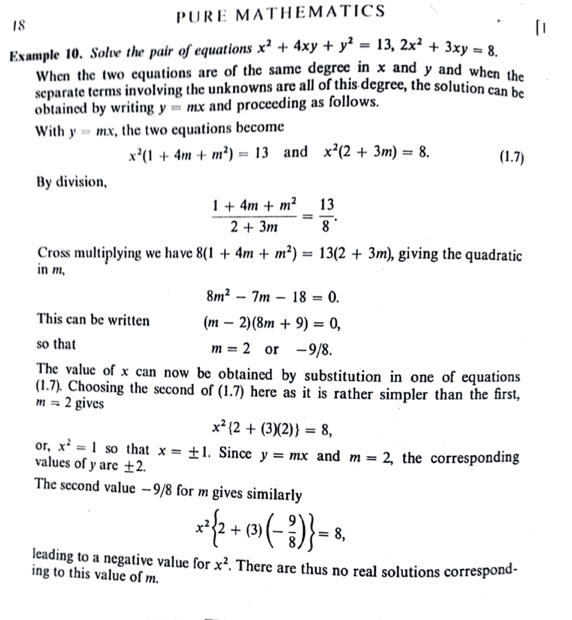
I was going through this...
1693204391194.png


The steps are quite clear; although i do not know whether it is a general approach to let ##y=mx## in such kind of problems when the degree are the same...second degree, third degree and so on.

My approach to this problem was straightforward;

##y=\dfrac{8-2x^2}{3x}##

thus on substitution to first equation, we shall have,
...
##9x^4+96x^2-24x^4+64-32x^2+4x^4-117x^2=0##

##-11x^4-53x^2+64=0##

Let

##m=x^2##

then it follows that,

##11m^2+53m-64=0##

##m=1, ⇒ x=±1##

The values of ##y## would be found by substituting ##x=±1## into ##y=\dfrac{8-2x^2}{3x}##

cheers.

My interest is on the highlighted part.
 
Last edited:
Physics news on Phys.org
As is clear from the working, ##m## is a variable, not a constant of proportionality. There was a thread yesterday where a similar approach caused this confusion. In general, as long as ##x \ne 0##, you can always set ##m = \frac y x##. Personally, I would use ##z = \frac y x##, and then it's clearer what's happening.
 
  • Like
  • Informative
Likes   Reactions: topsquark and chwala
chwala said:
My interest is on the highlighted part.
I don't see any highlighted part.
 
Mark44 said:
I don't see any highlighted part.
I assume it is the passage in lilac: "although i do not know whether it is a general approach to let in such kind of problems when the degree are the same...second degree, third degree and so on."
 
  • Like
Likes   Reactions: chwala
haruspex said:
I assume it is the passage in lilac: "although i do not know whether it is a general approach to let in such kind of problems when the degree are the same...second degree, third degree and so on."
You're right. I thought he meant that something was highlighted in the image from the book. Also, that lilac doesn't really stand out very distinctly.
 

Similar threads

  • · Replies 6 ·
Replies
6
Views
1K
Replies
4
Views
2K
  • · Replies 5 ·
Replies
5
Views
3K
  • · Replies 2 ·
Replies
2
Views
1K
  • · Replies 1 ·
Replies
1
Views
1K
  • · Replies 20 ·
Replies
20
Views
5K
  • · Replies 5 ·
Replies
5
Views
2K
  • · Replies 4 ·
Replies
4
Views
2K
Replies
2
Views
2K
Replies
3
Views
3K