Question about time-variant Schrodinger's eq'n

  • Context: Undergrad 
  • Thread starter Thread starter woody stanford
  • Start date Start date
  • Tags Tags
    Schrodinger equation
Click For Summary
SUMMARY

The discussion centers on the time-variant form of Schrödinger's equation and the interpretation of the energy term (E) within it. Participants confirm that E represents the energy of the system, specifically one of the eigenenergies, and clarify that it cannot be substituted with a Hamiltonian. The conversation also emphasizes the necessity of using complex arithmetic when dealing with complex numbers in the equation. Additionally, the participants highlight that the energy interpretation is non-relativistic, focusing on kinetic and potential energy rather than mass-energy equivalence.

PREREQUISITES
  • Understanding of complex numbers and complex arithmetic
  • Familiarity with Schrödinger's equation, both time-dependent and time-independent forms
  • Knowledge of eigenvalue problems in quantum mechanics
  • Basic concepts of kinetic and potential energy in physics
NEXT STEPS
  • Research the mathematical treatment of complex numbers in quantum mechanics
  • Study the implications of eigenvalues and eigenstates in quantum systems
  • Explore the Hamiltonian operator and its role in quantum mechanics
  • Investigate the principles of quantum electrodynamics for photon interactions
USEFUL FOR

Students and professionals in physics, particularly those focusing on quantum mechanics, computational physics, and anyone developing simulations involving Schrödinger's equation.

woody stanford
Messages
26
Reaction score
4
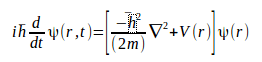
The question I have is regarding the time-variant form of Schrödinger's equation. Can I just put a complex number of form c=a+bi where the i is in it or can I just literally put sqrt(-1) where the i is:
schrod_tv_eqn1.png


addendum: sorry forgot the t in the right-hand term, it should read (r,t) instead of (r)

Also any comments/insights on some of the other terms in it would be welcomed (as I'm writting a c program to inject various values into it) and would appreciate the help.

Was thinking if I could just put a+bi in there that to put it back to i all I would have to do is set (real)a=0 and (imaginary)b=1
 
Last edited:
Physics news on Phys.org
woody stanford said:
The question I have is regarding the time-variant form of Schrödinger's equation. Can I just put a complex number of form c=a+bi where the i is in it or can I just literally put sqrt(-1) where the i is:

View attachment 119009

addendum: sorry forgot the t in the right-hand term, it should read (r,t) instead of (r)

Also any comments/insights on some of the other terms in it would be welcomed (as I'm writting a c program to inject various values into it) and would appreciate the help.

Was thinking if I could just put a+bi in there that to put it back to i all I would have to do is set (real)a=0 and (imaginary)b=1

I think you are going to have to treat it as a complex number and make sure you use complex arithmetic throughout.
 
mike1000 said:
I think you are going to have to treat it as a complex number and make sure you use complex arithmetic throughout.

See that's why I come here...get a few opinions...a few facts...a few points of view. Thank you sir. Basically what I was thinking but wanted to bounce it off the ole colleagues. Means I'm not nuts (comforting to know). lol
 
OK, got some more question.

Still working on my program to compute the time invariant version of SE. Here is that equation:

schrod_ti_eqn1.png


Ok, here is my question. The E here I believe can have a Hameltonian substituted in BUT I'm interested in the classic interpretation of the E term here. Is it system total energy? I assume it has a local associated with it, but what "energy" does it represent?

Is it the mass terms converted to energy via the equation e=mc^2? Is it the total kinetic energy of all particles within the local system being described? What exactly does that E term mean?

...(and don't reference a Hameltonian unless it gets me closer to what I'm looking for...in other words if you invoke the Hameltonian option you will be required lol to explain it from there, not from the easier to explain E at that point)?

Addendum: ok, came up with a hypothetical E value based on the relation E=h/wavelength since I'm using a psi(x)=A*sin(kx+d) wave function that I believe is for [the electrical component for] a beam of light (ie. photon). I'm using a 500 nm (visible red) beam of light in the simulation btw (if it helps).

E=h/wavelength
 
Last edited:
woody stanford said:
Still working on my program to compute the time invariant version of SE. Here is that equation:
Always good to learn the language: they are called the time-dependent and time-independent Schrödinger equation.

woody stanford said:
Ok, here is my question. The E here I believe can have a Hameltonian substituted in BUT I'm interested in the classic interpretation of the E term here. Is it system total energy? I assume it has a local associated with it, but what "energy" does it represent?
There is a lot of confusion here. You can't "substitute" E for a Hamiltonian, since you have the Hamiltonian on the left-hand side. E is a scalar, and it is indeed the energy of the system. To be more precise, it is one of the eigenenergies. (You do know what an eigenvalue problem is?) Also, you don't need to invoke a "classical interpretation" for E.

woody stanford said:
Is it the mass terms converted to energy via the equation e=mc^2? Is it the total kinetic energy of all particles within the local system being described? What exactly does that E term mean?
This is purely non-relativistic, so there is no ##mc^2## term. To know what the energy corresponds to, you have to look at the Hamiltonian. In your case, the first term is the kinetic energy, while the second is an unspecified potential ##V(x)##. So the total energy is kinetic + potential energy, with the potential energy correspond to whatever lead to the presence of a position dependent potential ##V(x)## is the first place.

woody stanford said:
Addendum: ok, came up with a hypothetical E value based on the relation E=h/wavelength since I'm using a psi(x)=A*sin(kx+d) wave function that I believe is for [the electrical component for] a beam of light (ie. photon). I'm using a 500 nm (visible red) beam of light in the simulation btw (if it helps).

E=h/wavelength
You can't use that Hamiltonian to describe a beam of light. This is only for a massive particle. And if you want to talk about photons, you'll have to upgrade to quantum electrodynamics, which I guess is not what you want to do here.
 

Similar threads

  • · Replies 2 ·
Replies
2
Views
1K
  • · Replies 5 ·
Replies
5
Views
2K
  • · Replies 2 ·
Replies
2
Views
1K
  • · Replies 17 ·
Replies
17
Views
3K
  • · Replies 1 ·
Replies
1
Views
2K
  • · Replies 5 ·
Replies
5
Views
2K
  • · Replies 11 ·
Replies
11
Views
2K
  • · Replies 6 ·
Replies
6
Views
2K
  • · Replies 19 ·
Replies
19
Views
2K
  • · Replies 5 ·
Replies
5
Views
1K