Question about ultrasonic receiver orientation

Click For Summary
SUMMARY

This discussion focuses on the use of an ultrasonic transmitter and three receivers for determining the transmitter's position relative to the receivers. The orientation of the receivers significantly impacts distance measurements, especially when considering factors like beam angle and reflections from nearby structures. The conversation highlights the need for a conical reflector to achieve a 360° azimuth radiation pattern and suggests using time-of-flight measurements for improved accuracy. Additionally, employing techniques such as pseudo random sequences and chirp signals can enhance measurement precision.

PREREQUISITES
  • Understanding of ultrasonic transmission and reception principles
  • Familiarity with triangulation algorithms in positioning systems
  • Knowledge of time-of-flight measurement techniques
  • Experience with signal processing methods, such as correlation and beat frequency analysis
NEXT STEPS
  • Research the design and implementation of conical reflectors for ultrasonic applications
  • Learn about time-of-flight measurement techniques in ultrasonic positioning
  • Explore the use of pseudo random sequences in signal processing for distance measurement
  • Investigate the effects of environmental factors, such as wind speed, on ultrasonic measurements
USEFUL FOR

Engineers, robotics developers, and researchers involved in ultrasonic positioning systems and distance measurement applications will benefit from this discussion.

nikosb
Messages
29
Reaction score
1
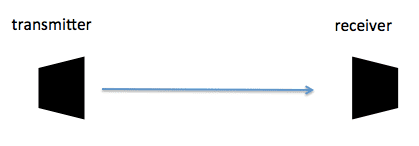
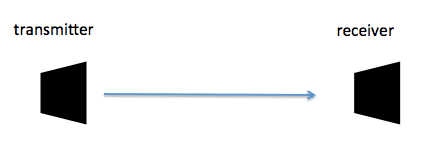
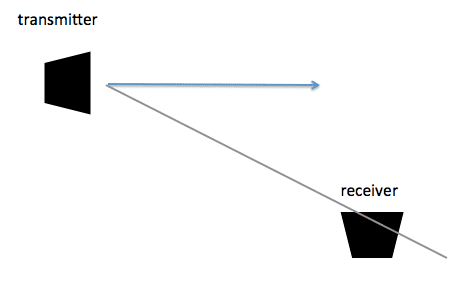
I would like to use an ultrasonic transmitter and three receivers to be able to determine the position of the transmitter relative to the receivers. The distances to be measured are around 3-4 ft. I want to understand how the receivers orientation relative to the transmitter can affect the distance measurement. I attach some simple pictures for illustration, in the first one the receiver is placed directly in front of the transmitter and opposite which is the ideal situation. In the second picture the receiver is placed in front of the transmitter but it is facing away from it. In the third picture the receiver is within the beam angle but is facing almost tangent to the beam. Basically as long as the receiver is within the beam range does its orientation matter?
q7CzP.png

3UL8c.png

TB9g1.png
 
Engineering news on Phys.org
nikosb said:
I would like to use an ultrasonic transmitter and three receivers to be able to determine the position of the transmitter relative to the receivers. The distances to be measured are around 3-4 ft. I want to understand how the receivers orientation relative to the transmitter can affect the distance measurement. I attach some simple pictures for illustration, in the first one the receiver is placed directly in front of the transmitter and opposite which is the ideal situation. In the second picture the receiver is placed in front of the transmitter but it is facing away from it. In the third picture the receiver is within the beam angle but is facing almost tangent to the beam. Basically as long as the receiver is within the beam range does its orientation matter?
q7CzP.png

3UL8c.png

TB9g1.png

It sounds like you are wanting to use an omnidirectional ultrasound transmitter and 3 triangulating receivers to do this. First problem is that there aren't any omnidirectional US transmitters that I know of, at least not simple ones. Second problem is if there can be reflections from any nearby walls or structures, that will confuse any amplitude-centric triangulation algorithms.

Can you say more about what your overall project is? Is it something like robotic location or something? Can you use other techniques for the location function? One variation would be time-of-flight measurements to triangulate with US...
 
If this is a 2D positioning system then phase and orientation of the Rx and Tx will be important. To resolve the problem, mount all transducer elements on the same plane with their axis vertical. Place a conical reflector on axis to give phase independent 360° azimuth radiation patterns. The cone profile can be adjusted to a hyperboloid which will give a better horizontal radiation pattern.

To measure position you need to measure the arrival time of pulses from the transmitter. To measure more accurately you might transmit a pseudo random sequence, then correlate the received channels to get the relative delay times. I would also consider transmitting a chirp, then multiplying the RX channels by each other to get the beat frequencies and hence period = differential time.

Depending on the number and position of RXs there may be a position error due to wind speed. It may also be a Doppler anemometer.
 
The reason that I didn't respond to this before is that I think he's still referring to the 3D feet and wrist motion tracking system that he introduced a couple of thread back.
 

Similar threads

Replies
13
Views
4K
  • · Replies 6 ·
Replies
6
Views
3K
  • · Replies 15 ·
Replies
15
Views
4K
  • · Replies 6 ·
Replies
6
Views
3K
  • · Replies 12 ·
Replies
12
Views
2K
  • · Replies 2 ·
Replies
2
Views
2K
  • · Replies 4 ·
Replies
4
Views
5K
  • · Replies 23 ·
Replies
23
Views
7K
  • · Replies 1 ·
Replies
1
Views
3K
  • · Replies 6 ·
Replies
6
Views
4K