Question concerning Kirchoff's Laws

  • Thread starter Thread starter Linus Pauling
  • Start date Start date
  • Tags Tags
    Laws
Click For Summary
SUMMARY

This discussion focuses on the application of Kirchoff's Laws in analyzing electrical circuits, specifically addressing the relationships between currents and voltages in series and parallel connections. Participants clarify that according to Kirchoff's Current Law (KCL), the current entering a junction equals the current leaving, while Kirchoff's Voltage Law (KVL) states that the sum of the electrical potential differences around any closed circuit must equal zero. The conversation highlights the importance of resistor values in determining current relationships, emphasizing that I1 does not equal I3 when multiple resistors are involved in a branch.

PREREQUISITES
  • Understanding of Kirchoff's Current Law (KCL)
  • Familiarity with Kirchoff's Voltage Law (KVL)
  • Basic knowledge of series and parallel circuit configurations
  • Ability to analyze resistor values and their impact on current flow
NEXT STEPS
  • Study the implications of resistor values on current distribution in circuits
  • Learn how to apply Kirchoff's Voltage Law to complex circuits
  • Explore the concept of equivalent resistance in series and parallel circuits
  • Investigate practical applications of Kirchoff's Laws in circuit design
USEFUL FOR

Electrical engineering students, circuit designers, and anyone interested in mastering circuit analysis using Kirchoff's Laws.

Linus Pauling
Messages
187
Reaction score
0
1. Which of the following relationships must be true according to the laws of series and parallel connections?
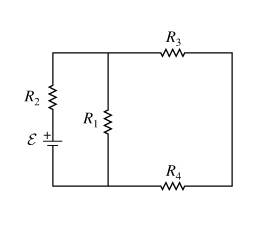
1082045A.jpg


The options are:
I1 = I3
I3 = I4
I2 = I3 + I4
I1 = I3 + I2
V1 = V2
V3 = V4
V1 = V3 + V4
V2 = V3 + V4
V1 = V2 + V3 + V4


2. Loop and junction laws


3. By the junction law, I said that I1 = I3, I3 = I4, and I2 = I3 + I4. That's wrong, and I suspect that it's wrong because one or more of the options involving the potential drops is correct. But I don't understand why any of those would be true if the potential drops across each resistor in the direction of current flow.
 
Physics news on Phys.org
I assume I1 is the current through R1, etc. The truth of some of the answers depends on the values of the resistors.

What does Kirchoff's current law say? Explain how you applied it to get the answers you did.
 
3 and 4 are in series, so they must have the same current. I mis-typed above: I said I2 = I1 + I3, because current flowing from I2 reaches the junction then goes to either 1 or 3... also, I changed my mind, I1 does not equal I3, I1 is greater because on the "I3" branch there's two resistors.
 
Linus Pauling said:
3 and 4 are in series, so they must have the same current. I mis-typed above: I said I2 = I1 + I3, because current flowing from I2 reaches the junction then goes to either 1 or 3...
Yes.
Also, I changed my mind, I1 does not equal I3; I1 is greater because on the "I3" branch there are two resistors.
This is one of those cases where the specific resistor values matter. You can't just count the number of resistors. If R1 > R3+R4, then I1 < I3, right?
 
Right, so I3 = I4 and I2 = I1 + I3... but what else am I missing? I assume one or more of the options regarding potential is correct, but as I stated I don't understand why.
 
Apply Kirchoff's voltage law to the three loops in the circuit.

Kirchoff's current law tells you that elements in series have the same current; Kirchoff's voltage law tells you that elements in parallel have the same voltage across them.

Note that the problem isn't well stated as both the currents and voltages should have a direction associated with them. I assume they're just working with magnitudes in the equations.
 

Similar threads

Replies
4
Views
1K
  • · Replies 9 ·
Replies
9
Views
4K
  • · Replies 11 ·
Replies
11
Views
2K
  • · Replies 4 ·
Replies
4
Views
2K
  • · Replies 9 ·
Replies
9
Views
3K
  • · Replies 3 ·
Replies
3
Views
2K
  • · Replies 3 ·
Replies
3
Views
4K
  • · Replies 11 ·
Replies
11
Views
3K
  • · Replies 10 ·
Replies
10
Views
3K
  • · Replies 7 ·
Replies
7
Views
15K