Understanding Derivative of Position Function: Is Velocity Wrong?

Click For Summary
SUMMARY

The discussion centers on the interpretation of the derivative of the position function as presented in Kleppner and Kolenkow's textbook. A participant questions the validity of the velocity expression, suggesting it should be A(α²)(e²ˣ). However, the consensus is that this expression is incorrect due to dimensional inconsistencies. Specifically, Aα² represents acceleration, while the argument of the exponential function must remain dimensionless, highlighting the importance of unit analysis in deriving velocity from position.

PREREQUISITES
  • Understanding of calculus, specifically differentiation
  • Familiarity with the concepts of position, velocity, and acceleration
  • Knowledge of dimensional analysis in physics
  • Basic understanding of exponential functions
NEXT STEPS
  • Study the derivation of velocity from position functions in classical mechanics
  • Learn about dimensional analysis and its applications in physics
  • Review the properties of exponential functions and their derivatives
  • Examine the notation differences between physics and mathematics, particularly in vector calculus
USEFUL FOR

Students of physics, particularly those preparing for advanced mechanics courses, educators teaching calculus-based physics, and anyone interested in the mathematical foundations of motion analysis.
mopit_011
Messages
17
Reaction score
8
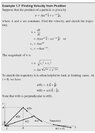
Hello! So, I was beginning to skim Kleppner and Kolenkow for an upcoming course I’m taking over the summer. I saw this on pg. 17 and was wondering if I’m making a silly mistake in understanding what the book is saying. When they take the derivative of the position function, isn’t the velocity wrong? For vx, shouldn’t the function be A(alpha squared)(e^2x)? Thank you!
 

Attachments

  • 0D595288-FF0F-4552-A7D6-195884E27EE7.jpeg
    0D595288-FF0F-4552-A7D6-195884E27EE7.jpeg
    25.5 KB · Views: 185
Physics news on Phys.org
Not sure how you came to that conclusion. Using the full expression for position write out the expression for the x-component of the position and derive from it the expression for the x-component of velocity.
 
It is useful to check units.
##A## must have units of position ##e^{\alpha t}## is dimensionless.
##\alpha## has units of inverse-time since the argument of the exponential function ##{\alpha t}## is dimensionless.

Thus, in your proposed expression,
##A\alpha^2## has units of position per time-squared (an acceleration)
and ##2x## (with units of position) can't be the necessarily-dimensionless argument of the exponential function.
As @Dragon27 says, it's unclear how you arrived at your expression.

(Note: ##v_x## is the ##x##-component of a vector ##\vec v##.
Once, when I taught a math-methods class for physics students,
one of the students who was a mathematics major interpreted
"##v_x##" as the partial-derivative of a function ##v##...
since some math books use that notation.)
 

Similar threads

  • · Replies 13 ·
Replies
13
Views
3K
  • · Replies 12 ·
Replies
12
Views
3K
  • · Replies 14 ·
Replies
14
Views
7K
  • · Replies 12 ·
Replies
12
Views
3K
  • · Replies 1 ·
Replies
1
Views
1K
  • · Replies 6 ·
Replies
6
Views
3K
  • · Replies 17 ·
Replies
17
Views
1K
Replies
6
Views
2K
  • · Replies 13 ·
Replies
13
Views
2K
  • · Replies 12 ·
Replies
12
Views
3K