Friction, Mass and Acceleration: Analyzing Block Motion

Click For Summary
SUMMARY

The discussion focuses on the analysis of block motion involving friction, mass, and acceleration. The equations presented include F=u*n and F=(m1+m2)a, leading to the conclusion that the force acting on the second mass can be expressed as F=(u*m1g(m1+m2))/m2. Participants clarify the definitions of the forces in the equations, emphasizing that the first F represents Newton's Second Law while the second F denotes the force of friction. The importance of understanding the common acceleration of the two masses before sliding is highlighted.

PREREQUISITES
  • Understanding of Newton's Second Law of Motion
  • Friction coefficient concepts in physics
  • Basic algebra for manipulating equations
  • Knowledge of free body diagrams
NEXT STEPS
  • Study the derivation of Newton's Second Law in various contexts
  • Learn about the coefficients of friction and their applications
  • Explore free body diagram techniques for complex systems
  • Investigate the dynamics of sliding friction and its effects on motion
USEFUL FOR

Students of physics, educators teaching mechanics, and anyone interested in understanding the principles of motion involving friction and acceleration.

as2528
Messages
40
Reaction score
9
Homework Statement
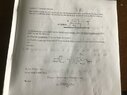
Two blocks of mass m2 and m1 are put on a frictionless level surface as shown in the figure below. The static coefficient of friction between the two blocks is µ. A force F acts on the top block m2.

(c) Find the magnitude of the force F above which the block m1 starts to slide relative to the block m1.
Relevant Equations
F=ma
F=u*N
The block starts to slide if friction can no longer hold the block.

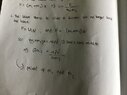
F=u*n and F=(m1+m2)a
so: (m1+m2)a=uN=>am1+am2=uN=>am2=(uN)/(am1)

So:am2=(uN)/(am1) is the force.

The answer is F=(u*m1g(m1+m2))/m2
I do not see how the acceleration terms are canceled. Is my answer equivalent to this?
 

Attachments
  • 03exam2msol.pdf
    03exam2msol.pdf
    45 KB · Views: 142
  • IMG-0592.jpg
    IMG-0592.jpg
    53.7 KB · Views: 152
  • IMG-0593.jpg
    IMG-0593.jpg
    49.5 KB · Views: 128
Last edited:
Physics news on Phys.org
There is no figure below. Please post it.
 
kuruman said:
There is no figure below. Please post it.
Added it!
 
Please use the "Attach files" link on the lower left to put the figure in your post. It is inconvenient for people to download pdf files just to look at a figure. You will have to do that because you need to post your free body diagram that resulted in your equation.
Can you identify what each "F" in your equation stands for and explain your reasoning?
F=u*n and F=(m1+m2)a

(Fill in the blanks)
The first F stands for _________________________

The second F stands for _________________________

I set the two equal because _____________________________
 
kuruman said:
Please use the "Attach files" link on the lower left to put the figure in your post. It is inconvenient for people to download pdf files just to look at a figure. You will have to do that because you need to post your free body diagram that resulted in your equation.
Can you identify what each "F" in your equation stands for and explain your reasoning?
F=u*n and F=(m1+m2)a

(Fill in the blanks)
The first F stands for _________________________

The second F stands for _________________________

I set the two equal because _____________________________
I have now attached the pictures. The first F is for Newton's Second Law. The second F is for the force of friction. When the force of friction breaks, and I set it equal to Newton's Second Law, I can find the magnitude of the force acting on object 2 at that instant.
 
Do you understand how the first equation in part (c) was put together? The acceleration does not "cancel out". It is replaced by its value found in part (b). Just before the two masses start sliding relative to each other, they have the common acceleration from part (b). In your expression you left the acceleration as ##a## which doesn't do much for you. The two masses have common acceleration ##a=\frac{F}{m_1+m_2}## until the top mass starts sliding on the bottom mass.
 
  • Like
Likes   Reactions: as2528
kuruman said:
Do you understand how the first equation in part (c) was put together? The acceleration does not "cancel out". It is replaced by its value found in part (b). Just before the two masses start sliding relative to each other, they have the common acceleration from part (b). In your expression you left the acceleration as ##a## which doesn't do much for you. The two masses have common acceleration ##a=\frac{F}{m_1+m_2}## until the top mass starts sliding on the bottom mass.
I see now. I did not realize that, I understand now. Thanks!
 
  • Like
Likes   Reactions: berkeman

Similar threads

Replies
23
Views
2K
  • · Replies 17 ·
Replies
17
Views
2K
  • · Replies 5 ·
Replies
5
Views
2K
Replies
14
Views
3K
  • · Replies 3 ·
Replies
3
Views
2K
  • · Replies 4 ·
Replies
4
Views
3K
Replies
13
Views
3K
  • · Replies 9 ·
Replies
9
Views
2K
Replies
20
Views
3K
  • · Replies 11 ·
Replies
11
Views
2K