Question on group theory: simplest math construction

Click For Summary
SUMMARY

The discussion focuses on the construction of the dihedral group D_2 and its subgroups, specifically addressing why only two of the three subgroups Z_2 are utilized in certain mathematical constructions. The participants analyze the implications of using all three subgroups, concluding that a direct product group formed from three subgroups, each containing two elements, would yield eight distinct elements. This outcome indicates that such a construction cannot be isomorphic to a group with only four elements, which aligns with the author's goal of representing a group with four elements.

PREREQUISITES
  • Understanding of group theory concepts, particularly dihedral groups.
  • Familiarity with subgroup structures and their properties.
  • Knowledge of isomorphism in group theory.
  • Basic comprehension of direct product groups and their element counts.
NEXT STEPS
  • Study the properties of dihedral groups, specifically D_2 and its subgroups.
  • Learn about the concept of group isomorphism and its implications in group theory.
  • Explore the construction and characteristics of direct product groups in detail.
  • Investigate examples of subgroup structures within various groups to solidify understanding.
USEFUL FOR

Mathematicians, students of abstract algebra, and anyone interested in the foundational concepts of group theory and its applications in mathematical constructions.

Abolaban
Messages
13
Reaction score
0
Hello Big Minds,

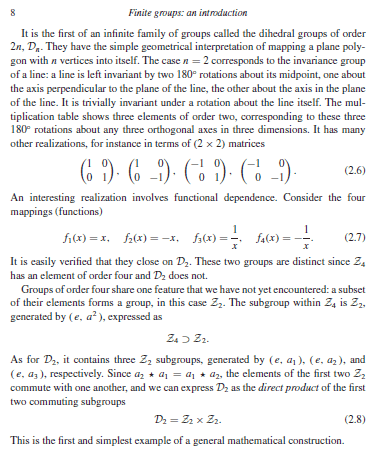
In the following analysis...It is said that D_2 contains three subgroups Z_2...why did he choose a mathematical constuction contains only two of the the three subgroups? shouldn't he use the three in his construction? what will happen if he used the three?
upload_2015-2-1_10-52-31.png

[from the book of P.Ramond, Group Theory, p8.]

best regards

Abolaban
 
Last edited:
Physics news on Phys.org
How many distinct elements would the direct product group have if he used 3 subgroups, each with 2 elements in them? If a direct product has 8 elements , it can't be isomorphic to a group with only 4 elements in it. His goal was to write an direct product that is essentially the same group as the 4 element group.
 

Similar threads

  • · Replies 1 ·
Replies
1
Views
2K
  • · Replies 13 ·
Replies
13
Views
3K
  • · Replies 3 ·
Replies
3
Views
2K
  • · Replies 7 ·
Replies
7
Views
3K
  • · Replies 1 ·
Replies
1
Views
2K
  • · Replies 20 ·
Replies
20
Views
2K
  • · Replies 6 ·
Replies
6
Views
4K
  • · Replies 4 ·
Replies
4
Views
2K
  • · Replies 5 ·
Replies
5
Views
3K
  • · Replies 27 ·
Replies
27
Views
4K