Question re Galaxy Rotation Curve

Click For Summary
The discussion focuses on the derivation of the "Expected from visible disk" curve in galaxy rotation curves, particularly the discrepancy between expected orbital velocities based on Newtonian mechanics and actual observations. The user seeks clarification on how to calculate the baryonic mass distribution function, ρb(R), given the total mass M(∞) of a galaxy. They express a need for a theoretical framework or reference that outlines this calculation. Additionally, they provide an integral formula for gravitational acceleration, Ab(R), and its relationship to orbital velocity, V(R). The conversation emphasizes the complexities of mass distribution within galaxies and the challenges in deriving accurate models.
Buzz Bloom
Gold Member
Messages
2,517
Reaction score
465
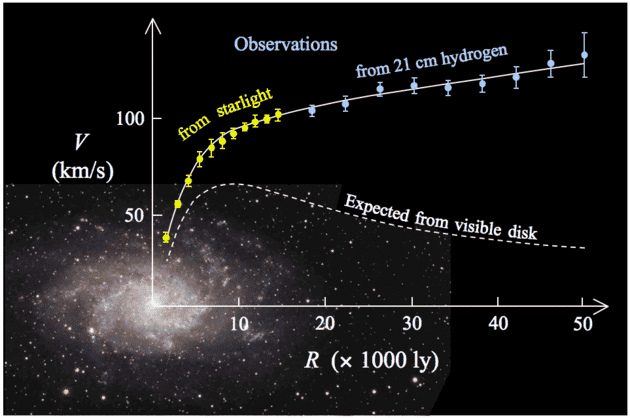
The diagram below is from https://en.wikipedia.org/wiki/Galaxy_rotation_curve .
GalaxyVelocityDistribution.PNG

I would much appreciate a derivation explaining the shape of the "Expected from visible disk" curve in the diagram. Naively, based on Newtonian mechanics for the orbital velocity of a circular orbit,
V = √GM/R ∝ 1/R1/2 .​
Obviously, this is not the shape of the diagram curve. I suppose the diagram curve towards the right might be close to the above formula, but what is the derivation for the shape of the left part of the curve?
 
Astronomy news on Phys.org
The formula you quote is only valid outside the mass distribution (assumed spherically symmetric). In a galaxy, the stars are orbiting inside the mass distribution itself (they are part of it!).
 
Orodruin said:
The formula you quote is only valid outside the mass distribution (assumed spherically symmetric). In a galaxy, the stars are orbiting inside the mass distribution itself (they are part of it!).
Hi @Orodruin:

Thanks for your post. I apologize for being vague in specifying the information I was seeking.

I interpret your quote as implying that projected onto the primary plane of a spiral galaxy, the "disk" is assumed to have a 2D radially symmetric distribution of baryonic mass, including star mass, dust, and gas, say ρb(R). Then the mass M(R) for r < R is
M(R) = ∫0R π r ρb(r) dr .​
The total mass of the baryonic matter in the galaxy would then be M(∞).

Q1: Is there some theory that produces a calculation of the function ρb(R) given M(∞)? If so, what is it, and what is this function ρb(R) that the theory produces?
I have tried to find the answer to this on the internet, but, if it is there, my research skills are inadequate to find it.

Given ρb(R), I know how to write down a complicated integral for the value of the gravitational acceleration Ab(R) of a test particle at radius R based on this distribution. I am guessing that to calculate the function of V(R) for the lower curve in the diagram, it would be first necessary to calculate the value of this integral Ab(R). Then V(r) = √Ab(R)/R.

Q2: Please cite a reference, if you know of one, that shows the calculation of Ab(R) given ρb(R).

Regards,
Buzz
 
CORRECTIONS

M(R) = ∫0R 2 π r ρb(r) dr

V(R) = √(Ab(R)/R)​

ADDITION

Here is the integral form of Ab(R).
Ab(R) = (G/2π) ∫0R ρb(r) ∫0 [(r-R cos θ)/(R2+r2-2 r R cos θ)3/2] dθ dr​
 
Last edited:
UC Berkely, December 16, 2025 https://news.berkeley.edu/2025/12/16/whats-powering-these-mysterious-bright-blue-cosmic-flashes-astronomers-find-a-clue/ AT 2024wpp, a luminous fast blue optical transient, or LFBOT, is the bright blue spot at the upper right edge of its host galaxy, which is 1.1 billion light-years from Earth in (or near) a galaxy far, far away. Such objects are very bright (obiously) and very energetic. The article indicates that AT 2024wpp had a peak luminosity of 2-4 x...

Similar threads

  • · Replies 1 ·
Replies
1
Views
2K
  • · Replies 5 ·
Replies
5
Views
3K
Replies
14
Views
4K
  • · Replies 12 ·
Replies
12
Views
2K
  • · Replies 1 ·
Replies
1
Views
3K
  • · Replies 4 ·
Replies
4
Views
2K
  • · Replies 2 ·
Replies
2
Views
2K
  • · Replies 6 ·
Replies
6
Views
3K
  • · Replies 72 ·
3
Replies
72
Views
10K
  • · Replies 10 ·
Replies
10
Views
1K