Question regarding angular frequency of a SHM

Click For Summary

Homework Help Overview

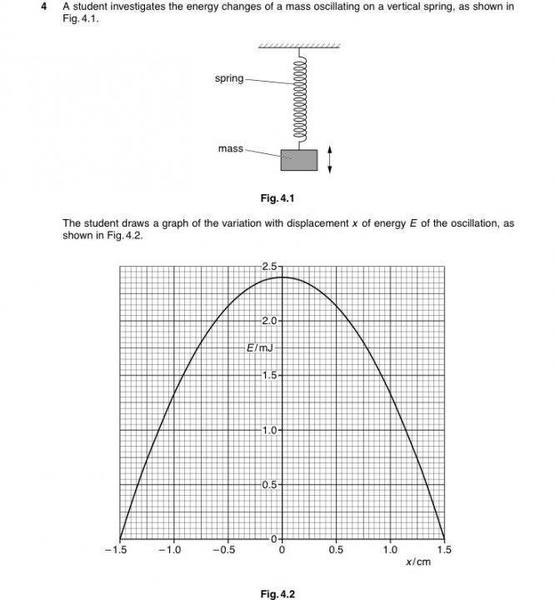
The discussion revolves around the concept of angular frequency in simple harmonic motion (SHM), specifically addressing the relationship between angular frequency (ω), kinetic energy (KE), and amplitude. Participants explore how changes in kinetic energy relate to amplitude while questioning the constancy of angular frequency in the context of a fixed mass and spring system.

Discussion Character

  • Exploratory, Conceptual clarification, Assumption checking

Approaches and Questions Raised

  • Participants attempt to relate kinetic energy to angular frequency and amplitude, questioning why angular frequency remains constant despite variations in maximum kinetic energy. Some express confusion about the dependency of maximum kinetic energy on angular frequency and amplitude.

Discussion Status

There is an ongoing exploration of the relationship between angular frequency, kinetic energy, and amplitude. Some participants provide insights regarding the constancy of angular frequency based on the fixed parameters of the spring and mass, while others seek further clarification on these points.

Contextual Notes

Participants note that the spring constant and mass are unchanged, which is central to the discussion about the constancy of angular frequency. There is an emphasis on understanding how these constants influence the behavior of the oscillator.

Janiceleong26
Messages
276
Reaction score
4
1. Homework Statement

image.jpg

image.jpg

Homework Equations


KE=½m(ωa)2

The Attempt at a Solution


So first I did this:
2.4x10-3= ½ mω2(1.5x10⁻²)2
To find mω2=21.33
And substitute that into the KE eqn to find the new amplitude, which is 1.30x10⁻²
But I only did that because that was the only way I could think of.
My question is, why is ω constant despite changes in the max KE?
 
Physics news on Phys.org
Janiceleong26 said:
1. Homework Statement

View attachment 98703
View attachment 98704

Homework Equations


KE=½m(ωa)2

The Attempt at a Solution


So first I did this:
2.4x10-3= ½ mω2(1.5x10⁻²)2
To find mω2=21.33
And substitute that into the KE eqn to find the new amplitude, which is 1.30x10⁻²
But I only did that because that was the only way I could think of.
My question is, why is ω constant despite changes in the max KE?
How does the max KE depend on ω and the amplitude?
 
Linear velocity will change during the oscillation (x changes)
upload_2016-4-7_10-57-15.png


so the KE

upload_2016-4-7_10-59-52.png


will too:
upload_2016-4-7_10-58-50.png
 

Attachments

  • upload_2016-4-7_10-59-47.png
    upload_2016-4-7_10-59-47.png
    677 bytes · Views: 393
ehild said:
How does the max KE depend on ω and the amplitude?
Max KE=½m(ωa)2
 
@Physics-Tutor Thanks but I'm still confused. How do we know that the angular frequency, ω, is constant?
 
Janiceleong26 said:
Max KE=½m(ωa)2
Changing KE means changing the amplitude if it is the same oscillator. You know that ω=√(k/m). If the spring is the same and the mass of the load is the same, why should the frequency change?
 
Janiceleong26 said:
@Physics-Tutor Thanks but I'm still confused. How do we know that the angular frequency, ω, is constant?
We use the same spring and loading mass.
 
Janiceleong26 said:
Thanks but I'm still confused. How do we know that the angular frequency, ω, is constant?
ehild said:
We use the same spring and loading mass.
ehild is correct:
upload_2016-4-7_14-11-33.png


k is the spring constant, m the mass. These two are constant, so the angular velocity is constant.
 

Attachments

  • upload_2016-4-7_14-12-10.png
    upload_2016-4-7_14-12-10.png
    728 bytes · Views: 463
  • upload_2016-4-7_14-12-13.png
    upload_2016-4-7_14-12-13.png
    728 bytes · Views: 454
  • upload_2016-4-7_14-12-27.png
    upload_2016-4-7_14-12-27.png
    728 bytes · Views: 417
ehild said:
Changing KE means changing the amplitude if it is the same oscillator. You know that ω=√(k/m). If the spring is the same and the mass of the load is the same, why should the frequency change?
Physics-Tutor said:
ehild is correct:
View attachment 98717

k is the spring constant, m the mass. These two are constant, so the angular velocity is constant.
Oh, I got it. Thanks a lot !
 

Similar threads

Replies
2
Views
1K
  • · Replies 11 ·
Replies
11
Views
2K
  • · Replies 3 ·
Replies
3
Views
3K
  • · Replies 8 ·
Replies
8
Views
5K
  • · Replies 3 ·
Replies
3
Views
3K
Replies
7
Views
2K
Replies
5
Views
4K
  • · Replies 6 ·
Replies
6
Views
3K
Replies
3
Views
988
  • · Replies 15 ·
Replies
15
Views
6K