Question while I study Modern Quantum physics by Sakurai

Click For Summary

Discussion Overview

The discussion revolves around a specific section in the book "Modern Quantum Physics" by Sakurai, particularly focusing on the interpretation of certain mathematical expressions involving operators and their application in quantum mechanics. Participants explore the implications of notation and the meaning of differential elements in the context of quantum operators, with an emphasis on clarity in distinguishing between operators and scalar quantities.

Discussion Character

  • Technical explanation
  • Conceptual clarification
  • Debate/contested

Main Points Raised

  • One participant questions how equations (1.6.26) and (1.6.27) relate to each other, suggesting the need for clarity in notation.
  • Another participant proposes using hats on operators to clarify their roles in the equations, leading to a specific mathematical manipulation involving infinitesimals.
  • Several participants express curiosity about the interpretation of the expression ##{\bf x K} \cdot d{\bf x'}## and how it should be understood in terms of operator multiplication.
  • There is a discussion about the meaning of "dx'" as a scalar multiplied by the identity operator, with some participants suggesting this could be misleading or incorrect.
  • One participant raises a concern about the presence of dx' in multiple directions, questioning the fundamental understanding of the notation used.
  • Another participant clarifies that dx is a vector in the context of differential forms, while also referring to elements in the Hilbert space spanned by kets.
  • There is a suggestion that the position operator is a vector operator with components in each axis, and its action on a position ket is discussed.
  • Some participants express confusion about the distinction between vectors in ordinary calculus and those in Hilbert space, indicating a need for further reading.

Areas of Agreement / Disagreement

Participants express differing interpretations of the notation and its implications, indicating that multiple competing views remain. The discussion does not reach a consensus on the correct interpretation of certain expressions or the clarity of the textbook's presentation.

Contextual Notes

Participants note that the notation used in the textbook may not explicitly clarify the distinctions between operators and scalars, leading to confusion. There are also unresolved questions regarding the mathematical steps and assumptions underlying the interpretations discussed.

Who May Find This Useful

This discussion may be useful for students and practitioners of quantum mechanics who are studying operator notation and its implications in quantum theory, particularly those using Sakurai's textbook.

BREAD
Messages
50
Reaction score
0
In the book of Modern Quantum physics by Sakurai
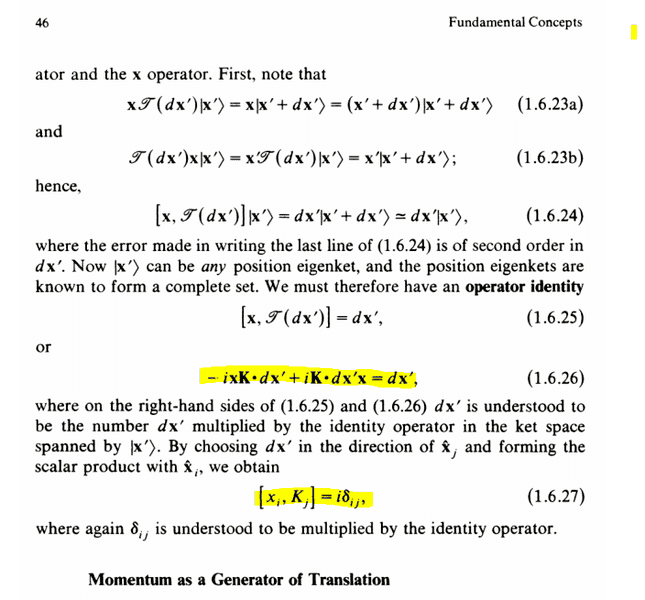
upload_2017-3-3_22-33-37.png


I wonder how 1.6.26 can be 1.6.27.
 
Physics news on Phys.org
Actually, I'll put hats on the operators (something that perhaps Sakurai ought to have thought about):

If you set ##\mathbf{dx'} = (dx_1, 0, 0)## then ##\mathbf{\hat{K}} \cdot \mathbf{dx'} = \hat{K_1} dx_1## and (1.6.26) becomes:

##-i \mathbf{\hat{x}}\hat{K_1} dx_1 + i\hat{K_1}\mathbf{\hat{x}}dx_1 = (dx_1, 0, 0)##

Where ##dx_1## is an "infinitesimal" number and can be cancelled, and ##\mathbf{\hat{x}} = (\hat{x_1}, \hat{x_2}, \hat{x_3})##; giving:

##-i (\hat{x_1}\hat{K_1} - \hat{K_1}\hat{x_1}, \ \hat{x_2}\hat{K_1} - \hat{K_1}\hat{x_2},\ \hat{x_3}\hat{K_1} - \hat{K_1}\hat{x_3}) = (1, 0, 0)##

Which gives the result for ##\hat{K_1}##. Repeat for ##\mathbf{dx'} = (0, dx_2, 0)## etc.
 
  • Like
Likes   Reactions: vanhees71 and blue_leaf77
Thanks, @PeroK. Out of curiosity: How did you know ##{\bf x K} \cdot d{\bf x'}## was to be interpreted as ##{\bf x} \left ({\bf K} \cdot d{\bf x'} \right)## and not as ##\left ({\bf x K} \right ) \cdot d{\bf x'}## ?
 
BvU said:
Thanks, @PeroK. Out of curiosity: How did you know ##{\bf x K} \cdot d{\bf x'}## was to be interpreted as ##{\bf x} \left ({\bf K} \cdot d{\bf x'} \right)## and not as ##\left ({\bf x K} \right ) \cdot d{\bf x'}## ?

I looked at my notes and, unlike Sakurai, I tend to distinguish between operators and numbers/vectors. You have to do that at the beginning of the section/proof and keep track of it.
 
  • Like
Likes   Reactions: vanhees71 and BvU
I suspect I am being dumb here, but I can't work out how this squares with the line

"dx' is understood to be the number dx' multiplied by the identity operator in the ket space spanned by lx'>"

the |x'> ket is earlier defined as follows

1646947938353.png


Surely this means that the dx' is present in y directions and z directions as well.

Or am I misunderstanding something fundamental?
 
The notation ##\mathbf x = (x,y,z)## is not uncommon.
 
Ah, hang on, may have worked out my confusion

When it says "dx' is understood to be the number dx' multiplied by the identity operator in the ket space spanned by lx'>"

Doesn't this mean that is is an operator which can be written as a 3x3 matrix of the form:

(dx,0,0)
(0,dx,0)
(0,0,dx)

which means if we select a particular vector like (1,0,0)t to multiply right, we get the equations you show?
 
dx is the vector dx=(dx,dy,dz), and $$\hat{\mathbf{K}}=(\hat{K}_{x},\hat{K}_{z},\hat{K}_{z})$$
such that
$$\hat{\mathbf{K}}\cdot d\mathbf{x}=\hat{K}_{x}dx+\hat{K}_{z}dy+\hat{K}_{z}dz$$
 
  • Like
Likes   Reactions: PeroK and whyohwhy
So it sounds like what we are saying is that the following sentence is incorrect or at the very least misleading?

"dx' is understood to be the number dx' multiplied by the identity operator in the ket space spanned by lx'>"

either this or I am incorrect in viewing the identity operator in the ket space lx'> as:

(1,0,0)
(0,1,0)
(0,0,1)

or I am misunderstanding what is meant by "the number dx'" which I am interpreting to mean a scalar
 
  • #10
when acting on kets (or bras), all numbers can be understood as the number multiplying the identity operator. For example
$$3:=3\hat{I}$$,
means
$$(3\hat{I})\left|A\right\rangle =3\left(\hat{I}\left|A\right\rangle \right)=3\left|A\right\rangle $$
 
  • #11
whyohwhy said:
or I am misunderstanding what is meant by "the number dx'" which I am interpreting to mean a scalar

In here the word vector has two meanings. dx is a vector in the ordinary sense of vector calculus(more precisely, it's a differential form).

The other meaning of the word vectors refers to the elements belonging to the Hilbert space spanned by the kets $$\left|\mathbf{x}\right\rangle$$.
 
  • Like
Likes   Reactions: PeroK and whyohwhy
  • #12
Yes but a vector cannot be right? This is a vector times a identity operator?
 
  • #13
andresB said:
In here the word vector has two meanings. dx is a vector in the ordinary sense of vector calculus(more precisely, it's a differential form).

The other meaning of the word vectors refers to the elements belonging to the Hilbert space spanned by the kets ##\left|\mathbf{x}\right\rangle## .
So this sounds like it could be right to me. But I don't get the distinction between elements belonging to Hilbert space and vectors in the ordinary sense. Looks like I have some more reading to do! Thanks so much
 
  • #14
The position operator is a vector operator, loosely this means that it has components in each axis
$$\hat{\mathbf{X}}=\hat{x}\mathbf{i}+\hat{y}\mathbf{j}+\hat{z}\mathbf{k}$$
its actions on a 3d position ket is
$$\hat{\mathbf{X}}\left|\mathbf{x}\right\rangle =\left(x\mathbf{i}+y\mathbf{j}+z\mathbf{k}\right)\left|\mathbf{x}\right\rangle $$
 
  • Like
Likes   Reactions: whyohwhy
  • #15
whyohwhy said:
So this sounds like it could be right to me. But I don't get the distinction between elements belonging to Hilbert space and vectors in the ordinary sense. Looks like I have some more reading to do! Thanks so much
I recommend you to first get used to the derivation of the commutation relations with the translation operator for the 1d case (1 spatial dimension, the Hilbert space of square-integrable functions is still infinite-dimensional).
 
  • #16
andresB said:
The position operator is a vector operator, loosely this means that it has components in each axis
$$\hat{\mathbf{X}}=\hat{x}\mathbf{i}+\hat{y}\mathbf{j}+\hat{z}\mathbf{k}$$
its actions on a 3d position ket is
$$\hat{\mathbf{X}}\left|\mathbf{x}\right\rangle =\left(x\mathbf{i}+y\mathbf{j}+z\mathbf{k}\right)\left|\mathbf{x}\right\rangle $$
Ah! This makes sense! But isn't mentioned in the textbook up to this point. Or at least not explicitly.
 
  • #17
whyohwhy said:
Ah! This makes sense! But isn't mentioned in the textbook up to this point. Or at least not explicitly.
The 3d vector notation is unusual, generally speaking, books write the action of each component individually

$$\hat{x}\left|\mathbf{x}\right\rangle =x\left|\mathbf{x}\right\rangle ,\;\hat{y}\left|\mathbf{x}\right\rangle =y\left|\mathbf{x}\right\rangle ,\;\hat{z}\left|\mathbf{x}\right\rangle =z\left|\mathbf{x}\right\rangle $$
 
  • Like
Likes   Reactions: whyohwhy

Similar threads

  • · Replies 2 ·
Replies
2
Views
1K
  • · Replies 1 ·
Replies
1
Views
1K
  • · Replies 3 ·
Replies
3
Views
1K
  • · Replies 2 ·
Replies
2
Views
2K
  • · Replies 1 ·
Replies
1
Views
5K
  • · Replies 2 ·
Replies
2
Views
3K
  • · Replies 3 ·
Replies
3
Views
3K
  • · Replies 8 ·
Replies
8
Views
1K
  • · Replies 4 ·
Replies
4
Views
2K
  • · Replies 2 ·
Replies
2
Views
1K