Probability flux integrated over all space is mean momentum?

Join the discussion
Registration is free. Ask a follow-up in this thread, or start your own.
2 replies · 2K views
euphoricrhino
Messages
23
Reaction score
14
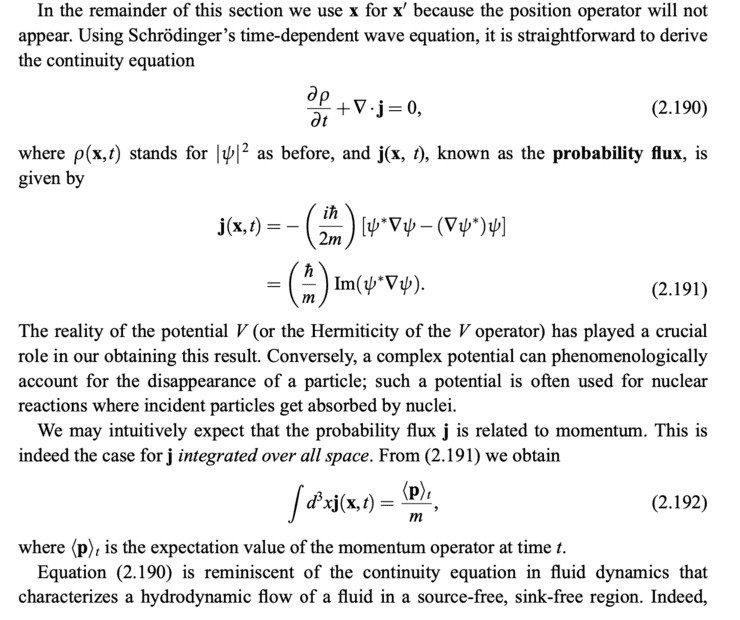
In Sakurai Modern Quantum Mechanics, I came across a statement which says probabiliy flux integrated over all space is just the mean momentum (eq 2.192 below). I was wondering if anybody can help me explain how this is obtained.
I can see that ##i\hbar\nabla## is taken as the ##\mathbf{p}## operator, but I don't see how the integration gives the mean of ##\mathbf{p}##.
Thanks in advance!
Screen Shot 2022-08-11 at 15.28.15.png
 
Physics news on Phys.org
The expectation value of the momentum is
$$\langle \vec{p} \rangle = \langle \psi|\hat{\vec{p}}|\psi \rangle = \int_{\mathbb{R}^3} \mathrm{d}^3 x \psi^*(t,\vec{x}) (-\mathrm{i} \hbar \vec{\nabla}) \psi(t,\vec{x}).$$
Now you can add the same expression with the ##\nabla## put to ##\psi^*## by partial integration and divide by 2:
$$\langle \vec{p} \rangle = \frac{1}{2} \int_{\mathbb{R}^3} \mathrm{d}^3 x (-\mathrm{i} \hbar) [\psi^*(t,\vec{x}) \vec{\nabla} \psi(t,\vec{x}) - \psi(t,\vec{x}) \vec{\nabla} \psi^*(t,\vec{x})].$$
Comparing this with Eq. (2.191) of the book you get immediately Eq. (2.192).
 
  • Like
Likes   Reactions: Lord Jestocost, gentzen, PeroK and 1 other person
Great, thanks a lot.
I missed the integration by part trick. This is awesome!