Questions about Neutron scattering theory

Click For Summary

Discussion Overview

The discussion revolves around neutron scattering theory as presented in Lamarsh's "Introduction to Nuclear Reactor Theory." Participants raise questions about the conversion of differential cross sections between frames of reference, the implications of isotropic scattering in the center of mass frame, and the conditions under which inelastic processes occur, particularly regarding the formation of a compound nucleus.

Discussion Character

  • Exploratory
  • Technical explanation
  • Debate/contested

Main Points Raised

  • One participant questions the process of converting differential cross sections from the center of mass frame to the laboratory frame, noting the complexity introduced by moving targets.
  • Another participant suggests that for solid or liquid moderators, the assumption of zero target velocity is reasonable due to the significant velocity difference between neutrons and target nuclei.
  • Concerns are raised about the interpretation of scattering angles, particularly whether a neutron passing through hydrogen without scattering is still considered scattering.
  • Participants discuss the conditions under which inelastic processes require the formation of a compound nucleus, with some arguing that this may not apply in cases involving molecules or solids.
  • There is a mention of the effects of thermal motion on target nuclei and how this may influence scattering outcomes.
  • One participant expresses confusion about the independence of cross-sectional area from the velocity of the nucleus when transforming between inertial frames.

Areas of Agreement / Disagreement

Participants express varying interpretations of the implications of neutron scattering theory, particularly regarding the treatment of moving targets and the conditions for inelastic interactions. No consensus is reached on these points.

Contextual Notes

Some participants note that the mathematical treatment becomes more complicated when considering moving nuclei, which may introduce anisotropy in the differential cross-section. Additionally, the discussion touches on the thermal velocities of target nuclei and their relevance to neutron interactions.

Who May Find This Useful

This discussion may be of interest to students and professionals in nuclear engineering, particularly those exploring neutron scattering theory and its applications in reactor physics.

dRic2
Gold Member
Messages
887
Reaction score
225
Hi, I'm reading Lamarsh's book "Introduction to nuclear reactor theory" and in chapter two there is a brief description of neutron scattering theory. I have a few questions about it.

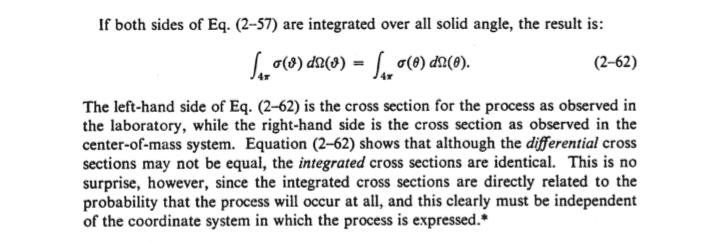
1) In the book the author says that it is easier to analyze the interaction process in the center of mass frame, but then there is the problem to "convert" the differential cross section found in the center of mass frame to the laboratory system. In order to do so he says:
1.png

And he later continues:
2.png

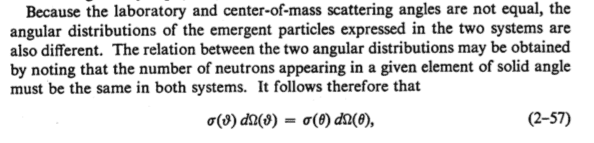
This is all crystal-clear, but then he says:

3.png

Which I do not understand. (I read Section 2-8 but I didn't find anything useful...) I'd appreciate any help on this.

2) In the next part of the chapter he says that ##H^1## elastic scattering is always isotropic in the center of mass frame for all the energies of interest in reactor theory. If you adopt spherical coordinates and you call ##\theta## the scattering angle in the laboratory frame, he shows that you can find the following relation for the differential cross section:
$$\sigma( \theta) = \frac k {\pi} cos( \theta)$$
where ##0 < \theta < \frac {\pi} 2## and ##k## is a constant. He then concludes that in this situation you can't have backward scattering. I also noticed that the highest values of the cross section (in the laboratory frame) happens when ##\theta = 0##... What does it mean? That the neutron is more likely to pass "through" the hydrogen ? Is this still called scattering ?

3) The author also says that all inelastic processes require the formation of a compound nucleus. I think this is true only when we are dealing with a single "isolated" nucleus, am I right? Otherwise if I'm dealing with molecules or solids I can easily think of inelastic interaction without the formation of a compound nucleus, right ? (for example: ionization of a molecule or exiting the lattice of a cristalline structured solid)

Thanks in advance
Ric
 

Attachments

  • 1.png
    1.png
    17 KB · Views: 737
  • 2.png
    2.png
    25 KB · Views: 785
  • 3.png
    3.png
    7.9 KB · Views: 721
Engineering news on Phys.org
dRic2 said:
Which I do not understand. (I read Section 2-8 but I didn't find anything useful...) I'd appreciate any help on this.
The math is more complicated if the target is moving.
http://farside.ph.utexas.edu/teaching/336k/Newtonhtml/node52.html

However, for a solid or liquid moderator (e.g., water), the assumption of zero velocity of the atoms, or in this case, hydrogen (protons) in the water, is reasonable, since the neutrons will have velocities orders of magnitude greater. At thermal equilibrium at room temperature, thermalized neutrons with energy ~0.0253 eV, or 2200 m/s.

One can certainly try solving the lab and CM equations with a nonzero target velocity, which is the case in a plasma, for example.
dRic2 said:
What does it mean? That the neutron is more likely to pass "through" the hydrogen ? Is this still called scattering ?
When the neutron scattering angle is zero, it means the proton in the hydrogen atom receives the maximum energy/momentum, i.e., the neutron essentially stops and proton is recoiled. In a system where the projectile has roughly equal mass to the target, there can be no backscattering. On the other hand, if the hydrogen atom (proton) has some velocity, there could indeed be backscattering, or up-scattering for the neutron.
dRic2 said:
The author also says that all inelastic processes require the formation of a compound nucleus. I think this is true only when we are dealing with a single "isolated" nucleus, am I right?
Yes, the inelastic process refers to a single or individual nucleus. For molecules, especially where the neutrons have very low energies, one does have to consider the effects of the entire molecule, for example H2O.
dRic2 said:
Otherwise if I'm dealing with molecules or solids I can easily think of inelastic interaction without the formation of a compound nucleus, right ? (for example: ionization of a molecule or exiting the lattice of a crystalline structured solid)
The formation of a compound nucleus, which would transform or transmute the target nucleus, unless the reaction results in the emission of another neutron of lower energy, is a nuclear effect. The ionization of the atom and surrounding atoms is an atomic effect, and is a different matter in material behavior.

Some other notes - http://mragheb.com/NPRE 402 ME 405 Nuclear Power Engineering/Neutron Collision Theory.pdf
 
Last edited:
Thank you very much! I'm fairly new to nuclear engineering and I'm struggling a bit with new concepts. Your answer was very clear but I still have a question.

I read the links you posted, here I quote the first one:

http://farside.ph.utexas.edu/teaching/336k/Newtonhtml/node52.html said:
However, a cross-sectional area is not changed when we transform between different inertial frames.

This is exactly what I would expect and it is coherent with what Lamarsh says:
1.png


This assumption seems to me independent of the velocity of the nucleus so I don't understand why it should not be correct for moving nuclei (in the laboratory system)...Off Topic: Nice to meet a Satch's fan. Saw him in concert 5 years ago... Awesome :cool::cool:
 

Attachments

  • 1.png
    1.png
    17 KB · Views: 606
dRic2 said:
This assumption seems to me independent of the velocity of the nucleus so I don't understand why it should not be correct for moving nuclei (in the laboratory system)...
It seems one is reading the old version of Lamarsh, Nuclear Reactor Theory, Addison-Wesley Publishing Co., 1965, 1972, which was the text I used for my nuclear reactor theory class in 1980-1981. Equation 2-57 is derived based on the nucleus at rest in the laboratory frame, which makes the math simpler. If the nucleus has a velocity, which is a vector, the equations become more complicated, because one must consider the momentum of the nucleus, which then affects the differential cross-section, adding an anisotropy.

However, where the target nuclei are vibrating thermally/randomly, on average, one can treat the target nucleus as having a zero velocity. The other consideration is that the normal moderator temperature in a BWR is about 272-285°C, and for high power fuel, the coolant becomes steam in the top two thirds of the fuel assembly, while in PWRs, the moderator temperature is about 290-330°C. The fuel temperature is even higher, ~370°C at the surface and ~400°C to 1400°C in the center depending on the power level. Resonance absorption by U-238 and Pu-240 becomes important, particularly during transients where the temperature in the fuel would become greater.

One could attempt the math working with a non-zero nuclear velocity. Traveling toward or away from the neutron, but then try the general case where the nucleus/atom is traveling at some angle from the direction of the neutron.

I was reading some notes yesterday that indicated most fissions in an LWR occur at neutron energies of about 0.1 eV, which is four times the thermal equilibrium energy at room temperature.

What part of section 2.8 was not useful?
 
Sorry for the late replay, but I had to prepare other exams during the past few weeks. I have to think it through on my own... Maybe I'll be back. Thanks a lot for the help-
 

Similar threads

  • · Replies 8 ·
Replies
8
Views
3K
  • · Replies 15 ·
Replies
15
Views
4K
Replies
1
Views
1K
  • · Replies 1 ·
Replies
1
Views
1K
  • · Replies 1 ·
Replies
1
Views
4K
  • · Replies 14 ·
Replies
14
Views
5K
Replies
11
Views
2K
  • · Replies 15 ·
Replies
15
Views
4K
  • · Replies 11 ·
Replies
11
Views
3K
Replies
11
Views
7K