Questions regarding "Thermal History of the Early Universe"

Click For Summary

Discussion Overview

The discussion revolves around understanding specific aspects of particle physics as presented in a paper on the thermal history of the early universe. Participants seek clarification on the counting of particle varieties and related properties, including spin and polarization, as well as the implications of photon mass values.

Discussion Character

  • Technical explanation
  • Conceptual clarification
  • Debate/contested

Main Points Raised

  • One participant questions the components of the count g for quarks, specifically the meaning of the second "2" in the equation g = 2⋅2⋅3, suggesting it may relate to spin values.
  • Another participant agrees with the first question and adds that the second "2" for τ, μ, and e also likely corresponds to spin values, indicating a total of 12 when considering particle-antiparticle pairs.
  • Clarifications are provided regarding the polarization of particles, suggesting that both particle and antiparticle have two spin possibilities.
  • Questions arise about the photon, specifically why g = 2 for the photon, with a response indicating it relates to the two polarization directions.
  • Participants discuss the photon mass value, with one suggesting that the theoretical expectation is zero, and the given value represents an upper bound.
  • Another participant notes that the photon mass limit referenced is outdated and suggests checking the current status, indicating that values may be model-dependent.

Areas of Agreement / Disagreement

Participants generally agree on the interpretation of polarization in relation to particle counts, but there are differing views on the implications of the photon mass and the relevance of the outdated values presented in the paper.

Contextual Notes

Some participants note that the values discussed may be model-dependent and that the photon mass limit is based on older experimental data, which could affect the accuracy of the claims made.

Buzz Bloom
Gold Member
Messages
2,517
Reaction score
465
I do not have any education in particle physics, and I am trying to read the paper
http://www.helsinki.fi/~hkurkisu/cosmology/Cosmo6.pdf .
I would much appreciate some help regarding the specific questions below.

The following is from the first page of the article.
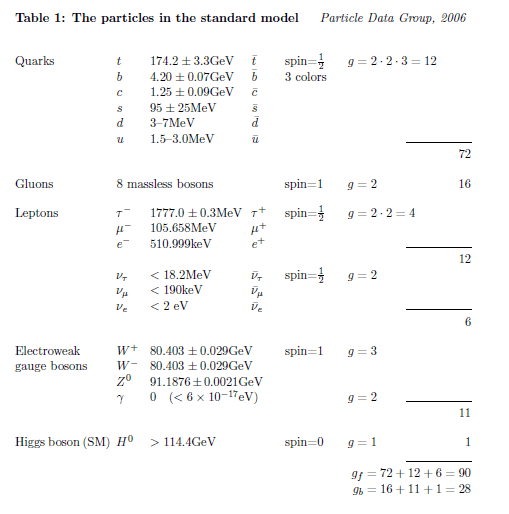
ThermalHistoryTable1.png

I gather that g is a count of the different varieties of particles of different types. There are some oddities in the table I can't figure out, and I hope someone will be able to explain them to me.
1. Under Quarks, g = 2⋅2⋅3. I get that one "2" is for the particle and its antiparticle, and the "3"is for 3 colors. What is the other "2"? Is it +1/2 and -1/2 spin values?
2. For each of τ, μ, and e, g = 2⋅2=4, making 12 altogether. One "2" corresponds to the particle and antiparticle. What is the other "2" Is it +1/2 and -1/2 spin values?
3. For Electroweak gauge bosons, g=3. Is this because there are 3 spin values: +1, 0, and -1?
4. Under Electroweak gauge bosons, there is a single line for γ, the photon. Why is g = 2 for the photon?
5. Also, what is the photon mass value in parentheses, "< 6×10-17 eV"?
Regards,
Buzz
 
Last edited:
Physics news on Phys.org
Buzz Bloom said:
1. Under Quarks, g = 2⋅2⋅3. I get that one "2" is for the particle and its antiparticle, and the "3"is for 3 colors. What is the other "2"? Is it + and - spin values?
2. For each of τ, μ, and e, g = 2⋅2=4, making 12 altogether. One "2" corresponds to the particle and antiparticle. What is the other "2" Is it + and - spin values?
The thing you are missing in both your first questions is polarisation. Both particle and anti-particle come with two spin possibilities.

Buzz Bloom said:
3. Under Electroweak gauge bosons, there is a single line for γ, the photon. Why is g = 2 for the photon?
Same as for the quarks and leptons. It is the two polarisation directions.

Buzz Bloom said:
4. Also, what is the photon mass value in parentheses, "< 6×10-17 eV"?
Most likely because it is zero according to theory and that is the upper bound.
 
Hi Orodruin:

Thanks a lot for your prompt and useful answers.

I have been updating the post, and I think I added a question after your answer post. Please look at the revised questions #3.

Regards,
Buzz
 
It is from 2006, so the experimental upper limit on the photon mass is a bit outdated. See the current status. Most of those values are a bit model-dependent, but they are all extremely tiny.
 

Similar threads

  • · Replies 4 ·
Replies
4
Views
2K
  • · Replies 1 ·
Replies
1
Views
3K
Replies
7
Views
2K
  • · Replies 4 ·
Replies
4
Views
3K
  • · Replies 0 ·
Replies
0
Views
3K
  • · Replies 0 ·
Replies
0
Views
4K
  • · Replies 35 ·
2
Replies
35
Views
9K
  • · Replies 7 ·
Replies
7
Views
4K
  • · Replies 5 ·
Replies
5
Views
2K
  • · Replies 2 ·
Replies
2
Views
2K